Honeyberries are hardy deciduous bushes grown for blue fruits with a sweet, tangy flavour. They are edible selections of Lonicera caerulea, also called haskap or blue honeysuckle. Give them sunshine, moisture and a compatible flowering partner, then allow the berries to ripen fully before picking.
Hardy outdoor fruit bush
Plant compatible varieties together
Early flowers for visiting insects
Blue berries with a tangy flavour
Easy to fit into a fruit garden
| Botanical name | Lonicera caerulea, edible cultivated selections |
| Family | Caprifoliaceae |
| Other names | Haskap and blue honeysuckle |
| Plant type | Deciduous perennial shrub |
| Usual mature height | About 1.2–2m, depending on cultivar |
| Position | Sun or light shade; sun helps cropping |
| Soil | Fertile, moisture retentive and well drained |
| Soil reaction | Tolerates a broad pH range |
| Winter hardiness | Very hardy in UK gardens |
| Planting time | Spring; autumn also suitable in workable soil |
| Plant spacing | Around 1.5m; allow more for vigorous cultivars |
| Flowering | Late winter to spring, varying with cultivar |
| Pollination | Two different compatible varieties flowering together |
| First harvest | Allow a couple of seasons for establishment |
| Picking season | Late spring to summer, depending on cultivar |
| Ripeness check | Blue skin alone is not enough |
| Pruning | Minimal while young; later thin after harvest |
| Container growing | Possible in large, well drained pots |
| Main competitors | Birds may take ripening berries |
| Edible identity | Buy labelled honeyberries; other honeysuckles differ |
| Plant name | Crop type | Spacing |
Sow indoors
Plant outdoors
Harvest
Polytunnel | |||||||||||
|---|---|---|---|---|---|---|---|---|---|---|---|---|---|---|
| Jan | Feb | Mar | Apr | May | Jun | Jul | Aug | Sep | Oct | Nov | Dec | |||
| Honeyberry | Soft fruit | Single 150cm, In row 150cm, Row gap 200cm; increase for vigorous cultivars | No activity recorded | No activity recorded | Plant outdoors | Plant outdoors | Plant outdoors, Harvest | Harvest | Harvest | Harvest | No activity recorded | Plant outdoors | Plant outdoors | No activity recorded |
Sow indoors: no months recorded. Plant outdoors: March, April, May, October, November. Harvest: May, June, July, August. Polytunnel: no months recorded.
The planting band covers spring and autumn establishment of nursery bushes. The May to August harvest band spans different varieties and UK conditions; one bush will not crop throughout that whole period. Early selections can ripen in late May or June, while others are later. No sowing or polytunnel band is shown because named outdoor plants are the normal route.
Honeyberry offers unusual hardy fruit without the acidic soil requirements of blueberries. Allow space for two substantial bushes.
Flavour varies with cultivar and ripeness. Choose plants for fruit quality and compatible flowering dates.
Photo: Nadiatalent, CC BY-SA 4.0. Resized and optimised; cropped for display. Adapted image under the same licence.
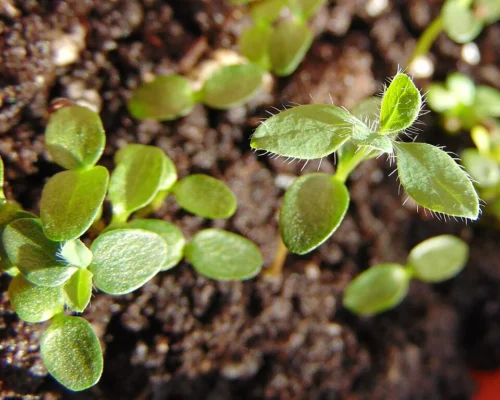
Choose an open, sunny position with moisture retentive soil. Light shade is tolerated, but a heavily shaded corner is unlikely to give the best crop.
Avoid soil that remains waterlogged. Improve the wider planting area with organic matter where appropriate, and keep the surface free from competing weeds.
Allow about 1.5m between bushes, increasing this for vigorous selections. Leave room to walk around the plants for picking and checking fruit protection.
Large containers are useful where soil or space is limited. Give each bush adequate root space and drainage, and position compatible partners near one another.
Photo: Agnieszka Kwiecień, Nova, CC BY-SA 4.0. Resized and optimised; cropped for display. Adapted image under the same licence.
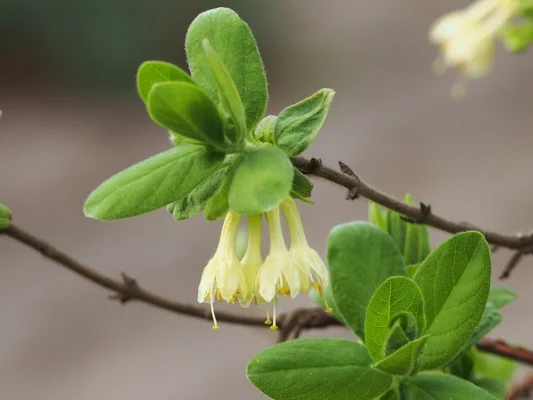
Ask a nursery for edible cultivars forming a compatible pair with overlapping flowering times.
1.
Choose two different varieties recommended as partners. Two plants propagated from the same cultivar do not provide the same pollination benefit.
2.
Plant in spring, or in autumn while the soil is workable. Delay if the ground is frozen, flooded or too wet to prepare without compacting it.
3.
Clear perennial weeds, loosen compacted soil and dig a hole wide enough for the roots.
4.
Water before removing pots. Ease out tightly circling roots without unnecessarily breaking the rootball.
5.
Set each bush at its previous soil level. Refill around the roots, firm gently and water thoroughly to settle the soil.
6.
Apply an organic mulch across the root area, leaving the base of the stems clear. Retain the labels so you can track flowering and fruit quality.
7.
Keep checking soil moisture during the first growing season, especially in dry spring weather. A newly planted bush needs help while its roots establish.
8.
Let young plants establish. Remove only damaged or dead growth initially.

Watering
Keep establishing plants watered through dry spells. Moisture is especially useful while flowers and young fruit develop, but the roots still need air rather than saturated soil.
Container plants need more frequent checks than established garden bushes. Water thoroughly when needed and allow excess to escape; do not leave pots standing in a filled saucer.

Feeding
Give a modest spring application of balanced fertiliser according to its instructions. Excessive feeding is unnecessary for a bush growing well in reasonable garden soil.
Renew organic mulch annually and keep weeds away from the shallow root area. Avoid deep hoeing close to the plant, which can damage roots.

Pruning
For roughly the first three years, concentrate on removing dead or damaged branches. Repeatedly shortening every shoot can sacrifice useful growth without improving the bush.
Once established, prune after harvest. Remove weak, damaged or overcrowded growth and gradually take out selected older stems at the base, retaining a balanced supply of healthy younger branches.

Winter care
Honeyberry is a hardy outdoor shrub and normally needs no heated winter accommodation. Leaf fall is part of its deciduous cycle, not a sign that an otherwise healthy bush has died.
Check drainage and the stability of container plants. Keep compatible bushes together as early flowers open, and avoid moving one partner into a greenhouse that advances its flowering ahead of the other.
Honeyberry is a bush rather than a twining climbing honeysuckle. It has paired leaves, pale creamy yellow flowers and blue fruits often covered with a whitish bloom. Fruit shape ranges from rounded to distinctly elongated.
Only grow and eat fruit from correctly labelled edible Lonicera caerulea selections. This guide is not an identification key for wild berries: the name honeysuckle includes other plants whose berries are unsuitable to eat.
Photo: Agnieszka Kwiecień, Nova, CC BY-SA 4.0. Resized and optimised; cropped for display. Adapted image under the same licence.
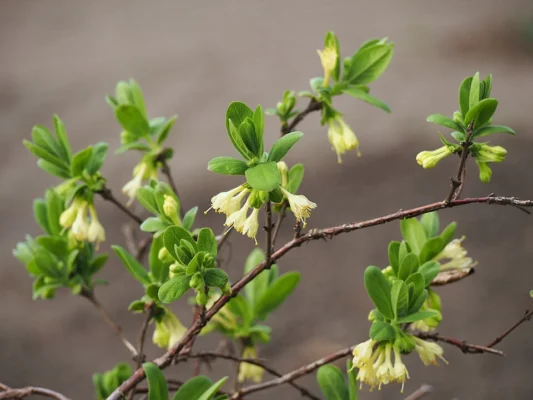
Different breeding groups can flower at different times. A supplier recommended pairing matters more than a general claim that any two honeyberries will pollinate each other.
Cold weather can limit insect activity during early flowering. If both compatible bushes are in bloom, a soft brush can transfer pollen between their flowers to assist pollination.
Wait beyond the first change of skin colour. A ripe berry should have developed its flavour, with purple to reddish flesh rather than a green interior. Pick gently and use delicate fruit promptly, or freeze a sound surplus.
Photo: Maxime Laterreur, CC BY-SA 4.0. Resized and optimised; cropped for display. Adapted image under the same licence.
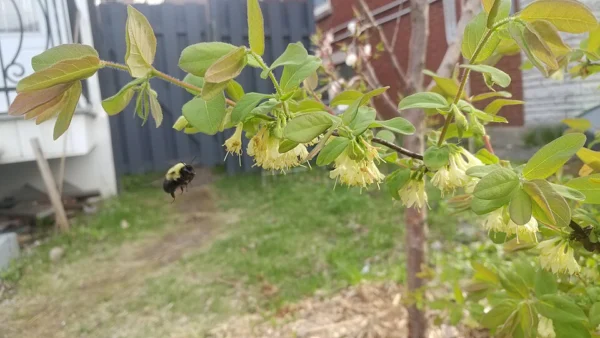
Check that two different compatible cultivars flower together. Poor insect activity during cold weather can also reduce set. Adding a second plant of the same cultivar does not solve incompatibility.
Skin colour can develop before the flesh is ready. Leave the remaining berries longer and check a small sample from your known edible cultivar rather than stripping the whole bush at once.
Birds can take the crop quickly. Use well secured fruit protection where needed, keep it clear of branches and check regularly so wildlife cannot become trapped.
Inspect young shoots for aphids. Small colonies often attract predators; assess the damage before intervening and avoid unnecessary treatment while flowers are attracting insects.
Powdery mildew can affect honeyberry. Improve air movement without overpruning, reduce root stress during dry weather and remove badly affected fallen material as part of ordinary garden hygiene.
Named varieties are maintained by vegetative propagation. Semi ripe summer cuttings or hardwood autumn cuttings are possible projects, but obtaining nursery plants is the simpler way to establish a known pollination pairing.
Seedlings vary and are not copies of the parent cultivar. Do not rely on saved seed to reproduce a named variety or to guarantee a compatible flowering partner.
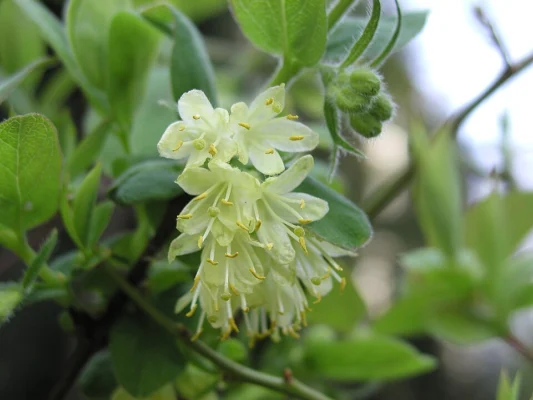
Aurora
A popular selection with large fruit. Honey Bee is a recognised compatible partner, and some UK suppliers offer Aurora with Blue Banana as a matched pair.
Illustrative honeyberry in spring; this plant is not confirmed as Aurora.
Photo: Basik07, CC BY-SA 2.5. Resized and optimised; cropped for display. Adapted image under the same licence.
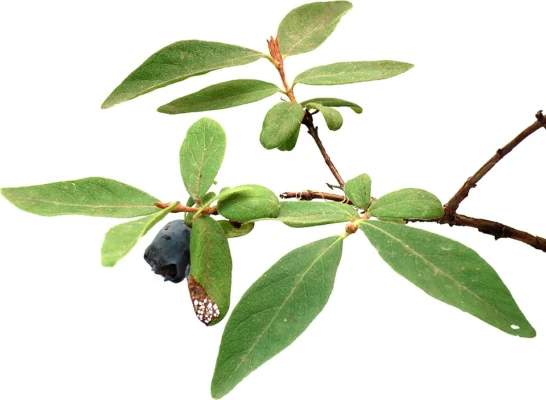
Blue Banana
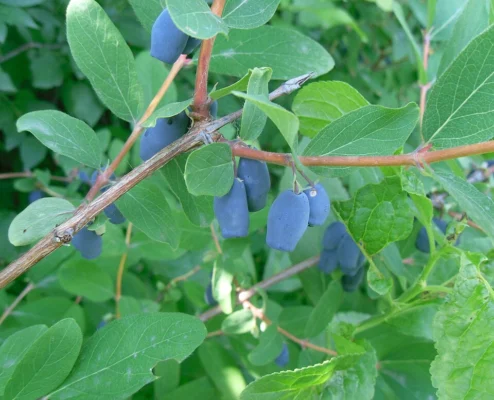
Honey Bee
A vigorous pollination partner used with several compatible selections, including Aurora and Borealis. Its own fruit can be used too; it is not a nonfruiting male plant.
Illustrative blue honeyberries on a bush, not confirmed as Honey Bee.
Photo: ИринаЯ, CC BY-SA 4.0. Resized and optimised; cropped for display. Adapted image under the same licence.
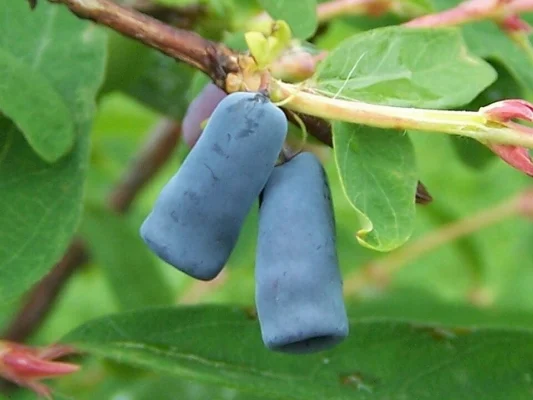
Borealis
Known for delicate fruit suited to careful fresh picking. Choose an appropriate partner such as Honey Bee, checking the nursery’s advice for the plants supplied.
Illustrative elongated honeyberries; this photograph does not establish a cultivar.
Photo: Jerzy Opioła, CC BY 2.5. Resized and optimised; cropped for display.
Ask about flowering overlap, eventual size and fruit flavour. Keep cultivar labels with the plants for future reference.
The early flowers can provide food for visiting bumblebees and other insects. Pollination and the crop benefit when flowering bushes are accessible to those visitors.
Inspect fruit protection often, securing any loose material.
Published by Buy From Farmers Direct. Sources checked 6 October 2026. Growing references: RHS: honeyberry growing guide; RHS: growing edible honeysuckle; RHS: Lonicera caerulea var. edulis; University of Saskatchewan: growing haskap; University of Saskatchewan: haskap varieties and partners; The Wasabi Company: Aurora and Blue Banana pair; Duchy of Cornwall Nursery: Blue Banana; Rocket Gardens: honeyberry growing guide. The seasonal timeline uses the shared BFFD Growers Calendar record; adjust timings to your variety and local conditions.
For dependable pollination, grow two different compatible cultivars that flower together. Two identical cultivar plants are not equivalent, and both suitable partners can produce fruit.
No. Buy labelled edible honeyberry selections of Lonicera caerulea. Do not use this guide to decide whether fruit from an unknown honeysuckle or wild shrub is edible.
Early cultivars may ripen in late May or June, with others cropping later in summer. Blue skin can precede full ripeness, so check flavour and flesh colour on a known edible plant.
No. Unlike blueberries, they tolerate a broad soil pH range. Aim for fertile, well drained ground that retains moisture rather than buying ericaceous compost automatically.
Yes, in generous containers with drainage and regular attention to watering. Provide compatible cultivars and enough room for their mature growth, even when each is in a separate pot.
Prune very little during the first three years. Later, thin selected weak, damaged or old growth after harvest, retaining healthy younger stems rather than cutting the whole bush back each year.
Plant a well matched pair, keep the roots comfortable and give the fruit time to ripen. Honeyberries can become a useful early addition to a varied fruit garden.
Explore more growing guides: Blueberry, Blackcurrant, Blackberry.
Want to get food independence, support your local grower, get better prices and shop more privately?
Local food isn’t just something you find. It’s something you protect. A free account helps keep local supply visible, supported, and resilient.

….it takes 30 seconds for food lovers and 5 minutes for suppliers
We built this for people who care where their food comes from. For people who want to remain food secure. For Farmers to get to the local people, who deserve a better income and to deliver a better price for you. For the environmentally conscious and the privacy-conscious. An account simply helps us make the map and supplier reach more useful to you, without changing how open it is. You’re always in control.


Find local food. Stay connected to it. Create a free account to support local producers and be part of a growing food network.


