Lovage brings a strong celery flavour to the kitchen and can produce far more leaf than its first small pot suggests. A polytunnel offers a sheltered place to raise young plants or manage a leafy crop, but this hardy perennial does not need permanent protection. Give it space, dependable moisture and plenty of ventilation rather than treating it like a tender summer herb.
Hardy perennial herb
Strong celery flavour
Allow generous space
Keep evenly moist
Ventilate in warm weather
| Botanical name | Levisticum officinale |
| Plant type | Herbaceous perennial |
| Main harvest | Young aromatic leaves |
| Flavour | Strong celery character |
| Hardiness | Hardy outdoors in the UK |
| Need for cover | Optional, not required for winter survival |
| Polytunnel use | Propagation and managed leaf production |
| Preferred light | Good light with some summer shade |
| Soil | Fertile, moisture retentive and well drained |
| Mature spread | Can approach 1m |
| Flowering height | Can reach about 2m or more |
| Sowing | Spring |
| Planting young plants | Late spring to early summer |
| Harvest season | Mainly spring and summer |
| First seedling harvest | Allow establishment before regular cutting |
| Winter habit | Dies back and regrows in spring |
| Watering | Check covered beds and pots regularly |
| Flower management | Remove stems if leaves are the priority |
| Propagation | Seed or spring division |
| Common pests | Slugs, snails and celery leaf miner |
| Plant name | Crop type | Spacing |
Sow indoors
Plant outdoors
Harvest
Polytunnel | |||||||||||
|---|---|---|---|---|---|---|---|---|---|---|---|---|---|---|
| Jan | Feb | Mar | Apr | May | Jun | Jul | Aug | Sep | Oct | Nov | Dec | |||
| Lovage (Polytunnel) | Herbs | Allow up to 1m for a mature clump; do not retain close seedling spacing permanently | No activity recorded | No activity recorded | Sow indoors, Polytunnel | Sow indoors, Harvest, Polytunnel | Sow indoors, Plant outdoors, Harvest, Polytunnel | Plant outdoors, Harvest, Polytunnel | Harvest, Polytunnel | Harvest, Polytunnel | Harvest, Polytunnel | No activity recorded | No activity recorded | No activity recorded |
Sow indoors: March, April, May. Plant outdoors: May, June. Harvest: April, May, June, July, August, September. Polytunnel: March, April, May, June, July, August, September.
Spring and summer harvest dates cover leaves from established plants; September allows for ripe seed where flower stems are retained. The polytunnel band is an optional growing period, not a requirement for protection. Seedlings need time to build a strong crown, and winter dieback is normal.
Useful if you want to raise a few lovage seedlings under cover or can reserve a generous corner for leaf production. One healthy plant is often enough for a household because the flavour is concentrated.
Less suitable as a permanent resident of a small crowded tunnel. Its mature height and spread compete with other crops, so an outdoor herb bed may be the better final home once the plant is established.
Photo: 4028mdk09, CC BY-SA 3.0. Resized and optimised; cropped for display. Adapted image under the same licence.
Choose a bright position away from the hottest, driest edge of the tunnel. Light shade during strong summer sunshine can help reduce stress, provided the plant still receives enough light for sturdy growth.
Allow for the mature crown rather than the size of a young plug. Keep it clear of narrow paths and avoid placing it where flower stems will interfere with roof vents or the cover.
In a soil bed, use fertile ground that holds moisture without remaining saturated. The polytunnel roof excludes rain, so even a damp outdoor week does not remove the need to check the bed.
Decide whether the tunnel is a nursery or the plant's long term growing space. That choice affects pot size, spacing and how soon you should move a vigorous young lovage outside.
1.
Obtain correctly labelled culinary lovage, Levisticum officinale, as seed or a young plant. Do not rely on scent alone to identify an unknown plant in the carrot family.
2.
For seed raising, sow a small quantity in spring using moist peat free seed compost. Label clearly and follow the packet depth rather than scattering a large crop you will struggle to accommodate.
3.
Keep seed compost evenly moist without saturation and provide good light once growth appears. Ventilate the propagation area so young seedlings do not remain in stagnant damp air.
4.
Move established seedlings into individual pots before their roots become crowded. Handle them carefully by a leaf or the rootball, avoiding pressure on the soft stem.
5.
Prepare the final bed or a substantial drained container. Plan for the plant's eventual spread of up to about 1m instead of using close seedling spacing as a permanent arrangement.
6.
Water the rootball and plant at its existing depth. Firm gently, water thoroughly and check that water drains rather than collecting around the crown.
7.
If moving plants from the tunnel to an outdoor bed, acclimatise them gradually. Hardy roots do not make soft growth instantly resistant to a sudden change in wind and sunlight.
8.
Allow young plants to establish before taking much leaf. Observe their regrowth after light picking and increase harvest only when the crown is growing strongly.

Watering
Inspect moisture beneath the surface, especially after warm sunny days. Water the root area thoroughly when needed; frequent small splashes can leave deeper roots dry while keeping the crown unnecessarily wet.
Container plants need particularly regular checks. Aim for steady moisture through active growth, then reduce watering as foliage dies back. Dormant roots should not sit in saturated compost.

Feeding
A fertile bed and a spring mulch of well rotted organic matter usually support strong growth. Lovage is naturally vigorous, so avoid pushing it with repeated heavy feeding simply to fill the space quickly.
If a container plant weakens, check root crowding, water and drainage before adding fertiliser. Refreshing its growing space or moving it to a larger permanent bed may be more useful than increasing feed.

Pruning
Remove emerging flower stems when a continuing leaf crop is the priority. Young leaves provide the most useful kitchen harvest, while foliage can become stronger and less pleasant once the plant concentrates on flowering.
If summer leaves become tired, cutting back old growth can encourage a fresh flush when the plant has adequate moisture. Avoid repeatedly stripping a weak crown, and leave healthy foliage to rebuild its reserves.

Winter care
Lovage naturally dies down as the season ends. Mark its position so the resting crown is not dug over when the bed appears empty, and clear spent growth when it no longer has useful structure.
An unheated tunnel is sufficient for an established hardy plant; extra heat is not necessary. Continue occasional moisture and drainage checks, and ventilate when conditions allow rather than maintaining a permanently damp enclosure.
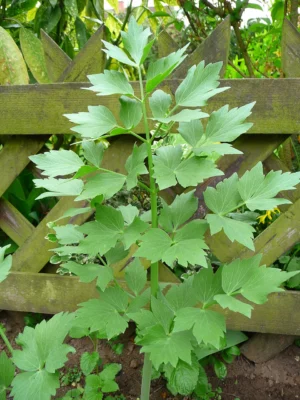
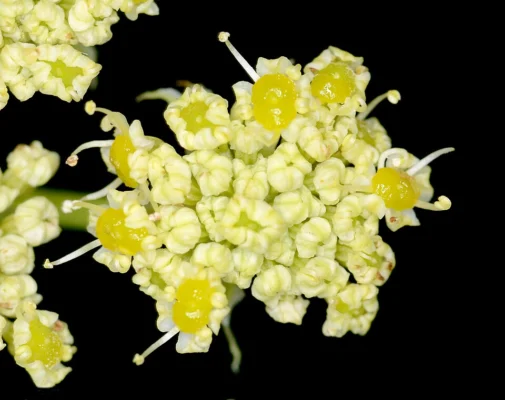
Lovage forms a clump of divided green leaves with a pronounced celery scent. When allowed to flower, it sends up tall stems carrying clusters of small yellowish green flowers arranged in umbels.
A labelled cultivated plant provides the safest starting point for a culinary harvest. Several plants in the same family can look similar, so do not use a brief leaf description as a guide to collecting unknown wild plants.
Photo: Danny Steven S., CC BY-SA 3.0. Resized and optimised; cropped for display. Adapted image under the same licence.
In cooler parts of the UK, cover can make spring propagation easier to manage. Any earlier leaf growth still depends on light and actual temperatures, so assess the plant rather than expecting a fixed extra harvest from the tunnel.
During warm spells, ventilation and soil moisture matter more than retaining heat. Open doors and vents appropriately and consider moving a container outside once conditions suit, freeing covered space for crops that need it more.
Pick small amounts of fresh young leaf and taste sparingly when cooking. Its strong flavour suits soups, stocks and savoury dishes; regular modest use is more practical than treating the whole mature clump as a salad crop.
Photo: Amada44, CC BY-SA 3.0. Resized and optimised; cropped for display. Adapted image under the same licence.
Check root moisture and temperature before assuming the plant needs feed. Improve ventilation and provide light shade where strong sun repeatedly causes stress, without leaving the roots waterlogged.
Look for slugs and snails around pots, bed edges and hiding places. Protect vulnerable new growth and remove unnecessary debris that makes inspection difficult.
Celery leaf miner can damage lovage foliage. Inspect the affected leaves and remove badly mined ones while retaining enough healthy growth for the plant to recover.
This is often normal maturity rather than a fault. Harvest and remove flower stems as appropriate, but consider an outdoor permanent position if the crown is overwhelming the covered bed.
Seasonal dieback is expected. Check that the crown is not rotting in saturated ground, mark its location and allow it to resume growth naturally as spring conditions improve.
Raise lovage from seed in spring, sowing only as much as you can use. Seedlings need time to establish; a bought young plant usually provides a quicker route to modest early harvests.
An established clump can be divided in spring, retaining healthy roots and growing points on each section. Replant and water promptly, then reduce harvesting while the divisions settle.
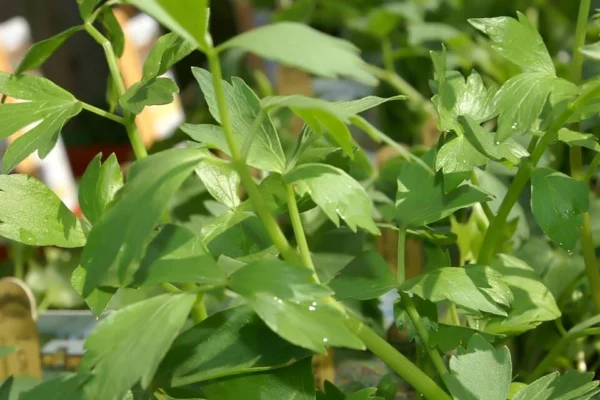
A labelled nursery plant
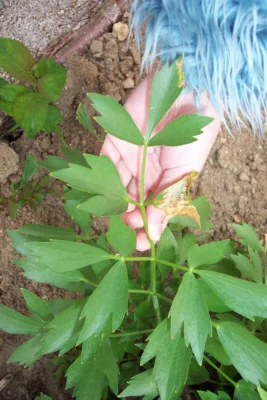
A healthy young lovage plant gives a practical start when one clump will meet your kitchen needs. The pictured foliage illustrates the species; lovage is generally sold as Levisticum officinale rather than a collection of distinct cultivars.
Photo: David J. Stang, CC BY-SA 4.0. Resized and optimised; cropped for display. Adapted image under the same licence.
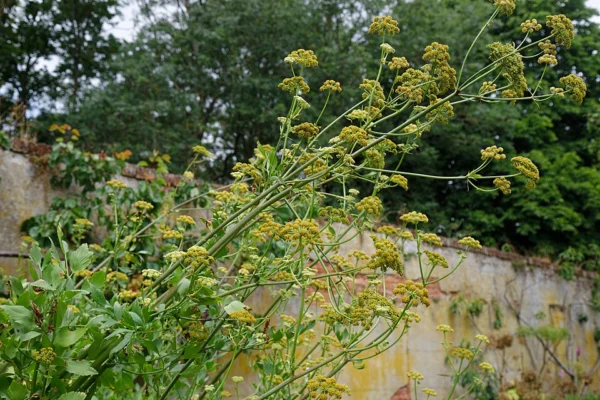
Room for mature growth
The flowering plant shown at Easton Lodge illustrates the scale lovage can reach outdoors. Allow that potential when planning a polytunnel bed, and move the plant outside if its canopy begins competing with other crops.
Photo: Acabashi, CC BY-SA 4.0. Resized and optimised; cropped for display. Adapted image under the same licence.
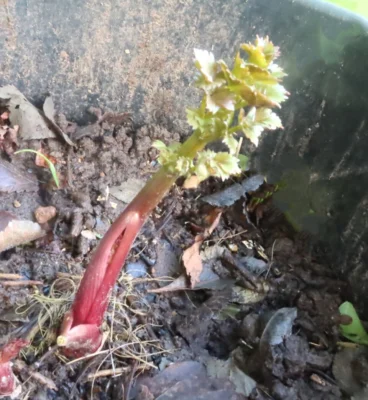
A spring division
A healthy established clump can be divided as growth resumes, keeping roots and a viable crown on each piece. The image shows an emerging lovage shoot, not a detached cutting or a completed division.
Photo: Patrick Roper, CC BY-SA 2.0. Resized and optimised; cropped for display. Young shoot of Lovage (Levisticum officinale), Sedlescombe by Patrick Roper

Flowers and seed
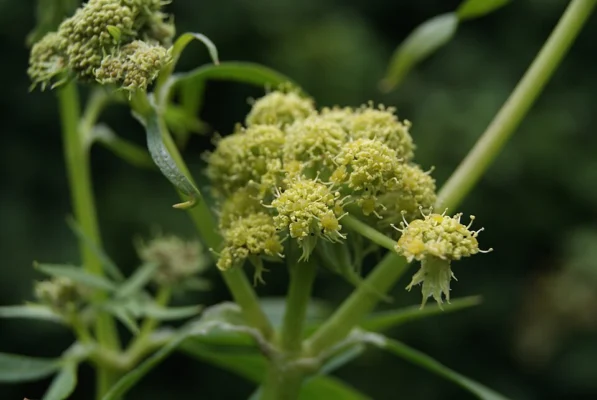
Leave selected stems if you want flowers and aromatic seed. The photograph shows developing buds, not ripe seed. Collect seed once mature and brown, then dry it thoroughly before storage; this is a later harvest than the tender leaf crop.
Photo: terri_bateman, CC0. Resized and optimised; cropped for display.
Ask local herb growers for labelled culinary lovage and advice on its mature size. A healthy young plant is often enough to begin a lasting kitchen supply.
Lovage flowers attract visiting insects when left to develop. An outdoor plant or accessible tunnel position lets insects reach the umbels, while a separate leaf crop can be kept from flowering.
If seed is not required, remove flowerheads before they scatter. This keeps the crop manageable and reduces volunteer seedlings appearing among unrelated plants in a covered bed.
No. It is hardy outdoors in the UK. Cover is an optional growing method for propagation or a managed leaf crop, not a winter survival requirement.
No. Lovage can form a broad crown and tall flower stems. Plan for its mature dimensions and move it outside if it begins to dominate limited tunnel space.
Do not expect a continuous winter crop. Lovage normally dies back, even though the crown survives. Any extended growth under cover depends on the season and conditions.
Very little until they are well established. Build a strong crown first and increase picking gradually only when healthy regrowth shows the plant can support it.
Remove flower stems if tender leaves are the priority. Leave selected stems where you want flowers for insects or seed, accepting that foliage quality can change as flowering develops.
Its vigorous roots and large canopy make a separate substantial container the better choice. Smaller neighbouring herbs can quickly lose space, light and moisture.
Use the polytunnel to make lovage easier to manage, not to force unnecessary heat. A well placed plant with room, water and careful picking can supply a distinctive flavour for many seasons.
Want to get food independence, support your local grower, get better prices and shop more privately?
Local food isn’t just something you find. It’s something you protect. A free account helps keep local supply visible, supported, and resilient.

….it takes 30 seconds for food lovers and 5 minutes for suppliers
We built this for people who care where their food comes from. For people who want to remain food secure. For Farmers to get to the local people, who deserve a better income and to deliver a better price for you. For the environmentally conscious and the privacy-conscious. An account simply helps us make the map and supplier reach more useful to you, without changing how open it is. You’re always in control.


Find local food. Stay connected to it. Create a free account to support local producers and be part of a growing food network.


