Mexican sunflower brings vivid orange flowers and broad green leaves to the summer border. Tithonia rotundifolia grows quickly once warmth arrives, but its tropical character makes a sheltered sunny position more valuable than an early start in cold soil. Raise a few sturdy plants in spring and give them room to branch for a late summer display.
Late summer colour
Grow from seed
Warm sunny position
Support tall stems
Flowers for insects
| Botanical name | Tithonia rotundifolia |
| Family | Asteraceae |
| Plant type | Half hardy annual |
| Typical height | 90cm–1.8m, according to selection |
| Typical spread | 45–60cm |
| Light | Full sun |
| Soil | Moderately fertile, well drained soil |
| Main interest | Orange and red flowers in late summer |
| Best starting point | Spring seed or young plants |
| Working spacing | Single 50cm, In row 50cm, Row gap 50cm |
| Flower colours | Orange, red orange and yellow selections |
| Main flowering | July to autumn frost |
| Leaf shape | Broad, often lobed |
| Stem character | Branched and somewhat brittle |
| Sowing | March–April under cover |
| Planting out | Late May–June after frost |
| Propagation | Seed |
| Winter habit | Killed by frost |
| Cutting use | Ornamental stems only |
| Different species | Not the perennial Tithonia diversifolia |
| Plant name | Crop type | Spacing |
Sow indoors
Plant outdoors
Harvest
Polytunnel | |||||||||||
|---|---|---|---|---|---|---|---|---|---|---|---|---|---|---|
| Jan | Feb | Mar | Apr | May | Jun | Jul | Aug | Sep | Oct | Nov | Dec | |||
| Mexican Sunflower | Not recorded | Single 50cm, In row 50cm, Row gap 50cm | No activity recorded | No activity recorded | Sow indoors, Polytunnel | Sow indoors, Polytunnel | Plant outdoors, Polytunnel | Plant outdoors | Harvest | Harvest | Harvest | Harvest | No activity recorded | No activity recorded |
Sow indoors: March, April. Plant outdoors: May, June. Harvest: July, August, September, October. Polytunnel: March, April, May.
Sow under cover in March or April, following the seed packet for temperature and depth. May and June planting means hardened plants set outside after the final local frost. The protected growing band covers the young plant stage, not year round tunnel cultivation. July to October in the harvest row means optional ornamental flower cutting, not food. Flowering may start later in a cool summer. Allow about 50cm between plants and more if a vigorous selection requires it.
Choose tithonia for a bright late season border or a warm cutting patch where tall annuals can spread. Start with a realistic amount of space and a plant you can reach easily for routine care. A small, well placed group is easier to establish than a crowded display that needs constant correction.
It is less dependable in cold, exposed gardens. Cool cloudy weather can delay growth and flowering even when watering and feeding are correct. Look at the garden through the whole year before buying. Space that seems empty in spring may already belong to a neighbouring plant by midsummer, while the winter conditions can be very different from a sheltered shop display.
Photo: User:Amada44, Public domain. Resized and optimised; cropped for display.

Use the warmest sunny part of the border with shelter from strong wind. A position behind a low windbreak can protect stems without casting heavy shade. Check how the light moves across the proposed position, including shade cast by fences and nearby trees. The amount of direct sun at midday alone does not describe the whole growing site.
Good drainage matters more than rich feeding. Improve the wider bed where needed, but do not create a small pocket of over enriched soil around each plant. Clear persistent weeds before planting. Working around established roots later is slower and risks damage, so this is a useful stage to deal with bindweed, couch grass or other unwanted growth.
A compact selection can grow in a large container, though vigorous plants are usually easier in the ground. A shallow decorative pot dries too quickly and can topple. Make drainage holes accessible and allow water to escape freely. Check the pot after heavy rain as well as during dry weather; a blocked outlet can undo otherwise careful watering.
Leave space for branching foliage and put supports in while plants are small. Tall flowers look effective among grasses, but should not lean across a narrow path. Leave practical access for inspection and maintenance. Think about the mature outline rather than filling every visible gap around a newly bought plant. Its neighbours will also be growing into the available space.
Photo: Krzysztof Ziarnek, Kenraiz, CC BY-SA 4.0. Resized and optimised; cropped for display. Adapted image under the same licence.

A handful of strong seedlings will usually make a better display than a crowded tray of weak plants. Prepare everything before removing plants from their pots or opening a seed packet, so roots and seedlings are not left exposed while you look for tools.
1.
Check the mature height on the seed packet. Compact and tall selections need different positions. Keep the label and record the planting date. That small record makes it much easier to understand differences in growth and to replace a successful selection accurately.
2.
Prepare a sunny bed and have supports ready before roots fill the young plants’ pots. Avoid working saturated soil: squeezing and treading it while wet can leave a compacted planting area. Wait for a workable day if the surface smears rather than crumbles.
3.
Sow under warm cover in March or April at the depth and temperature stated on the packet. Work with clean containers and fresh suitable compost where pots are involved. Reusing a container is fine after cleaning it, but a crust of old compost can conceal pests and obstruct drainage.
4.
Pot seedlings on individually and harden them off before planting after frost, usually late May or June. Use the forecast alongside the calendar. A warm afternoon does not cancel a cold night, and a printed month should never take priority over the conditions in your own garden.
5.
Plant without disturbing the rootball excessively, keeping the existing compost surface level with the soil. Work carefully rather than rushing to fill the space. Check the intended depth and spacing before finishing, because corrections are easier now than once growth is established.
6.
Water in and fit a discreet cane or supporting framework without pushing it through the rootball. Water gently enough to avoid washing compost away. If the surface settles, top it up to the intended level without burying the base more deeply than planned.
7.
Tie stems loosely as they develop and watch for slugs around young plants. Look again after the first windy or very wet spell. A plant that has rocked loose or a newly exposed rootball needs attention before the problem becomes established.
8.
Pinch a young growing tip if a bushier plant is wanted, understanding this can delay the first flowers. Review growth after a few weeks and adjust care to what you see. Regular observation is more useful than repeatedly adding fertiliser to a plant whose main problem is light, moisture or space.

Watering
Keep young plants steadily moist while roots establish. A small rootball can dry inside otherwise damp ground, so check close to the plant rather than relying on the appearance of the whole bed.
Established plants need watering during sustained dry weather, particularly while actively making stems and flowers. Water deeply at the base and let excess drain. Repeated light splashes wet the surface without reaching the main roots.

Feeding
Avoid excessive nitrogen, which can produce large soft plants with fewer flowers and poorer wind resistance. Ordinary moderately fertile garden soil is generally suitable after sensible preparation.
A container plant may need a flowering plant feed once compost nutrients are depleted. Follow the product rate and assess light and moisture first if flowering is poor. Feed cannot make a cold shaded position behave like a warm border.

Pruning
Remove faded flower heads with their short stalks to keep the display fresh. Handle stems carefully because they can snap when bent sharply. Use clean snips rather than tugging a flower sideways.
Cut ornamental stems when fresh and place them promptly in water. Take a balanced selection around the plant so one side is not stripped. Remove damaged stems and renew loose ties after windy weather.

Winter care
Frost ends the annual display. Clear collapsed plants when practical and compost healthy material. The photograph of snow damaged flowers illustrates weather damage, not useful winter hardiness.
Seed can be saved from fully mature dry heads on healthy plants, but it may not ripen in every UK summer. Keep dry seed labelled and cool. Buying fresh seed is more reliable when a particular named selection is required.
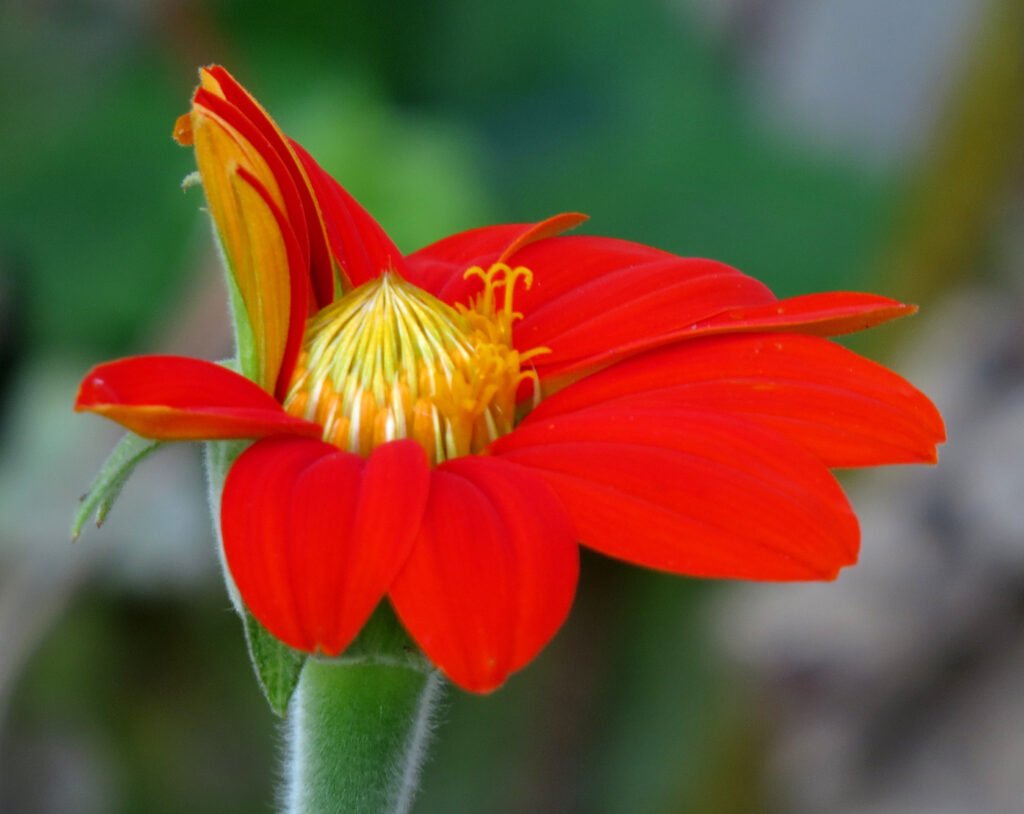
Tithonia rotundifolia carries bright daisy shaped heads above broad, sometimes three lobed leaves. The raised yellow centre and velvety looking growth distinguish its overall effect from many smaller bedding daisies.
It is not the same as the much larger perennial Tithonia diversifolia, and it is not a true Helianthus sunflower. Use the botanical name when buying seed so this annual UK calendar matches the plant.
Photo: Davidson Moreira, CC BY 4.0. Resized and optimised; cropped for display.

Delay outdoor planting until both nights and soil have warmed. A plant kept growing steadily in a pot can overtake one checked by an early cold spell outdoors.
Tall growth needs wind protection in exposed gardens. Positioning a plant among supportive neighbours helps, but do not rely on a fragile adjacent annual as its only support.
For a long display, keep removing old heads and allow fresh buds to develop. Late sowing can leave too little warm season for the plant to reach its best before autumn frost.
Photo: Rbreidbrown, CC BY-SA 4.0. Resized and optimised; cropped for display. Adapted image under the same licence.

Cold weather and insufficient sun commonly slow tithonia. Improve shelter and wait for warmth rather than applying repeated strong feeds.
Slugs and snails can damage seedlings. Check after dark and protect plants while they are small.
Wind and rough handling can snap branches. Support early, tie loosely and remove broken growth cleanly.
Excessive nitrogen, shade or a late start may explain this. Review the site and sowing date before changing fertiliser.
Remove spoiled heads and keep plants spaced. Long wet spells can shorten an individual flower’s useful life even on a healthy plant.
Sow fresh labelled seed in suitable compost under warm cover. Use the packet’s sowing depth and temperature because seed products can differ. Prick out or pot on promptly once seedlings are large enough to handle safely.
Allow seedlings good light, air and individual root space. Harden them off gradually and avoid leaving roots packed into tiny cells for weeks. Home saved seed may vary and needs to be completely dry before storage.
Tall orange forms
Traditional tall selections give height and vivid colour at the back of a warm border. Check the packet’s stated height and allow room for a broad branching plant.
Tithonia rotundifolia flower; cultivar unverified.
Photo: Alejandro Bayer Tamayo from Armenia, Colombia, CC BY-SA 2.0. Resized and optimised; cropped for display. Adapted image under the same licence.

Compact forms
Shorter selections suit smaller borders and substantial pots. Compact does not mean frost hardy or tolerant of shade; they still need warmth and good light.
Mexican sunflower bloom shown as a species example.
Photo: Ganesh Mohan T, CC BY-SA 4.0. Resized and optimised; cropped for display. Adapted image under the same licence.

Cutting selections
Choose a taller, clearly labelled seed strain when useful stem length is the main aim. Keep some flowers on the plant for garden display and visiting insects.
Flowering stem of Tithonia rotundifolia.
Photo: Prenn, CC BY-SA 3.0. Resized and optimised; cropped for display. Adapted image under the same licence.

Seed raised mixtures
A mixture can give variation in colour or habit, depending on the product. Read the description carefully and avoid assuming that a photograph proves the identity of every seedling.
Mexican sunflower flower; no named selection asserted.
Photo: Cbaile19, CC0. Resized and optimised; cropped for display.
Choose fresh labelled seed, a sunny sheltered site and supports suited to the expected height. Warmth and space will do more for a tithonia display than a large dose of fertiliser.
The open central disc attracts visiting insects during the flowering season. Keep several blooms on the plants if cutting stems, and combine tithonia with earlier flowers for a longer season of garden forage.
Photos taken overseas may show insects that are not usual UK visitors. Grow this plant for the insects present in your own garden rather than expecting North American butterfly species to appear.
Published by Buy From Farmers Direct. Growing guidance reviewed 11 October 2026. The seasonal timeline uses the shared BFFD Growers Calendar record; adjust timings to your variety and local conditions.
Tithonia rotundifolia is normally grown as a frost tender annual. Start again from seed each spring.
March or April under warm cover is a useful UK window. Follow the packet for exact sowing conditions.
It performs best in full sun and warmth. Shade and cool conditions often give disappointing flowering.
Tall selections benefit from early support and shelter, especially in windy gardens.
Yes, for ornamental arrangements. Cut fresh stems carefully and put them promptly into water.
No. This guide covers annual T. rotundifolia, which has different size and growing requirements.
Start tithonia steadily, plant it into warmth and let its branches fill their space. Well supported plants can carry bright flowers through the closing weeks of summer.
Explore more growing guides: Marguerite Daisy, Marigold, Miscanthus.
Want to get food independence, support your local grower, get better prices and shop more privately?
Local food isn’t just something you find. It’s something you protect. A free account helps keep local supply visible, supported, and resilient.

….it takes 30 seconds for food lovers and 5 minutes for suppliers
We built this for people who care where their food comes from. For people who want to remain food secure. For Farmers to get to the local people, who deserve a better income and to deliver a better price for you. For the environmentally conscious and the privacy-conscious. An account simply helps us make the map and supplier reach more useful to you, without changing how open it is. You’re always in control.


Find local food. Stay connected to it. Create a free account to support local producers and be part of a growing food network.


