Pulmonaria combines early clusters of small flowers with foliage that remains useful after the main spring display. Many selections have spotted or silvery leaves, making them valuable in lightly shaded borders. The key is a cool root area with dependable moisture: a dry position beneath thirsty trees can be much less suitable than it first appears.
Spring flowers for bees
Decorative summer leaves
Best in cool shade
Moist soil with drainage
Divide to preserve cultivars
| Botanical name or group | Pulmonaria species and garden hybrids |
| Family | Boraginaceae |
| Garden life cycle | Herbaceous or semi-evergreen perennial |
| Typical height | 20–45cm |
| Typical spread | 30–60cm between clumps, depending on cultivar |
| Position | Partial shade or light shade |
| Soil | Humus-rich, moist but not waterlogged soil |
| Flowering season | Late winter to spring |
| Foliage | Often spotted or silver-marked leaves |
| Hardiness | Most familiar garden cultivars are hardy outdoors |
| Main planting window | Spring or early autumn |
| Seed route | Optional seed route; follow the packet for the particular species or strain |
| Propagation | Divide healthy clumps after flowering or in autumn, retaining roots and growing points with each section. |
| Watering priority | Maintain reasonable moisture during active growth and hot dry spells. |
| Feeding approach | Modest feeding according to soil and container conditions |
| Pruning priority | Cut spent flower stems and remove old, tired foliage after flowering if needed. |
| Best garden role | Shaded border fronts and groundcover beneath open deciduous shrubs |
| Container suitability | Possible in cool drained pots with regular moisture checks |
| Harvest interpretation | Ornamental flowers only; no food harvest |
| Key distinction | Lungwort is an ornamental common name, not a medicinal recommendation |
| Plant name | Crop type | Spacing |
Sow indoors
Plant outdoors
Harvest
Polytunnel | |||||||||||
|---|---|---|---|---|---|---|---|---|---|---|---|---|---|---|
| Jan | Feb | Mar | Apr | May | Jun | Jul | Aug | Sep | Oct | Nov | Dec | |||
| Pulmonaria | Not recorded | 30–60cm between clumps, depending on cultivar | No activity recorded | No activity recorded | Plant outdoors | Plant outdoors | Plant outdoors | No activity recorded | No activity recorded | No activity recorded | Plant outdoors | Plant outdoors | No activity recorded | No activity recorded |
Sow indoors: no months recorded. Plant outdoors: March, April, May, September, October. Harvest: no months recorded. Polytunnel: no months recorded.
Plant in March to May or September and October when soil is workable and moisture is easier to maintain. Named cultivars are normally bought or divided, so a general seed band is omitted. Established hardy plants need no polytunnel season. The harvest band is empty because the guide concerns ornamental flowers and foliage.
Use pulmonaria along a cool path or at the front of a shaded border, where both the spring flowers and later leaf pattern can be seen.
Choose partial shade that shields the leaves from the strongest summer sun. Watch the proposed spot at different times of day before committing it. A bright place in early spring may become substantially shadier once surrounding shrubs and trees are in full leaf.
Provide moisture-retaining, humus-rich soil with an outlet for excess winter water. Check what happens after heavy rain as well as during dry weather. The appearance of the surface on planting day cannot tell you whether roots will remain saturated for long periods in winter.
Allow room for foliage to expand after flowering, and remove aggressive weeds before the clump spreads. Remove persistent weeds before planting, while their roots are accessible. Later digging between established plants can damage the roots you want to retain and creates repeated disturbance close to the crown.
Begin with correctly labelled pulmonaria and prepare its permanent position before planting. The following sequence keeps the needs of the roots, the eventual spacing and the first season's care together.
1.
Select a healthy labelled plant, comparing leaf pattern as well as flower colour. Retain the label and record the planting date. This helps distinguish a genuine problem from normal seasonal behaviour and keeps future decisions tied to the plant you actually bought.
2.
Plant in spring or early autumn during mild, moist conditions. Work when the growing medium is manageable. Avoid compressing very wet soil, and prepare any necessary support or container before taking the plant from its nursery pot or opening the seed packet.
3.
Prepare the rooting area and remove perennial weeds before the leaves spread. Clear only the area needed and check levels before proceeding. Good preparation should improve the whole rooting area rather than creating one isolated pocket that behaves differently from the surrounding bed.
4.
Space clumps roughly 30–60cm apart according to the cultivar’s vigour. Set out the intended positions before final planting. Stand back to check the mature spacing and the relationship with neighbouring growth; moving an empty pot is easier than moving an established root system.
5.
Plant at the previous soil level, keeping the crown accessible. Handle roots gently and keep them from drying in wind or sunshine. Have the prepared growing medium close by so young material spends as little time exposed as possible.
6.
Water thoroughly and apply a light organic mulch around, not over, the crown. Firm lightly enough to make contact without turning the root area into a compacted block. Add a durable label where it can be read without pushing hands through later growth.
7.
Protect young growth from slug damage while the plant establishes. Check again after the first thorough watering, as loose compost or soil may settle. Correct any exposed roots or low hollows promptly rather than burying the plant deeper with each subsequent top-up.
8.
Review the site in summer to ensure surrounding roots have not left the soil unexpectedly dry. Review progress regularly through establishment. Judge watering and protection from the plant, soil and weather together; a calendar date cannot account for every exposed, shaded or sheltered UK garden.

Watering
Maintain reasonable moisture during active growth and hot dry spells. Check moisture with a finger or small probe rather than relying on surface colour alone. Water the root area slowly enough for it to absorb moisture, and allow surplus to drain before considering another application.
A mature clump can wilt markedly in drought; check the soil and water the roots rather than misting leaves repeatedly. Pots and recently planted specimens need more frequent observation than established plants in open ground. Check again after wind or warm weather, especially where a wall or dense neighbouring foliage prevents rainfall reaching the roots.

Feeding
A spring mulch and ordinary border fertility are usually adequate. Read the product label and measure the stated amount. More fertiliser is not automatically better, and a weak plant may be responding to shade, damaged roots or unsuitable drainage rather than a shortage of nutrients.
Avoid heavy feeding where lack of water or excess sun is the actual cause of poor leaves. Keep any mulch away from the immediate base and check that the original planting depth remains visible. In containers, consider how long the compost has been in use before choosing a feeding or repotting routine.

Pruning
Cut spent flower stems and remove old, tired foliage after flowering if needed. Use clean, sharp tools and take time to locate the living growth before cutting. Remove material carefully so nearby shoots are not pulled loose, and inspect it for resident insects before disposal.
Let the fresh foliage grow without repeated clipping; it is an important part of the summer display. A light tidy and a major reduction are different operations. If the plant is unfamiliar, begin with clearly dead or spent material and use its observed growth to guide any further work.

Winter care
Most garden pulmonarias remain outdoors through UK winters. Keep drainage holes and surface outlets clear of debris. Wet roots and trapped airless foliage can cause damage even during a relatively mild winter, so inspect the growing position after prolonged heavy rain.
Clear only smothering debris and badly damaged leaves, retaining sound growth and good drainage. Adjust the plan to local exposure rather than the county name alone. A windy raised pot, a sheltered courtyard and an open garden bed can experience quite different conditions on the same night.
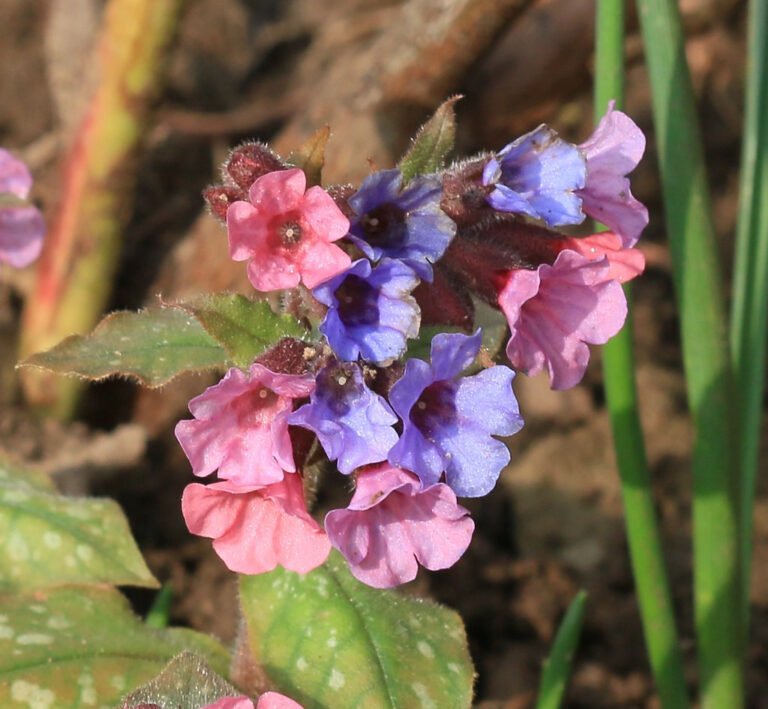
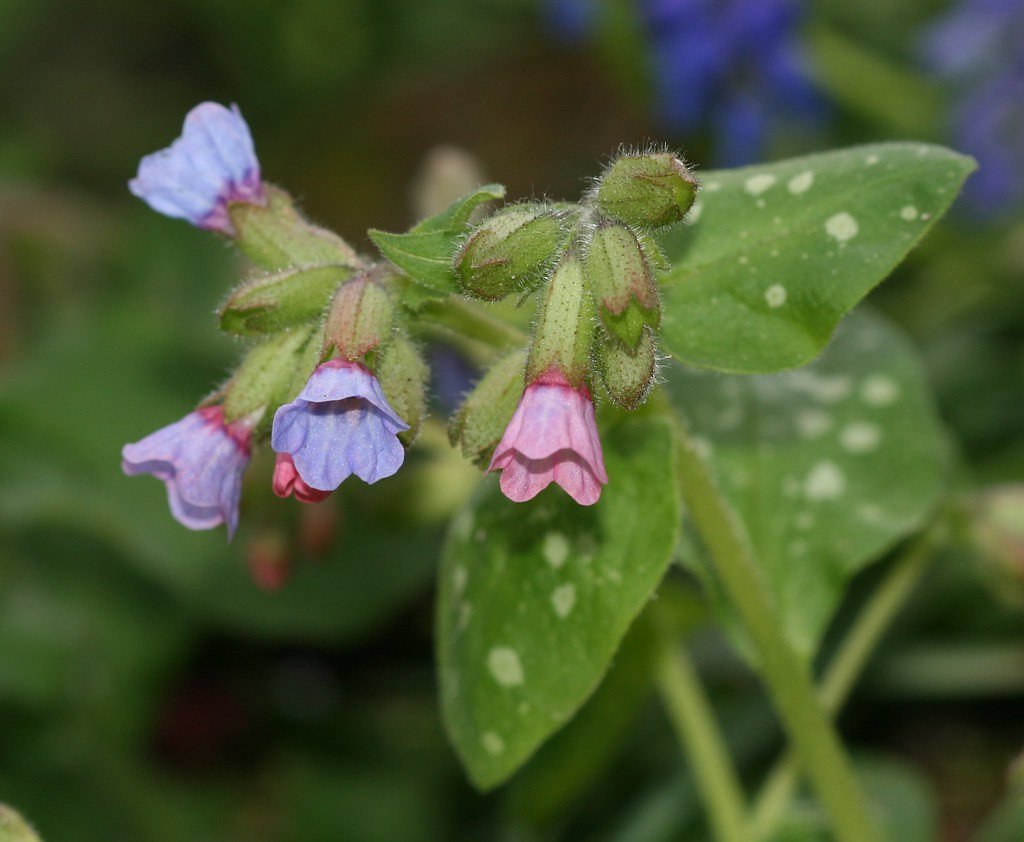
Pulmonaria has rough-textured leaves and clusters of small funnel-shaped flowers, often opening pink and maturing towards blue in some forms.
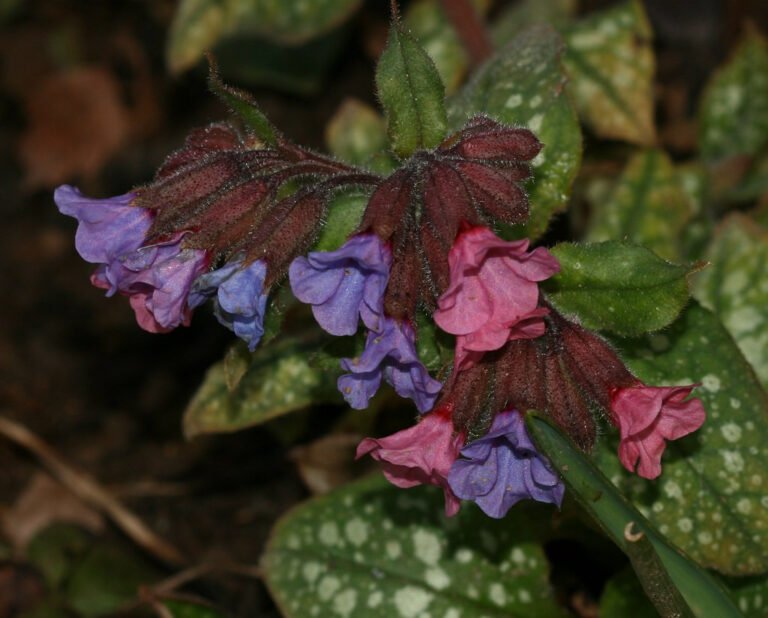
Leaf markings range from separate pale spots to broad silver areas. Not every species has the same pattern or colour-changing flowers, so retain cultivar labels.
Photo: Amanda Slater, CC BY-SA 2.0. Resized and optimised; cropped for display. Adapted image under the same licence.
A cool north- or east-facing border often offers useful conditions, provided the soil is not exhausted by larger roots.
In dry gardens, improve moisture retention across the bed and consider whether a more drought-tolerant plant would suit the site better.
Powdery mildew is more likely on stressed foliage. Improve moisture and airflow, and remove badly affected old leaves.
Move pots into cooler light and review the garden position before the next hot spell.
Water after checking the root area; a shaded site can still be very dry beneath trees.
Slugs and snails may feed on fresh growth. Protect young plants and tolerate light cosmetic damage.
Divide a congested healthy clump after flowering or in autumn rather than continually feeding an ageing centre.
Divide healthy clumps after flowering or in autumn, retaining roots and growing points with each section.
Seedlings may appear around plants but can differ from the parent. Use division for a named cultivar whose leaf markings and flowers you want to preserve.
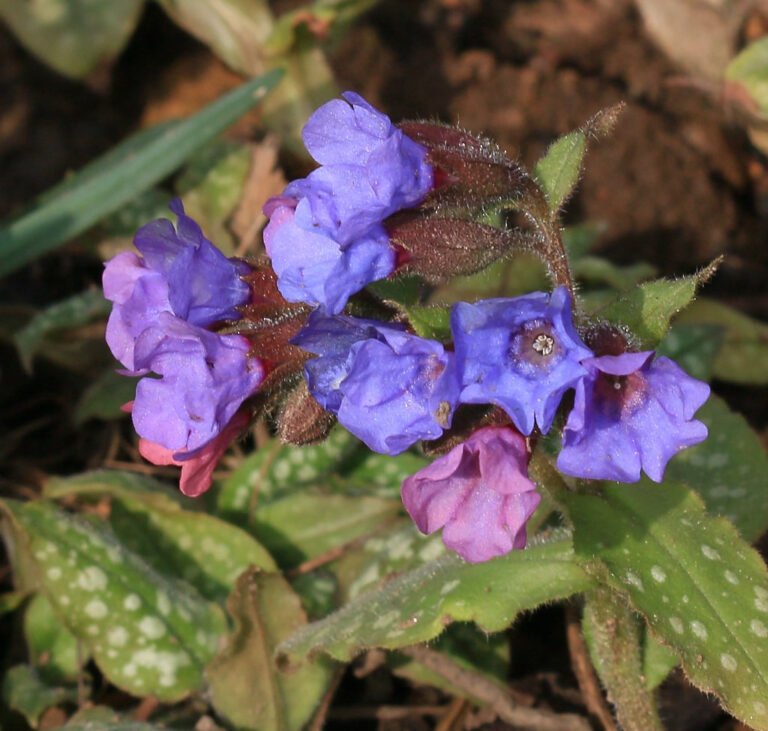
Pulmonaria angustifolia
A species with relatively narrow leaves and blue spring flowers, useful where a simpler foliage effect is preferred. It still needs suitable moisture and should not be treated as a dry-shade cure.
A lungwort comparison photograph; Pulmonaria angustifolia identity is not established by this image.
Photo: S. Rae, CC BY 2.0. Resized and optimised; cropped for display.
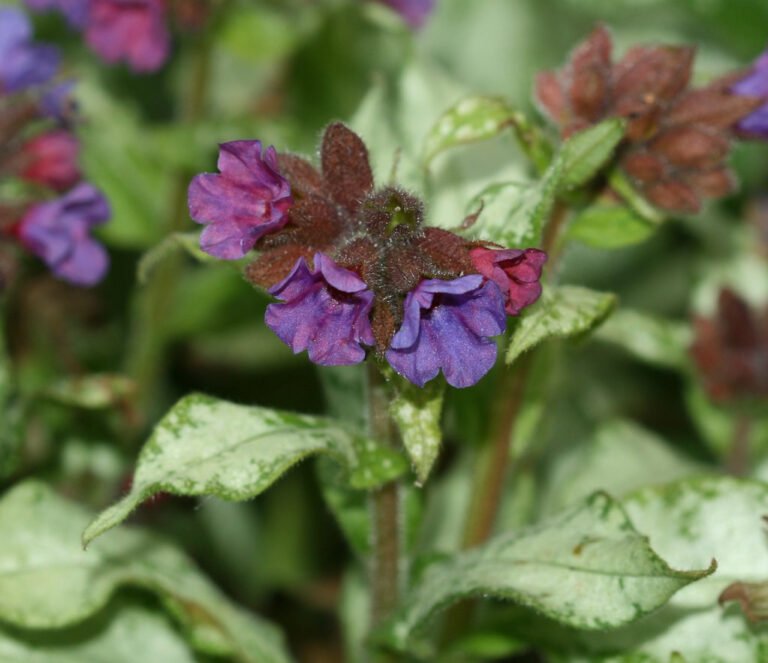
Diana Clare
A named garden selection admired for silvery foliage and spring flowers. Buy a labelled plant if the foliage effect is central to the design.
Lungwort flowers and foliage shown for comparison; Diana Clare cultivar identity is not verified.
Photo: S. Rae, CC BY 2.0. Resized and optimised; cropped for display.
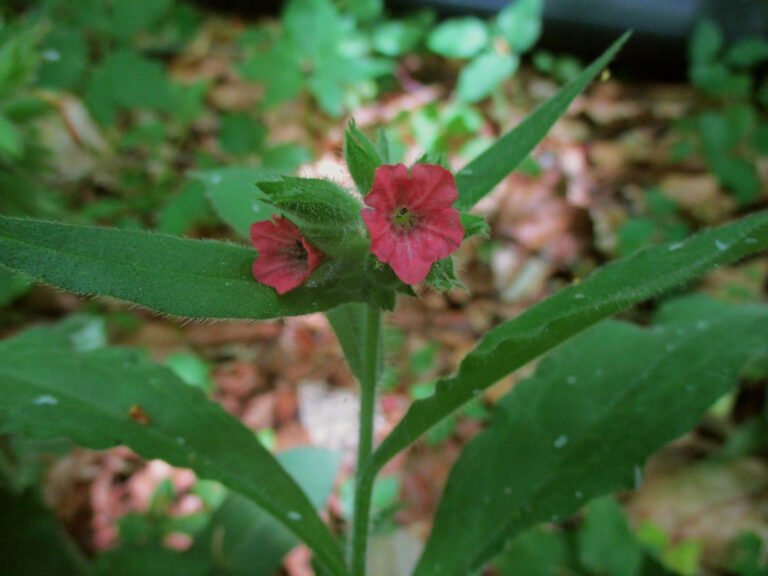
Pierre’s Pure Pink
A cultivar selected for pink flowers, offering an alternative to familiar blue and changing-colour types. Compare mature spread with nearby plants before grouping several together.
Pulmonaria rubra shown for comparison, as identified by the photographer; this is not an identified Pierre’s Pure Pink plant.
Photo: candiru, Public Domain Mark 1.0. Resized and optimised; cropped for display.
Argentea Group
Pulmonaria saccharata selections with strongly silvered foliage. The group name covers foliage character rather than guaranteeing every plant is one identical clone; confirm the nursery’s description.
Spotted lungwort foliage shown for comparison; Argentea Group identity is not verified.
Photo: brewbooks, CC BY-SA 2.0. Resized and optimised; cropped for display. Adapted image under the same licence.
Choose pulmonaria by mature size, flowering season and the conditions available in your garden. Compare healthy labelled plants, check the stated hardiness and arrange the growing position before bringing a large group home.
Early flowers attract bees at a time when many summer border plants are still dormant.
The low foliage contributes cover within a mixed shaded border; retain broader habitat variety without letting damp debris bury the crowns.
Published by Buy From Farmers Direct. Growing guidance reviewed 11 October 2026. The seasonal timeline uses the shared BFFD Growers Calendar record; adjust timings to your variety and local conditions.
It prefers moisture; very dry ground beneath trees often leads to poor foliage.
Some forms naturally change from pink towards blue as flowers age, but not all cultivars behave alike.
Yes, tired foliage can be removed carefully to make room for fresh leaves.
Divide it or buy labelled stock; seedlings can vary.
Most familiar hardy garden forms do not, provided drainage is suitable.
This guide treats it as an ornamental; no medicinal or food use is advised.
Give pulmonaria the position and seasonal care it needs, then allow time for establishment. A few regular observations of moisture, light and new growth will guide useful small adjustments through the year.
Want to get food independence, support your local grower, get better prices and shop more privately?
Local food isn’t just something you find. It’s something you protect. A free account helps keep local supply visible, supported, and resilient.

….it takes 30 seconds for food lovers and 5 minutes for suppliers
We built this for people who care where their food comes from. For people who want to remain food secure. For Farmers to get to the local people, who deserve a better income and to deliver a better price for you. For the environmentally conscious and the privacy-conscious. An account simply helps us make the map and supplier reach more useful to you, without changing how open it is. You’re always in control.


Find local food. Stay connected to it. Create a free account to support local producers and be part of a growing food network.


