A cordon pear turns a sunny boundary into a productive strip of garden. One main stem carries short fruiting branches, leaving room to grow several varieties where a spreading tree would be impractical. Support, summer pruning and compatible pollen underpin the autumn harvest.
Trained fruit tree
Permanent support
Sunny boundary
Summer pruning
Check pollination
| Botanical name | Pyrus communis |
| Plant type | Deciduous European pear |
| Training form | Single stem with short fruiting spurs |
| Position | Sunny and sheltered |
| Soil | Fertile and moisture retentive, with good drainage |
| Common rootstocks | Quince C or Quince Eline |
| Support | Permanent wires and a training cane |
| Planting distance | Usually 60 to 90cm between cordons |
| Stem direction | Often diagonal; vertical forms also available |
| Planting season | November to March preferred |
| Flowers | White spring blossom |
| Pollination | Usually benefits from a compatible different cultivar |
| Fruit | Dessert or cooking pears, depending on cultivar |
| Harvest | Usually August to October |
| Ripening | Pick firm and finish ripening indoors |
| Pruning | Annual summer pruning once established |
| Pruning trigger | New shoots becoming woody and growth slowing |
| Watering | Check closely beside walls |
| Propagation | Named grafted nursery trees |
| Main risks | Blossom frost, dryness and missed pruning |
| Plant name | Crop type | Spacing |
Sow indoors
Plant outdoors
Harvest
Polytunnel | |||||||||||
|---|---|---|---|---|---|---|---|---|---|---|---|---|---|---|
| Jan | Feb | Mar | Apr | May | Jun | Jul | Aug | Sep | Oct | Nov | Dec | |||
| Pear (Cordon) | Orchard fruit | Usually 60 to 90cm between cordons; confirm the chosen training system | Plant outdoors | Plant outdoors | Plant outdoors | No activity recorded | No activity recorded | No activity recorded | No activity recorded | Harvest | Harvest | Harvest | Plant outdoors | Plant outdoors |
Sow indoors: no months recorded. Plant outdoors: January, February, March, November, December. Harvest: August, September, October. Polytunnel: no months recorded.
The planting row shows the preferred dormant season and the harvest row covers typical European pear picking dates. Container trees can be planted in other suitable weather. Ripening indoors may continue beyond harvest; cordons normally grow outside without a polytunnel.
Choose a cordon if you want several pear varieties along a narrow sunny border and can make time for annual pruning. Fruit and blossom remain within easy reach.
Avoid squeezing one into permanent shade or relying on a weak decorative trellis. The narrow outline is maintained through care, rather than being a naturally miniature habit. Leave access along the whole row.
Photo: Ввласенко, CC BY-SA 3.0. Resized and optimised; cropped for display. Adapted image under the same licence.
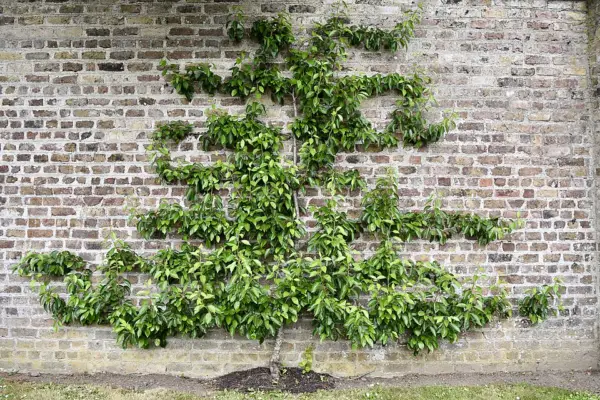
A warm wall or fence suits a cordon row, particularly where late fruit needs help to mature. Check how spring and summer shade affect the position.
Allow room to stand in front of the tree with secateurs and a picking basket. Keep fruit away from busy paths and allow for future stem extension.
Install strong posts and horizontal wires before planting. Fix training canes securely to carry the future crop as well as young stems.
Do not place the rootball immediately against masonry. Plant around 30cm out and pay particular attention to the dry strip beneath a wall or fence. Clear competing weeds and check that water reaches the roots.
Photo: Thoslee, CC BY-SA 4.0. Resized and optimised; cropped for display. Adapted image under the same licence.
Begin with a named pear sold for cordon training, or ask a specialist nursery to select a suitable young tree. Confirm the rootstock, fruiting habit and pollination partner before deciding how many stems the available boundary can accommodate.
1.
Measure the boundary and mark each planting position. A usual spacing is 60 to 90cm, adjusted to the nursery advice for the selected tree and training system. Record the chosen pollination partners.
2.
Prepare the wires and individual canes. For an oblique row, set canes consistently at roughly 45 degrees; buy a vertical cordon if that is the shape you want to maintain rather than forcing an older angled stem upright.
3.
Plant during the dormant season when the soil is workable. Delay planting into frozen or saturated ground and keep bare roots covered and moist while preparing the site.
4.
Dig a hole wide enough to spread the roots comfortably. Water a container tree before removing its pot; soak dry bare roots before planting rather than burying them in the hope that rainfall will catch up.
5.
Set the tree at its former soil level with the graft clearly above the surface. Arrange the stem towards its cane without twisting the roots, then backfill and firm the soil gently.
6.
Water thoroughly and mulch the cleared ground, leaving space around the trunk. Water should settle around the root area, and neither mulch nor soil should bury the graft.
7.
Tie the main stem to its support at several points using soft ties. Allow room for thickening and check that the stem cannot rub against a wire when the wind moves it.
8.
Ask which formative pruning has already been completed. Leave a correctly prepared nursery cordon intact at planting, then follow the appropriate first summer routine as its new growth develops.

Watering
Check soil moisture through the first growing seasons, especially under wall overhangs. Water the root zone thoroughly in dry conditions. Rainfall may leave sheltered roots dry.
Maintain steady moisture while fruit swells. Combine sensible thinning with regular soil checks rather than occasional enormous soakings.

Feeding
Mulch in spring with well rotted organic matter, keeping it clear of the trunk. On fertile ground this may provide all that is needed. Judge vigour, leaf colour and soil condition before adding a separate feed.
Extra fertiliser is not a substitute for pollen, sunlight or pruning. Long shoots and little fruit do not automatically mean the tree is hungry. If a feed is needed, use the product rate and avoid encouraging unnecessary soft growth.

Pruning
For an established cordon, summer prune once growth slows and shoots become woody. New growth over 20cm arising from an existing spur is shortened to one leaf beyond its basal leaf cluster. Leave shorter shoots, which may carry fruit buds, rather than clipping everything to one outline.
First summer training differs: new side shoots arising directly from the main stem are shortened to three leaves above the basal cluster; new growth from previously pruned side shoots goes back to one. Tie in the extending leader. Pear growth may be ready from late July, but use the shoot condition as your guide.

Winter care
Inspect wires, posts and ties while the leaves are off. Replace anything frayed or loose and remove rotten fruit still hanging on the spurs. The bare framework is easier to assess.
Winter is also the time to assess congested old spur systems. Renovate gradually rather than cutting the whole tree hard at once, and return to its normal summer routine. Ordinary annual maintenance should not become repeated severe winter shortening.
A cordon has one conspicuous main stem with short fruiting growth close to it. An espalier instead has distinct horizontal tiers and needs a different detailed pruning routine.
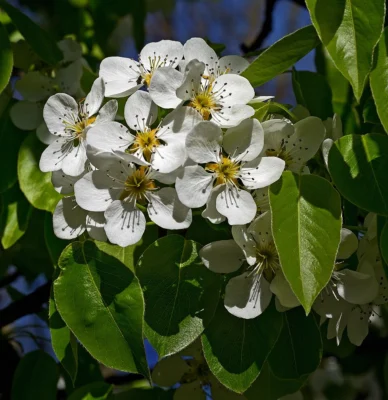
White flowers open in spring above oval green leaves. Pears may be green, golden, russeted or flushed, and shape varies considerably. Keep the cultivar label: neither a leaf nor an attractive fruit photograph reliably identifies your tree.
Photo: Forest and Kim Starr, CC BY 3.0 us. Resized and optimised; cropped for display. Forest & Kim Starr
Choose an earlier ripening cultivar for a cooler or exposed district, even if the boundary receives sunshine. A sheltered position improves the opportunity to crop, but cannot remove the effect of a spring frost on open flowers.
Cover reachable blossom temporarily when frost threatens and uncover it for daytime insect visits. After natural early summer fruit drop, reduce crowded clusters to one pear on a trained tree, keeping a sensible gap between retained clusters.
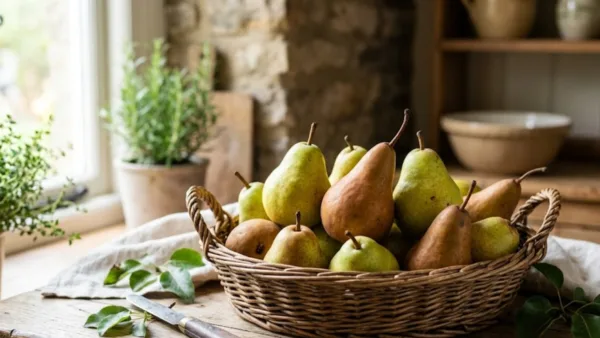
Test the first pears near the cultivar's expected harvest date. Mature fruit should release with a gentle lift and twist while still firm. Store sound pears carefully, bring small batches inside to finish ripening and check often for softening beside the stalk.
Image from the BFFD media library.
Check whether summer pruning was missed, but also review blossom frost and pollination. A heavily fed or repeatedly winter clipped tree may produce plenty of shoots without solving the underlying reason for a poor crop.
Strong growth near the top can leave an uneven cordon. Resume appropriate annual training and seek advice before drastic renovation. Avoid assuming that repeatedly cutting only the lower branches will restore balanced growth.
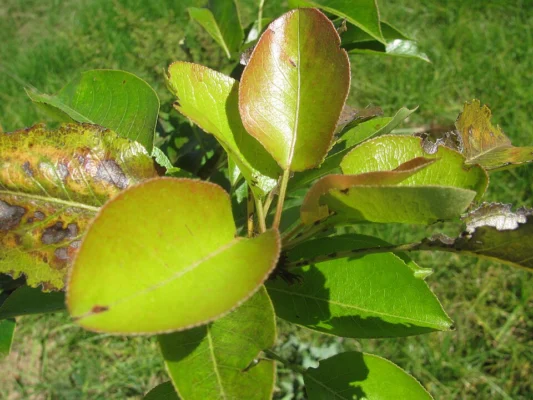
Pear rust can cause conspicuous orange patches. Do not strip the tree of its leaves. Monitor the effect on growth and seek a diagnosis if uncertain; nearby junipers can play a part in the disease cycle.
Pear scab affects leaves and fruit. Clear affected fallen material and assess damaged twigs. Slight skin marking is different from a deep split; cracked or rotting fruit should not go into long term storage.
Some early drop is normal, but a dry root zone can worsen losses. Check beneath the mulch and beside the wall. Reduce an excessive remaining crop and restore consistent watering without leaving the soil waterlogged.
Buy a grafted tree to obtain the named fruit on a predictable rootstock. A pip from a favourite pear does not reliably recreate that cultivar and is not a shortcut to a manageable cordon.
Grafting your own tree is a separate skilled project. Pear and quince compatibility varies, and some combinations need an intermediate graft. Nursery advice is worthwhile before investing several years in training an uncertain combination.
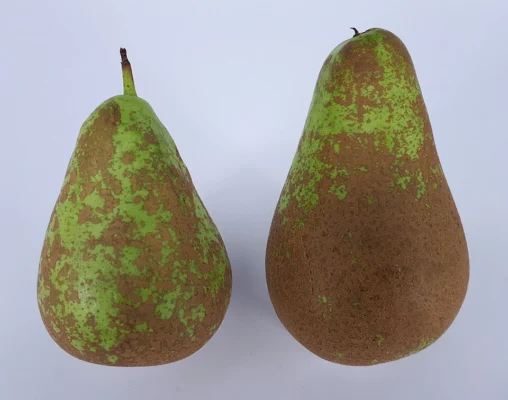
Conference
Familiar elongated pears with a sweet flavour make Conference a useful cultivar to compare. Its ability to set some fruit alone is helpful, but a suitable flowering partner is still sensible. The photograph shows labelled Conference fruit, not a cordon framework.
Photo: Fructibus, CC0. Resized and optimised; cropped for display.
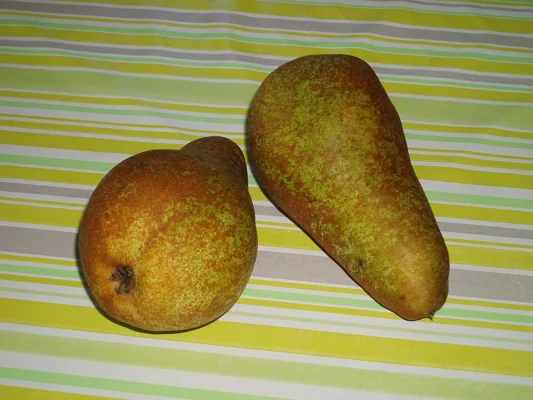
Concorde
Compare Concorde where you want a dessert pear with a relatively compact habit. Confirm the rootstock and suitability for your proposed training system. The pictured fruit is labelled Concorde; its appearance does not establish the size of the original tree.
Photo: Queeste, CC BY-SA 4.0. Resized and optimised; cropped for display. Adapted image under the same licence.
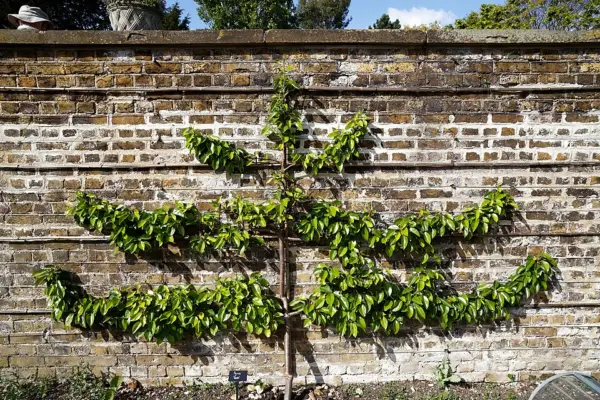
Beth
An earlier dessert pear worth discussing for a smaller or cooler garden. The photograph shows a labelled Beth trained as an espalier, demonstrating a different restricted form. Order a cordon tree if a single narrow stem is your intended design.
Photo: Acabashi, CC BY-SA 4.0. Resized and optimised; cropped for display. Adapted image under the same licence.
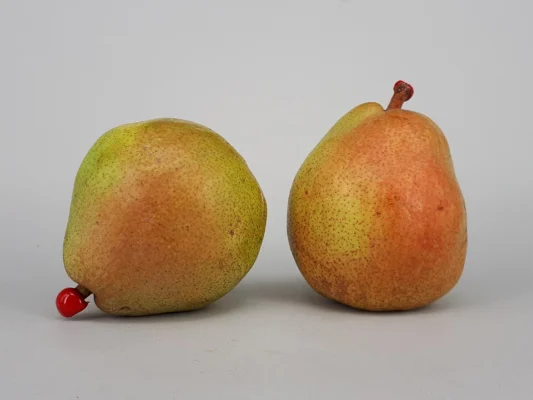
Doyenné du Comice
Comice offers rich eating quality when properly ripened, but deserves a warm position and careful consideration of local performance. The illustrated pears show the cultivar's fruit; check the nursery's advice on cropping and scab before selecting it for your row.
Photo: Fructibus, CC0. Resized and optimised; cropped for display.
Ask a local fruit nursery to match cultivars, rootstocks and pollination partners to your space. Take the boundary measurements when discussing your choices.
Pear blossom gives visiting insects a spring food source, while their movement between compatible trees assists fruit set. Keep flowers accessible in suitable weather and avoid unnecessary insecticide use, particularly during flowering.
A cordon makes ripening fruit easy to inspect and protect selectively. If you use netting, secure it firmly and check it frequently. Leave room for birds and beneficial insects elsewhere in the garden rather than enclosing the whole boundary unnecessarily.
Usually around 60 to 90cm, with permanent supports. Confirm the distance for your nursery tree and chosen training system, and allow working room in front of the row.
No. Its narrow form comes from training and pruning, supported by an appropriate rootstock. A young ordinary pear will not remain a neat column simply because it starts small.
Mainly in summer when new growth is becoming woody and slowing. Pears may be ready from late July. Use the correct cuts for the shoot's origin and the tree's stage of training.
They are the same cultivar, so they do not provide a different compatible pollen partner. Conference can set some fruit alone, but choose another suitable cultivar if reliable cross pollination is the aim.
Yes, if the position is sunny, sheltered and supported by sound posts and wires. Check soil moisture carefully because fences and nearby planting can leave the root area surprisingly dry.
European pears are generally picked mature but firm, then ripened indoors. Check the cultivar's normal picking period and test gently; leaving every pear until soft on the tree often disappoints.
A successful cordon row begins with the right trees and remains productive through small, well timed jobs. Keep the supports sound, the roots supplied with water and the short fruiting growth in balance, then enjoy several pear varieties from a modest boundary.
Want to get food independence, support your local grower, get better prices and shop more privately?
Local food isn’t just something you find. It’s something you protect. A free account helps keep local supply visible, supported, and resilient.

….it takes 30 seconds for food lovers and 5 minutes for suppliers
We built this for people who care where their food comes from. For people who want to remain food secure. For Farmers to get to the local people, who deserve a better income and to deliver a better price for you. For the environmentally conscious and the privacy-conscious. An account simply helps us make the map and supplier reach more useful to you, without changing how open it is. You’re always in control.


Find local food. Stay connected to it. Create a free account to support local producers and be part of a growing food network.


