An espalier apple brings a deliberate shape to the fruit garden: one upright trunk with paired horizontal branches arranged in tiers. Its narrow profile saves depth, but the arms still need considerable width. Success begins with the right rootstock and a strong framework, followed by patient training and selective summer pruning.
Trained horizontal tiers
Permanent support
Summer maintenance
Needs adequate width
Fruit garden feature
| Botanical name | Malus domestica |
| Family | Rosaceae |
| Plant type | Deciduous fruit tree |
| Growing form | Central trunk with horizontal tiers |
| Rootstock | M26 or MM106 for typical garden espaliers |
| Typical height | Commonly around 1.8 to 2m |
| Space required | Usually 3 to 4.5m wide |
| Plant spacing | Match the full width of the chosen framework |
| Sunlight | Sunny, sheltered position |
| Soil | Fertile soil with good drainage |
| Planting season | November to March while dormant |
| Blossom | Usually April or May |
| Harvest | August to October, by cultivar |
| Pollination | Compatible apple with overlapping blossom |
| Pruning | Summer maintenance; winter formation |
| Container suitability | Possible with specialist planning |
| First crops | Depends on age and training stage |
| Propagation | Grafting or budding named varieties |
| Winter care | Check supports and protect exposed pots |
| Main watch points | Scab, canker, codling moth and drought |
| Plant name | Crop type | Spacing |
Sow indoors
Plant outdoors
Harvest
Polytunnel | |||||||||||
|---|---|---|---|---|---|---|---|---|---|---|---|---|---|---|
| Jan | Feb | Mar | Apr | May | Jun | Jul | Aug | Sep | Oct | Nov | Dec | |||
| Apple (Espalier) | Orchard fruit | Single 4.50m, In row 4.50m, Row gap 2.00m; MM106 espalier example, allow access and adjust framework | Plant outdoors | Plant outdoors | Plant outdoors | No activity recorded | No activity recorded | No activity recorded | No activity recorded | Harvest | Harvest | Harvest | Plant outdoors | Plant outdoors |
Sow indoors: no months recorded. Plant outdoors: January, February, March, November, December. Harvest: August, September, October. Polytunnel: no months recorded.
Plant dormant grafted trees from November to March when soil conditions allow. The August to October harvest band spans cultivars, while structural winter training and summer pruning are separate jobs. No sowing or tunnel season applies to this outdoor trained tree.
Choose an espalier when you want a productive boundary with a visible structure. It makes sense beside a path where the branches can be reached from the front, rather than where the width is so tight that the arms must constantly be cut back.
This is a project built over several seasons. A partly trained tree saves time but still needs care and further training. Decide how many tiers you can realistically reach before buying the largest specimen available.
Photo: Vadakkan, CC BY-SA 4.0. Resized and optimised; cropped for display. Adapted image under the same licence.
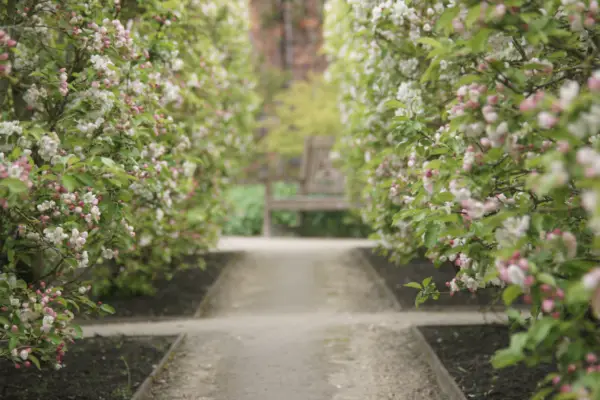
Reserve a sunny, sheltered wall, fence or sturdy freestanding wire system. The support must belong to the tree’s long term plan, so do not rely on a deteriorating fence panel.
Allow approximately 3 to 3.6m width for a modest M26 espalier in fertile ground, or 3.6 to 4.5m for a typical MM106 tree. More vigorous rootstocks suit larger frameworks, not smaller gaps.
Plan horizontal wires about 35 to 45cm apart, starting low enough to make useful first arms. Leave an air gap behind the branches and access in front for pruning, thinning and picking.
Soil beneath a wall can be dry and full of rubble. Check the planting position properly instead of judging it by the finished surface. Improving the wider root area is more useful than hiding the problem in a small rich planting pocket.
Photo: R J Higginson, CC BY-SA 3.0. Resized and optimised; cropped for display. Adapted image under the same licence.
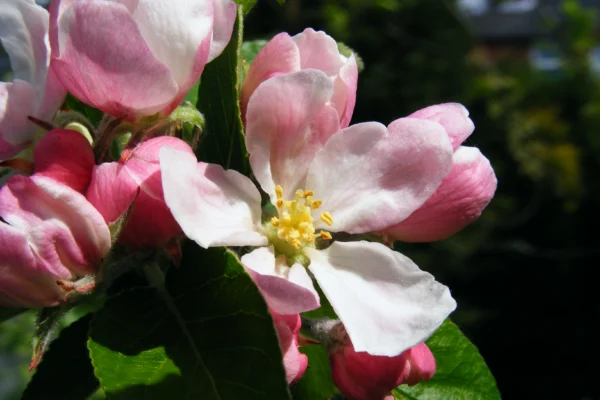
Start with a labelled spur bearing cultivar on a rootstock suited to the intended framework. A tree described as suitable for espalier training may be a young untrained tree, so check exactly what the nursery will supply.
1.
Draw the intended width, tier heights and clear working space before ordering the tree.
2.
Install a robust permanent support with horizontal wires at the planned levels.
3.
Prepare the root area and keep bare roots moist until planting.
4.
Plant at the original soil depth and keep the graft union well above the soil surface.
5.
Water thoroughly and settle the roots without burying the trunk more deeply.
6.
Secure existing trained arms with flexible ties, retaining their current shape.
7.
For a maiden tree, follow a staged formative plan to select a leader and a pair of side shoots.
8.
Label the cultivar and rootstock, mulch clear of the bark and record which tiers still need developing.

Watering
Check moisture along the root area, especially against walls. New trees and a developing crop need attention through dry weather even when the lawn beyond the wall looks green.
Water slowly enough for moisture to penetrate. If runoff escapes along paving, adjust where and how you apply it rather than simply using more water in the same place.

Feeding
Use mulch to support the soil and reduce competition. Review the strength of new growth before feeding; rapidly extending shoots already create more pruning work.
If growth is weak, examine water, drainage and the condition of ties before assuming a shortage of nutrients. Apply any chosen fruit feed at the stated rate over the root zone.

Pruning
Established espalier apples are maintained in late summer, commonly August once new shoot bases are woody. Shorten eligible new laterals from the framework to three leaves above the basal cluster, and longer growth from existing spurs to one. Retain useful short fruiting shoots.
Framework development is different: winter shortening of the central leader encourages the next tier. Train suitable young shoots gradually while flexible, preserving arm extensions until they fill their allotted space. Do not winter shorten every horizontal arm as though it were an ordinary bush branch.

Winter care
Review the bare structure and replace worn ties. Where an old spur system is overcrowded, thin it selectively during dormancy so future fruit has room.
Check wall fixings and posts after storms. Do not force a stiff mature branch down to repair a design error; gradual correction or a replacement young shoot may be the sounder option.
A true espalier has a vertical main stem with horizontal arms in distinct levels. A fan has radiating branches; a cordon usually concentrates growth along one main stem. These differences determine how you train new growth.
Flower buds form on short fruiting wood on suitable cultivars. Learn to recognise the framework, the new shoots and the spurs before cutting. A photograph taken before pruning is useful when reviewing the tree next year.
Photo: Andy / Andrew Fogg, CC BY 2.0. Resized and optimised; cropped for display.
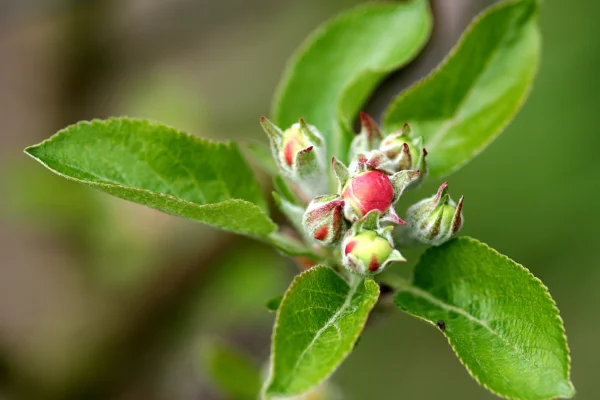
For a cooler garden, combine a favourable aspect with a cultivar proven locally. The warmest position cannot compensate for a chronically dry root zone or a tree planted in deep shade.
A wall can make temporary blossom protection easier to fit, but open flowers still need pollinating insects. Remove covers during suitable daytime weather and do not enclose the tree throughout flowering.
Keep notes for each tier as the tree develops. If upper arms grow faster than lower ones, adjust training and seek targeted advice rather than pushing ahead with another tier before the lower framework is established.
Photo: National Fruit Collection, Brogdale, Open Government Licence v2.0. Resized and optimised; cropped for display.
Growth has become unbalanced. Review training angles, light and pruning. Avoid adding more height until the existing arms are functioning well; retain useful lower growth rather than cutting all tiers identically.
Older wood becomes less flexible. Train young growth gradually and inspect attachment points. Do not force a rigid branch to fit the drawing; assess whether a healthy replacement shoot can be trained.
Check cultivar suitability, pollination and whether pruning removes too much potential fruiting wood. A decorative framework alone does not guarantee a crop.
Brown rot can follow wounds in the skin. Remove affected apples and old mummified fruit. Reduce crowding that lets damaged fruit stay pressed against healthy neighbours.
Canker may be responsible. Remove affected small growth into healthy wood. A lesion on a major arm or trunk requires careful assessment because rebuilding the framework takes time.
Espalier describes the shape trained after propagation. The named apple is normally grafted onto its chosen rootstock; sowing a pip does not reproduce that combination.
If learning grafting, practise on suitable young material and label every tree. Begin structural training only once the graft and tree are growing soundly. For a faster start, choose a healthy partly trained nursery tree.
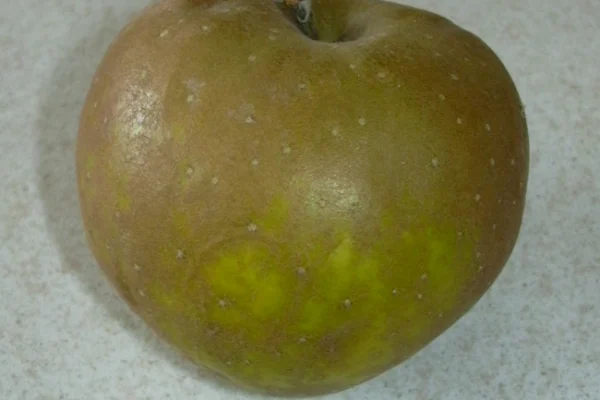
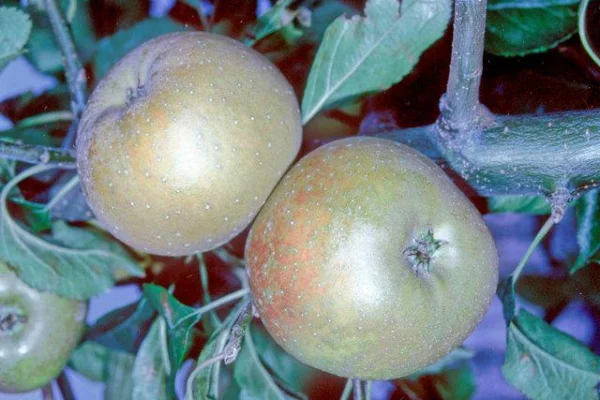
Malus domestica ‘Egremont Russet’
A russet dessert apple with a firm texture and nutty flavour. Its spur bearing habit suits trained forms. Flowering group 2; choose the rootstock separately from the fruit variety.
Photo: AJR, CC BY-SA 3.0. Resized and optimised; cropped for display. Adapted image under the same licence.
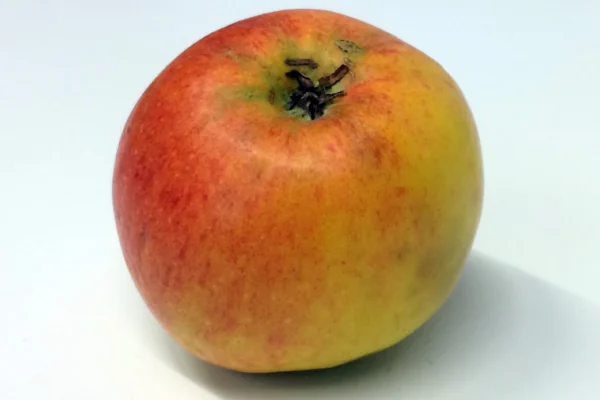
Malus domestica ‘James Grieve’
A juicy Scottish apple useful for cooking before full ripeness and eating later. Flowering group 3. Its spur bearing habit offers a useful option for either a supported trained tree or a conventional bush.
Photo: Aron Ambrosiani, CC BY-SA 4.0. Resized and optimised; cropped for display. Adapted image under the same licence.
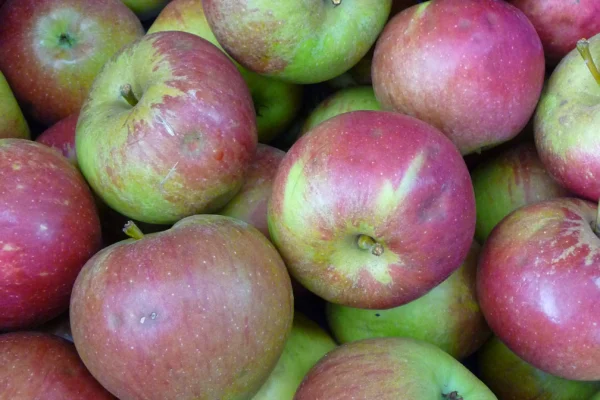
Malus domestica ‘Fiesta’
Also sold as Red Pippin, this Cox style apple gives an autumn crop with storage potential. A spur bearer in flowering group 3. A support framework helps organise its naturally rather untidy growth.
Photo: 4028mdk09, CC BY-SA 3.0. Resized and optimised; cropped for display. Adapted image under the same licence.
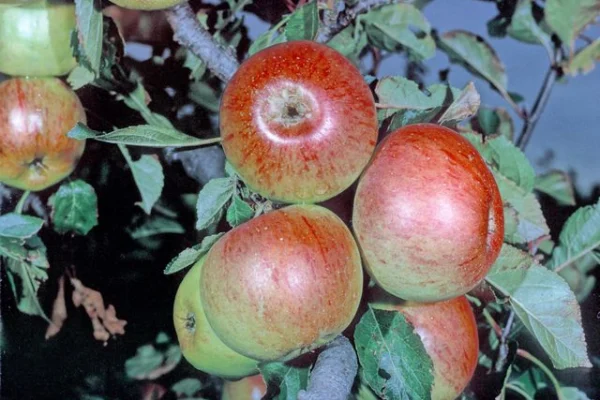
Malus domestica ‘Sunset’
A compact, aromatic dessert apple in flowering group 3. Its spur bearing habit is useful for small trained trees. Thin heavy crops thoughtfully because crowded fruit can remain small.
Photo: National Fruit Collection, Brogdale, Open Government Licence v2.0. Resized and optimised; cropped for display.
Explore the BFFD map for growers and producers near you. Check each listing and contact the business about seasonal apples or planting stock before travelling; availability and tree forms vary.
An espalier can provide accessible spring blossom in a small garden. Keep the area welcoming to pollinators by including flowers that bloom before and after the apple.
Inspect before spraying. A tidy framework makes monitoring practical, and the aim is a useful crop within a living garden rather than branches from which every insect has been excluded.
Published by Buy From Farmers Direct. Sources checked 4 October 2026. Growing references: RHS: Starting an espalier; RHS: Espalier pruning and training; RHS: How to grow apples; RHS: Fruit trees, feeding and mulching; RHS: Brown rot; RHS: Apple canker; RHS: Plant an apple tree for wildlife; Orange Pippin: Egremont Russet; Orange Pippin: James Grieve; Orange Pippin: Fiesta; Orange Pippin: Sunset. The seasonal timeline uses the shared BFFD Growers Calendar record; adjust timings to your variety and local conditions.
A typical garden espalier needs around 3 to 4.5m of width and roughly 1.8 to 2m of height. Rootstock, soil and planned tiers affect this. It saves depth rather than eliminating width.
The main maintenance prune is in late summer, usually August. Winter work is reserved for appropriate formative training, renovation or thinning congested spurs. These are different operations.
M26 can suit a smaller framework in fertile soil. MM106 is a common choice for a larger garden espalier. Ask the nursery to match the cultivar and rootstock to your exact width and tier plan.
A young suitably shaped tree may be trainable, but a mature bush has rigid branches and an established structure. Starting with a maiden or partly trained espalier is usually much more realistic.
Horizontal wires are commonly set about 35 to 45cm apart to support the tiers. Plan the lowest tier, total height and fixing strength before planting, with room for air and access behind the branches.
Most crop better with a compatible different apple flowering nearby. Training changes the shape, not the cultivar’s pollination requirements. Check the actual flowering groups before purchasing the trees.
Use the Growers Calendar to keep seasonal jobs in view, then explore the BFFD map to discover local food producers. A planting plan becomes more useful when it reflects your soil, available space and the apples you enjoy eating.
Explore more growing guides: Apple (Cordon), Apple (Dwarf), Apple (Large).
Want to get food independence, support your local grower, get better prices and shop more privately?
Local food isn’t just something you find. It’s something you protect. A free account helps keep local supply visible, supported, and resilient.

….it takes 30 seconds for food lovers and 5 minutes for suppliers
We built this for people who care where their food comes from. For people who want to remain food secure. For Farmers to get to the local people, who deserve a better income and to deliver a better price for you. For the environmentally conscious and the privacy-conscious. An account simply helps us make the map and supplier reach more useful to you, without changing how open it is. You’re always in control.


Find local food. Stay connected to it. Create a free account to support local producers and be part of a growing food network.


