Red onions bring colour to the chopping board and a versatile crop to a small vegetable patch. Choose seed for variety or sets for a simpler start. Match your planting season, protect early growth and let bulbs mature before storing.
Seed or sets
Sunny position
Colourful bulbs
Watch for bolting
Dry before storing
| Botanical name | Allium cepa, Cepa Group |
| Plant family | Amaryllidaceae |
| Crop | Mature red bulb onions |
| Colour | Purple red skins and coloured rings |
| Starting methods | Seed, sets or young plants |
| Main seed sowing | January to March under cover |
| Outdoor seed sowing | March to April in suitable soil |
| Spring set planting | March to April; follow supplier timing |
| Autumn planting | Only varieties labelled for overwintering |
| Seed depth | Approximately 1 to 1.5cm |
| Plant spacing | 10 to 15cm for individual bulbs |
| Row spacing | 25 to 30cm |
| Position | Full sun |
| Soil | Fertile and well drained |
| Set depth | Tip just visible above the soil |
| Main harvest | July to September; some seed crops later |
| Watering | During active growth in dry weather |
| Feeding | Avoid excess late nitrogen |
| Storage | Variety and curing determine keeping quality |
| Example cultivar | Red Baron |
| Plant name | Crop type | Spacing |
Sow indoors
Plant outdoors
Harvest
Polytunnel | |||||||||||
|---|---|---|---|---|---|---|---|---|---|---|---|---|---|---|
| Jan | Feb | Mar | Apr | May | Jun | Jul | Aug | Sep | Oct | Nov | Dec | |||
| Onion (Red) | Alliums | 10 to 15cm apart; rows 25 to 30cm | Sow indoors, Polytunnel | Sow indoors, Polytunnel | Sow indoors, Plant outdoors, Polytunnel | Sow indoors, Plant outdoors, Polytunnel | Plant outdoors | No activity recorded | Harvest | Harvest | Harvest | Harvest | No activity recorded | No activity recorded |
Sow indoors: January, February, March, April. Plant outdoors: March, April, May. Harvest: July, August, September, October. Polytunnel: January, February, March, April.
This is a spring planted crop. Sow under cover from January to March; direct sowing can follow in March or April. Transplants may go out into May. The polytunnel band is optional propagation. Autumn red onions need a separate variety specific schedule.
Red onions suit growers who use onions fresh and cooked. Red does not automatically mean mild or sweet. Choose a variety for flavour, season and keeping quality.
Start with a short row alongside a dependable storage onion. You can compare flavour and performance without committing the whole bed to one variety.
Photo: Adoscam, CC BY-SA 4.0. Resized and optimised; cropped for display. Adapted image under the same licence.
Choose a sunny position that remains open as neighbouring crops grow. Avoid broad courgette leaves or shaded hedges. Onion foliage needs light before bulbs swell.
Prepare soil with mature compost and remove perennial weeds. Onions have limited roots, so good soil structure and steady moisture are more useful than repeated strong feeds.
Space individuals 10 to 15cm apart, with 25 to 30cm between rows. Wider spacing helps larger bulbs and hand weeding. Keep variety labels visible.
Where soil is wet or unavailable, use a container around 45cm wide and deep with generous drainage and suitable peat free compost. Check moisture during dry, windy weather.
Image from the BFFD media library.
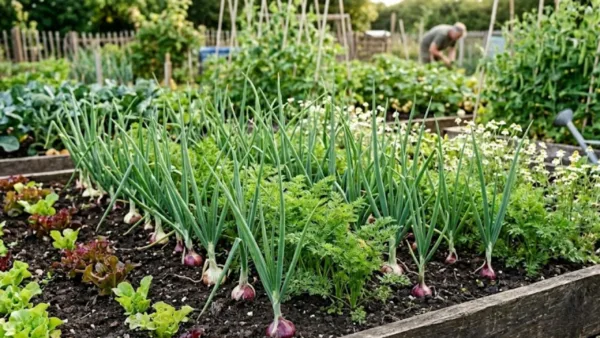
Match the variety to your chosen season before buying seed or sets. This sequence follows a spring crop; planting ordinary spring sets in autumn introduces a different level of cold exposure.
1.
Select firm sets without mould or soft patches, or buy fresh seed from a reputable supplier. Heat treated spring sets can reduce bolting risk. Keep the variety name and any planting instructions.
2.
Prepare the bed when soil is workable. Remove weeds and break up large surface clods without working wet ground. Make planting holes in firm soil rather than forcing bulbs down and damaging their bases.
3.
For seed, sow under cover from January to March with adequate light, or directly outside in March or April when soil warms. Cover approximately 1 to 1.5cm deep, following the packet.
4.
Keep seedlings evenly moist and well lit. Thin direct sowings progressively. If raising individual plants in modules, allow the roots to establish before moving them and harden them off gradually.
5.
Plant spring sets at the supplier's recommended time, usually March or April. Do not rush red sets into persistently cold, wet soil just because the calendar has reached the planting month.
6.
Space sets or individual transplants 10 to 15cm apart. Leave the pointed tip of each set just showing; keep transplants near their existing depth. Firm gently and water to settle the soil.
7.
Protect newly planted sets from birds with securely fitted temporary cover. Check underneath and replant any sound bulbs pulled loose. Remove unnecessary protection once roots hold the sets firmly.
8.
Label the row and keep weeds small. Watch for flower stalks as the plants develop. Mark any bolters for early kitchen use so they do not become mixed into the eventual storage crop.

Watering
Water during prolonged dry spells while leaves and bulbs develop. Aim at the soil and wet the root zone rather than repeatedly sprinkling the surface. Container crops need closer checks because their available moisture is limited.
As mature bulbs firm and foliage begins to fall, stop routine irrigation. Drying is part of preparing a keeping crop. Avoid letting a sprinkler intended for neighbouring vegetables repeatedly soak onions that are ready to ripen.

Feeding
Good soil preparation often supplies enough nutrition. If growth is weak, look first for drought, waterlogging, weeds or damaged roots. Extra feed cannot correct every cause of yellow leaves.
Avoid heavy nitrogen feeding late in the crop. It can keep foliage growing and leave thick necks that cure poorly. Follow product instructions if a genuine nutrient shortage needs correcting, especially in containers.

Pruning
Keep healthy foliage intact. Its colour and posture are useful signs of the crop's progress, but do not bend green tops over to hurry harvest. Allow natural yellowing and toppling.
Remove flower stalks promptly and use affected bulbs first. A cut flower stalk does not restore a bolted onion's storage potential. Hand weed close to swelling bulbs to avoid cuts and bruising.

Winter care
Spread harvested bulbs with space for airflow and move under cover in wet weather. Store only sound bulbs with properly dried necks and outer skins.
Keep stored onions cool, dry and ventilated, checking for soft spots and premature shoots. Autumn planted red varieties may be growing outdoors through winter, but that separate crop needs a well drained site and suitable cultivar.
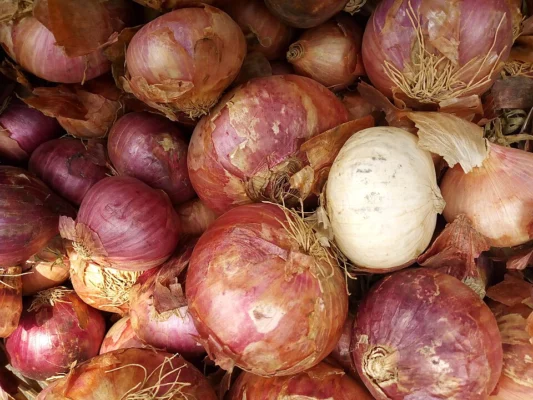
Red bulb onions have hollow, upright leaves and a swelling base that develops purple red outer skins. Cutting a mature bulb reveals layers with varying amounts of red pigmentation. Colour intensity and shape vary between cultivars.
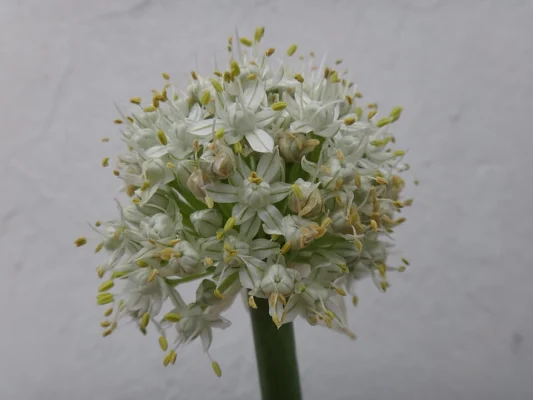
A flower stalk is thicker and firmer than the leaves and eventually carries a rounded flower head. This is bolting in a bulb crop. Do not confuse a developing flower bud with another healthy leaf or a sign that harvest quality is improving.
Photo: Sovlam, CC BY 4.0. Resized and optimised; cropped for display.
In exposed gardens, wait for suitable soil conditions. Bright, sheltered propagation can help seedlings establish. A heated room with poor light is not a substitute for good growing conditions.
Wet summers make harvesting and drying more demanding. Prepare a ventilated covered area before bulbs ripen. Lift carefully during a dry opportunity and avoid stacking damp onions in buckets or closed bags.
Record planting date, bolting and actual storage life for each variety. This helps distinguish a poor choice from a difficult season and makes future orders more purposeful.
Image from the BFFD media library.
Cold exposure and other stresses can trigger bolting, particularly in sets. Remove stalks and use the bulbs promptly. For the next crop, review timing and try suitable heat treated sets or seed raised plants.
Late planting, shading, weeds, drought and crowded spacing can all restrict growth. Check several causes before adding fertiliser. Small sound red onions are still usable; note which section of the bed performed best.
Allium leaf miner can cause rows of pale marks, distortion and internal feeding. Inspect stems for larvae or brown pupae. Appropriate insect mesh and moving crops away from previously affected ground can help reduce exposure.
Check the base for white fungal growth and tiny black resting bodies that suggest white rot. Isolate affected material and avoid moving contaminated soil. Ordinary short crop rotation does not remove this persistent disease.
Neck rot may become obvious only after storage begins. Remove deteriorating bulbs. Keep the next harvest unbruised, dry it thoroughly and reserve thick necked or damaged onions for prompt use instead of storing them.
Red onions can be raised from seed or grown from immature bulbs sold as sets. One set normally produces one larger bulb. Sets save propagation time; seed gives more choice and lets you raise precisely the number of plants you want.
For predictable bulbs, begin with identified planting stock rather than sprouting supermarket onions. Seed saving is a separate second year project requiring healthy plants and attention to cross pollination.
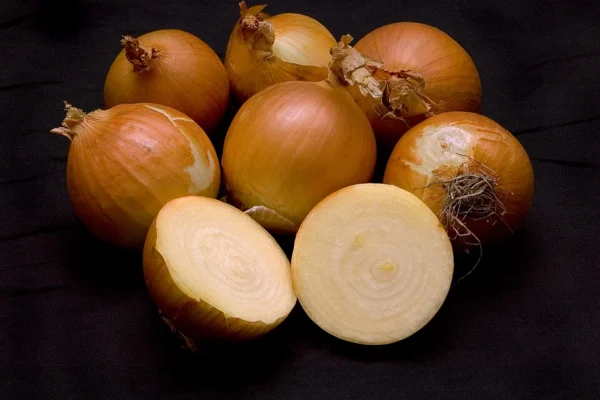
Golden onions for comparison
A separate golden storage variety makes a useful comparison beside red onions. This photograph shows yellow bulbs, not a red cultivar. Compare keeping quality and kitchen use rather than assuming colour predicts performance.
Photo: Andrew c at English Wikipedia, CC BY-SA 3.0. Resized and optimised; cropped for display. Andrew c
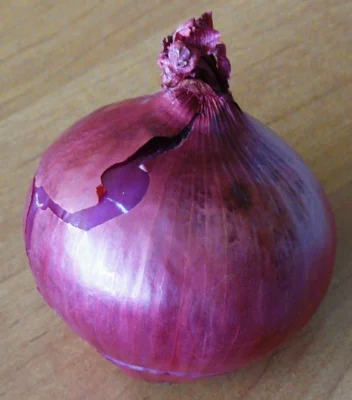
Red Baron
A recognisable red choice for a summer crop, with firm bulbs and a pronounced onion flavour. It can store well when properly matured and dried. The photograph is identified as Red Baron by its original photographer.
Photo: MOs810, CC BY-SA 4.0. Resized and optimised; cropped for display. Adapted image under the same licence.
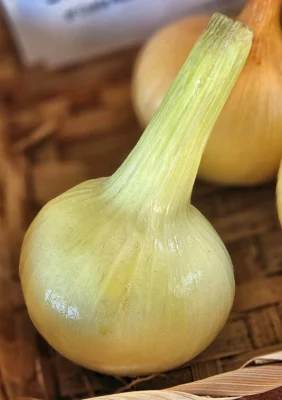
Choose a useful bulb size
Large exhibition onions represent a different goal from a regular kitchen supply. The pale onion pictured illustrates size only, not a red variety. Pick spacing and quantity that match what you actually cook.
Photo: Eric Polk, CC BY-SA 4.0. Resized and optimised; cropped for display. Adapted image under the same licence.
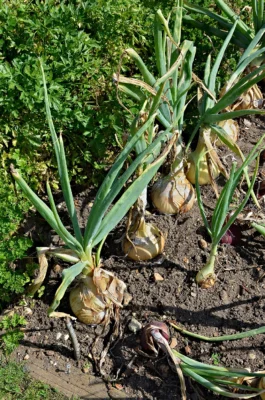
Choose the planting season
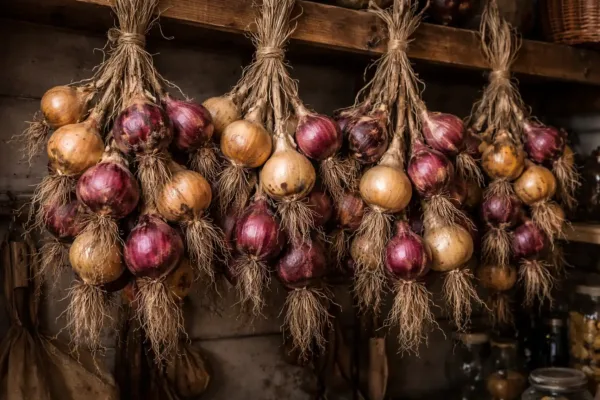
Buy a named overwintering variety if you want an autumn planting. Ordinary spring varieties are not interchangeable with it. The golden onions pictured illustrate maturity and are not identified as an autumn red cultivar.
Photo: JLPC, CC BY-SA 3.0. Resized and optimised; cropped for display. Photo: JLPC / Wikimedia Commons
Decide whether fresh use, cooking, storage or an earlier crop matters most. A labelled small planting helps you judge flavour and performance.
Onion flowers attract visiting insects, but a bulb crop is normally harvested before flowering. If you retain healthy plants for flowers, keep that purpose separate from your storage onions.
Secure bird protection and mesh without loose loops, and inspect beneath covers regularly. Avoid treating every leaf mark as a reason to spray. Identify the cause before choosing any response.
Spring varieties are usually planted in March or April, following supplier instructions and local soil conditions. Autumn planting is only for cultivars specifically sold for overwintering.
Cold exposure and other stresses can trigger flowering. Sets are more prone than seed raised plants. Review planting timing and consider heat treated spring sets. Use bolted bulbs early rather than storing them.
Yes. Sow under cover from January to March with sufficient light, or directly outside in suitable soil in March or April. Fresh seed and steady early growth give the crop a good start.
No. Flavour differs between varieties and crops. Some are distinctly pungent. Choose for the flavour description and intended use rather than assuming red skin always means a mild salad onion.
For storage, look for mature bulbs and foliage that yellows and falls naturally. Spring crops are commonly ready in summer or early autumn. Lift carefully and dry before storing.
Some red varieties keep well, but colour alone is not a storage guarantee. Variety, maturity, damage and curing all matter. Keep records and use unsound or thick necked bulbs promptly.
Choose a red onion that suits your season and cooking. Careful establishment and patient drying make a useful crop, even from a short row.
Want to get food independence, support your local grower, get better prices and shop more privately?
Local food isn’t just something you find. It’s something you protect. A free account helps keep local supply visible, supported, and resilient.

….it takes 30 seconds for food lovers and 5 minutes for suppliers
We built this for people who care where their food comes from. For people who want to remain food secure. For Farmers to get to the local people, who deserve a better income and to deliver a better price for you. For the environmentally conscious and the privacy-conscious. An account simply helps us make the map and supplier reach more useful to you, without changing how open it is. You’re always in control.


Find local food. Stay connected to it. Create a free account to support local producers and be part of a growing food network.


