Parsley supplies repeated small harvests from beds and pots. Slow germination needs patience, but established plants are straightforward to manage. This guide covers curly and flat leaf parsley for foliage; Hamburg parsley is selected for its enlarged edible root.
Curly or flat leaves
Biennial grown for foliage
Allow time for germination
Sun or partial shade
Pick outer stems
| Botanical name | Petroselinum crispum |
| Family | Apiaceae |
| Plant type | Biennial, usually grown as an annual leaf crop |
| Main leaf types | Flat leaf and curly leaf |
| Typical height | About 30 to 60cm, depending on variety |
| Position | Sun or partial shade |
| Soil | Fertile and moist, with good drainage |
| Indoor sowing | March to April for an early start |
| Outdoor sowing | Mid spring to late summer |
| Sowing depth | About 5 to 10mm; follow the packet |
| Germination | Allow roughly two to six weeks |
| Planting distance | 15 to 30cm, according to variety |
| Row spacing | About 20 to 30cm |
| Container size | At least 25cm wide and deep |
| Main harvest | Late spring or summer into autumn |
| Picking method | Cut a few outer stems near the base |
| Winter picking | Limited, depending on protection and weather |
| Second year | Flowering and seed production |
| Flowers | Small yellow green flowers in umbels |
| Renewal | Sow fresh plants regularly for tender leaves |
| Plant name | Crop type | Spacing |
Sow indoors
Plant outdoors
Harvest
Polytunnel | |||||||||||
|---|---|---|---|---|---|---|---|---|---|---|---|---|---|---|
| Jan | Feb | Mar | Apr | May | Jun | Jul | Aug | Sep | Oct | Nov | Dec | |||
| Parsley | Herbs | 15 to 30cm between plants and about 20 to 30cm between rows; follow the variety instructions | No activity recorded | No activity recorded | Sow indoors | Sow indoors, Plant outdoors | Sow indoors, Plant outdoors | Sow indoors, Plant outdoors, Harvest | Sow indoors, Harvest | Sow indoors, Harvest | Harvest | Harvest | No activity recorded | No activity recorded |
Sow indoors: March, April, May, June, July, August. Plant outdoors: April, May, June. Harvest: June, July, August, September, October. Polytunnel: no months recorded.
The calendar combines optional indoor sowing in March and April with outdoor sowing from April to August, adjusted for local conditions. April to June planting refers to early raised plants. June to October is the main harvest shown; established protected plants may crop outside it. No polytunnel is required.
Parsley fits beds, edges and patio pots. Grow several plants for regular cooking, allowing each to recover between pickings.
Seed takes patience and seedlings need protection from drying and grazing. Garden raised young plants give a quicker start if you want leaves sooner.
Photo: Forest and Kim Starr, CC BY 3.0 us. Resized and optimised; cropped for display. Forest & Kim Starr
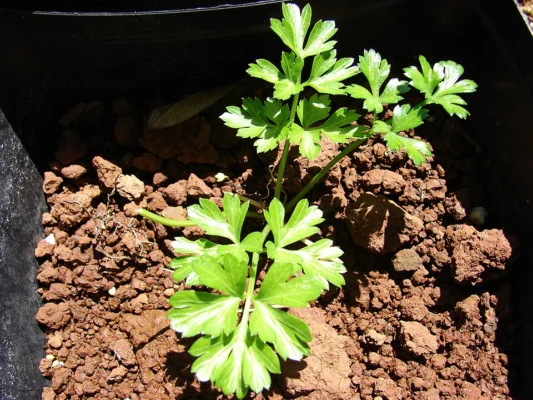
Choose sun or partial shade. A cooler summer position helps prevent containers drying rapidly, provided plants receive good light.
Prepare soil with well rotted garden compost and remove weeds. A fine, level surface makes shallow sowing and gentle watering easier.
Use fresh peat free compost in pots at least 25cm across and deep. Keep drainage holes open and leave space below the rim for watering.
Keep outer stems within easy reach. A bright windowsill supports small indoor harvests, but avoid trapping plants against hot glass.
Photo: H. Zell, CC BY-SA 3.0. Resized and optimised; cropped for display. Adapted image under the same licence.
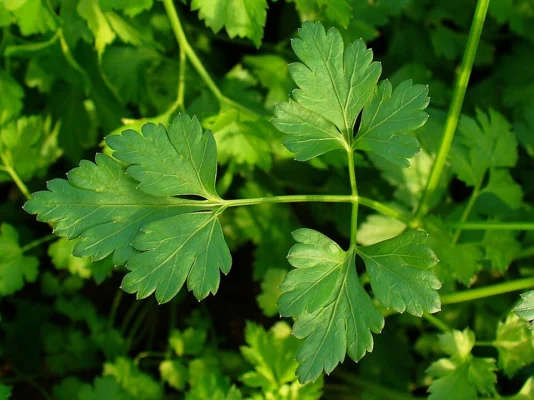
Use fresh seed and label the date. An empty tray after a fortnight may still germinate, so maintain moisture and wait.
1.
Choose flat or curly parsley to suit your cooking and available space. Check the packet for final size and its recommended sowing season.
2.
For an early start, fill modules or small pots with seed compost in March or April. Direct outdoor sowing can begin once spring conditions are suitable.
3.
Sow sparingly, around 5 to 10mm deep according to the packet. Cover lightly and water gently so the seeds remain in position.
4.
Keep the compost moist while germination proceeds. Provide suitable warmth for indoor sowings and avoid repeatedly disturbing the surface to look for roots.
5.
Give emerging seedlings good light. Thin overcrowded sowings carefully, keeping healthy plants and allowing room for further growth.
6.
Acclimatise indoor raised plants before planting outside. Move young plants with their root balls intact rather than pulling apart established roots.
7.
Plant about 15 to 30cm apart, allowing roughly 20 to 30cm between rows, adjusted to the cultivar. Keep the previous compost level and water in.
8.
Protect young growth from slugs and keep the area weed free. Begin light picking only once plants have enough foliage to keep growing afterwards.

Watering
Maintain even root moisture through active growth. Check pots regularly and water thoroughly when needed, allowing excess water to drain rather than leaving roots standing in it.
Dry conditions can restrict leaf production. A container that wilts despite wet compost needs a drainage and root check, while a dry pot needs a thorough watering.

Feeding
Parsley in fertile soil usually needs little extra feed. Fertiliser will not resolve slow germination or natural second year flowering.
Feed container plants every few weeks once compost nutrients are used. Apply balanced liquid fertiliser according to instructions, only during active growth.

Pruning
Cut a few mature outer stems near the base, leaving the central young leaves to develop. Taking whole stems is more useful than repeatedly stripping leaflets from their tips.
Remove yellowing or damaged foliage. Flower stems can be cut out to prolong leaf picking briefly, but this does not turn a biennial plant into a permanent leafy perennial.

Winter care
Outdoor growth slows and foliage may suffer in cold weather. A cloche, cold frame or bright sheltered position can extend picking, particularly from a later sowing, without guaranteeing a continuous winter supply.
Keep overwintered pots draining freely and water modestly when needed. Raise replacement plants for the following season, because surviving plants normally move towards flowering and seed production.
Flat parsley has divided green leaves with toothed edges; curly selections have more tightly crinkled foliage. In the second year, taller stems carry branching clusters of small yellow green flowers.
Use labelled garden plants or seed. The carrot family contains poisonous lookalikes, so this description is not sufficient for identifying wild edible plants. Root parsley belongs to the same species but is selected and managed for a different harvest.
Photo: Wikiseelie Y, CC BY 4.0. Resized and optimised; cropped for display.
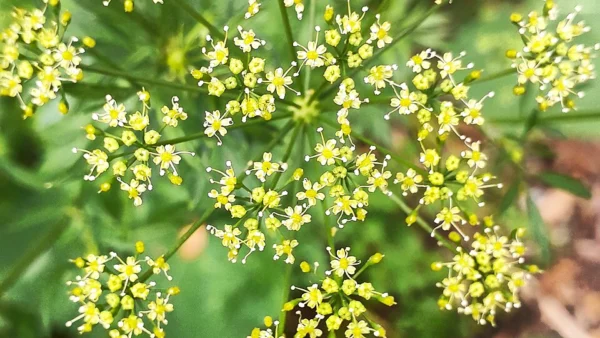
Indoor spring sowing gives a head start; later outdoor sowings replace ageing plants. In colder areas, wait for suitable soil conditions rather than following dates rigidly.
Leaf quality depends on moisture, age and picking intensity. Rotate between plants, wash harvested leaves and use fresh, or freeze surplus.
Buy seed or garden raised plants for outdoor growing. Crowded supermarket herb pots are designed for short term indoor picking.
Image from the BFFD media library.
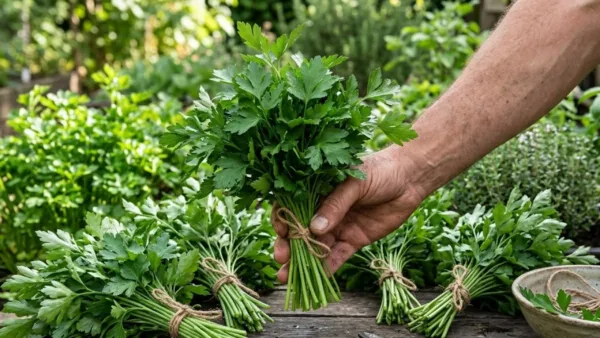
Parsley can take several weeks to germinate. Check seed age, temperature and moisture before resowing. Keep the surface from drying out, but avoid soaking compost that is already wet.
This is expected as parsley enters its second year, and leaf quality usually declines. Harvest what remains useful and replace the crop. Cutting flowers delays the change only temporarily.
Slugs and snails can quickly damage small plants. Inspect around pots and at dusk, remove hiding places immediately beside seedlings and protect vulnerable young growth while it establishes.
Celery leaf mining fly larvae make blotches inside parsley leaves. Tolerate light damage or remove affected portions. Fine insect mesh can prevent egg laying, combined with crop rotation so pests are not enclosed beneath it.
Check roots as well as leaves. Carrot fly can damage parsley roots, leaving tunnels and rusty scars. Protect future crops with complete insect mesh on a fresh site; yellow leaves alone do not prove this pest is present.
Sow a fresh batch rather than relying indefinitely on an ageing plant. Parsley is normally propagated from seed, with modules useful for moving young plants into their final position while limiting root disturbance.
To save seed, keep several healthy plants through flowering in their second year. Collect heads as seeds turn brown and dry them fully before storage. Different parsley varieties can cross, so maintain isolation if keeping a named variety true.
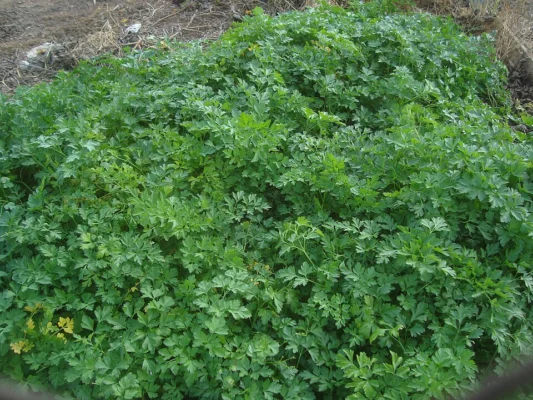
Italian Giant
A flat leaf parsley with large dark green leaves and a strong flavour. Allow enough room for its growth and cut a few outer stems at a time for the kitchen.
Illustrative mature flat leaf parsley; cultivar not verified.
Photo: Juan Emilio Prades Bel, CC BY-SA 4.0. Resized and optimised; cropped for display. Adapted image under the same licence.
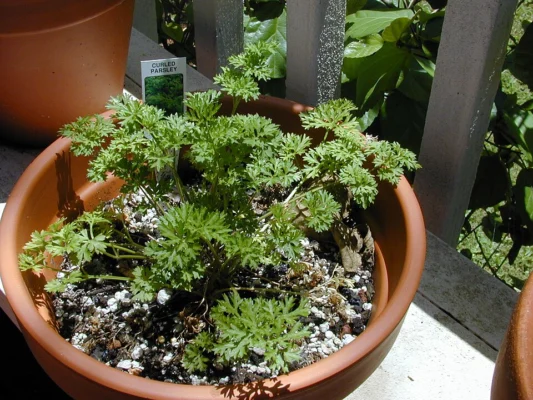
Moss Curled
A curly selection with finely divided, tightly crinkled foliage. Useful in pots or as an edging, with the same need for steady moisture and replacement as other leaf parsley.
Illustrative curly parsley in a pot; cultivar not verified.
Photo: Forest and Kim Starr, CC BY 3.0 us. Resized and optimised; cropped for display. Forest & Kim Starr
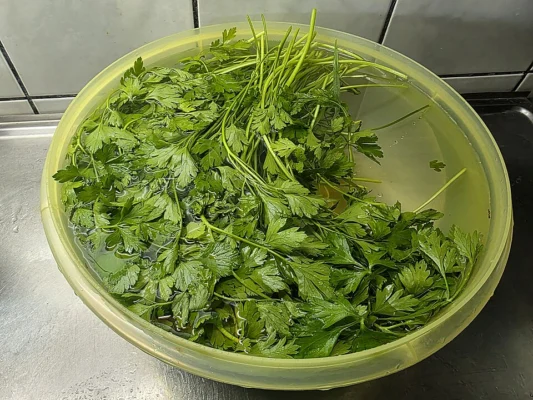
Titan
A relatively compact flat leaf selection with dark foliage and a pronounced parsley flavour. Its smaller habit can help where space is limited, but roots still need a suitable container.
Illustrative harvested flat leaf parsley; not verified as Titan.
Photo: Horacio Cambeiro, CC BY 3.0. Resized and optimised; cropped for display.
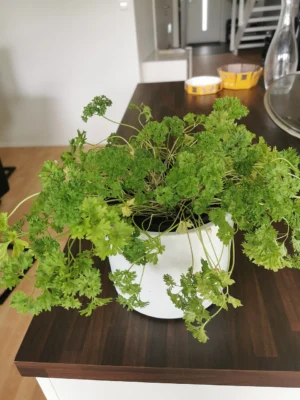
Envy
Produces dark green curled leaves and is suitable for container growing. Compare its size and texture with flat leaf types, and continue picking gently from several plants.
Illustrative potted curly parsley; not verified as Envy.
Photo: Netha Hussain, CC BY-SA 4.0. Resized and optimised; cropped for display. Adapted image under the same licence.
Compare leaf texture, flavour and mature size. Fresh seed offers an economical start; healthy garden raised plants shorten the wait for a first harvest.
Leaving some second year plants to flower provides small accessible blooms for visiting insects. Keep these seed plants separate from the younger batch grown mainly for tender leaves.
Leaf miners have natural enemies, including parasitoid wasps. Vigorous plants can tolerate some damage without intervention.
Published by Buy From Farmers Direct. Growing guidance reviewed 6 October 2026. The seasonal timeline uses the shared BFFD Growers Calendar record; adjust timings to your variety and local conditions.
Several weeks is normal, especially in cool conditions. Use fresh seed, maintain moisture and allow time before deciding the sowing has failed.
It is biennial. Plants may survive winter, but usually flower and set seed in their second year. Sow replacements for reliable leafy growth.
Partial shade suits it, especially where summer sun dries pots quickly. Deep shade is less suitable for strong leaf production.
Cut a few outer stems near the base and leave the young central growth. Avoid stripping a small plant bare.
Protection can extend picking from established plants, but growth depends on light and temperature. Keep some surplus frozen rather than assuming a constant winter crop.
Both belong to Petroselinum crispum, but Hamburg root parsley is selected for an enlarged root. This guide covers varieties grown primarily for leaves.
Allow time for germination, keep roots evenly moist and pick little and often. Raise replacements as older plants begin flowering.
Want to get food independence, support your local grower, get better prices and shop more privately?
Local food isn’t just something you find. It’s something you protect. A free account helps keep local supply visible, supported, and resilient.

….it takes 30 seconds for food lovers and 5 minutes for suppliers
We built this for people who care where their food comes from. For people who want to remain food secure. For Farmers to get to the local people, who deserve a better income and to deliver a better price for you. For the environmentally conscious and the privacy-conscious. An account simply helps us make the map and supplier reach more useful to you, without changing how open it is. You’re always in control.


Find local food. Stay connected to it. Create a free account to support local producers and be part of a growing food network.


