Summer savory is a small annual herb with narrow, aromatic leaves and a warm, peppery flavour. It is useful with beans, lentils, soups and cooked vegetables, and fits easily into a sunny herb bed or pot. Start a few plants in spring, pick lightly through summer and dry some sprigs before the season ends.
Peppery culinary herb
Annual plant
Sun and good drainage
Suitable for pots
Leaves fresh or dried
| Botanical name | Satureja hortensis |
| Family | Lamiaceae, the mint family |
| Growing cycle | Annual; normally sown again each year |
| Main harvest | Aromatic leaves and tender shoot tips |
| Flavour | Warm and peppery, generally gentler than winter savory |
| Typical size | About 25–30cm tall and wide |
| Position | Full sun |
| Soil | Moderately fertile and well drained |
| Protected sowing | March and April |
| Outdoor sowing | May and June once conditions are warm enough |
| Sowing depth | Surface sow or cover very lightly, following the packet |
| Germination | Often two to three weeks in suitable warmth |
| Germination temperature | Around 18–20°C is useful for protected sowing |
| Plant spacing | About 20–30cm |
| Row spacing | About 30cm |
| Minimum pot size | At least 20cm wide and deep for a small planting |
| Planting out | May and June after acclimatisation and local frost risk |
| Leaf harvest | Usually June to September, depending on the start |
| Flowers | Small pale pink, mauve or white flowers in summer |
| Winter approach | Dry leaves or retain seed; do not expect an evergreen annual plant |
| Plant name | Crop type | Spacing |
Sow indoors
Plant outdoors
Harvest
Polytunnel | |||||||||||
|---|---|---|---|---|---|---|---|---|---|---|---|---|---|---|
| Jan | Feb | Mar | Apr | May | Jun | Jul | Aug | Sep | Oct | Nov | Dec | |||
| Summer Savory | Herbs | Single 20–30cm, In row 20–30cm, Row gap 30cm | No activity recorded | No activity recorded | Sow indoors, Polytunnel | Sow indoors, Polytunnel | Sow indoors, Plant outdoors, Polytunnel | Sow indoors, Plant outdoors, Harvest | Harvest | Harvest | Harvest | No activity recorded | No activity recorded | No activity recorded |
Sow indoors: March, April, May, June. Plant outdoors: May, June. Harvest: June, July, August, September. Polytunnel: March, April, May.
March and April sowing is under cover; May and June also allow outdoor sowing in suitable conditions. Plant protected seedlings out in May or June after hardening off and once local frost risk has passed. June to September harvesting is a guide: later sowings start later, and early autumn weather can end picking. The protected band covers spring propagation only. Winter and creeping savory are different perennial species and do not follow this annual calendar.
Grow summer savory if you want a less familiar kitchen herb without dedicating a permanent corner to a large shrub. A few healthy plants usually provide plenty of small sprigs, so it makes sense to begin modestly and learn how you like its flavour.
It suits a sunny patio as well as open ground. In a damp garden, a draining container is often easier to manage than a low patch where rainwater sits around the roots.
Photo: Schlaghecken Josef, CC BY-SA 4.0. Resized and optimised; cropped for display. Adapted image under the same licence.
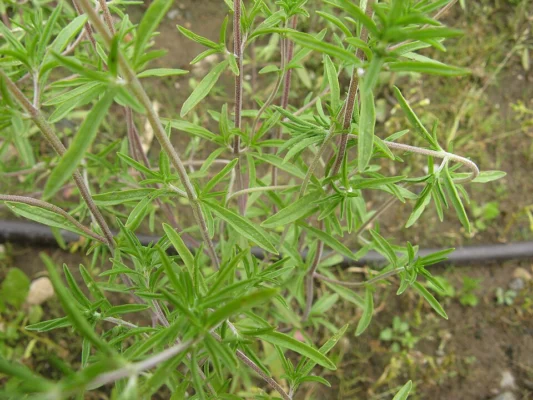
Choose a sunny, open position and keep taller neighbouring plants from shading the seedlings. Good light helps produce compact growth that is easier to harvest.
Use a bed with reasonably crumbly, freely draining soil. There is no need to make a rich vegetable trench for this herb; very heavy, constantly wet ground is the more important problem to avoid.
A pot at least 20cm across and deep can hold a small planting. Use peat-free compost with good drainage, and keep its drainage holes open rather than leaving the pot standing in water.
Place culinary herbs where you will actually pick them. A nearby tap helps during establishment, while an accessible path makes it easier to take just a sprig or two for cooking.
Photo: Schlaghecken Josef, CC BY-SA 4.0. Resized and optimised; cropped for display. Adapted image under the same licence.
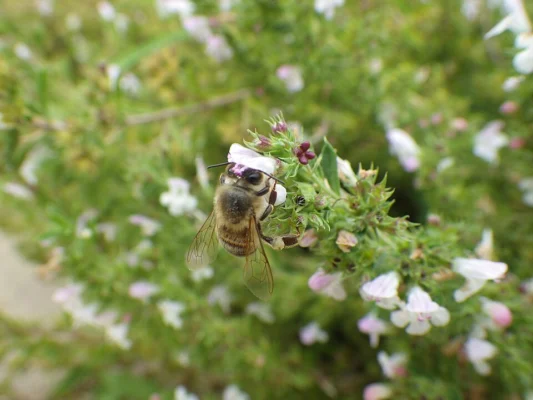
The seeds are small, so use a fine surface and sow sparingly. A spring module sowing gives you manageable young plants before they face the variable weather outdoors.
1.
Check that the packet says Satureja hortensis or summer savory. Winter savory has a similar name but a different lifespan and growth habit.
2.
For a protected start in March or April, fill clean small pots or modules with moist peat-free seed compost and gently level the surface.
3.
Scatter the seed thinly. Press it into contact with the compost and leave it on the surface or add only the very light covering recommended by the supplier.
4.
Keep the sowing bright and gently warm, around 18–20°C. Maintain moisture carefully; a strong jet of water can move the small seeds into crowded patches.
5.
When shoots appear, give them plenty of light and ventilation. Remove a propagator lid or plastic covering progressively rather than leaving seedlings enclosed in stale, wet conditions.
6.
Once seedlings have several leaves, move them into individual small pots or thin the modules. Handle by a leaf where possible and protect the delicate roots.
7.
Harden the young plants off before planting outside in May or June, once your local frost risk has passed. Plant at their previous depth with roughly 20–30cm between plants.
8.
Alternatively, sow directly into a fine outdoor seedbed in May or June, then thin to the same spacing. Water new plants in and keep weeds from overwhelming their first growth.

Watering
Water young plants during dry spells while they establish. Later, check how dry the root zone has become before watering again; constant surface dampness is not the aim.
Potted plants need more attention in hot weather than those in a bed. Water thoroughly when needed, allow surplus to drain and avoid keeping the base permanently wet.

Feeding
Summer savory in reasonably prepared ground normally needs little extra feeding. Its requirements are modest compared with heavy-cropping vegetables.
Use fresh compost for an annual container planting. If growth becomes poor, check light, drainage and root space before adding feed; fertiliser will not correct a waterlogged pot.

Pruning
Begin light picking once the plant has enough growth to spare. Pinch or snip shoot tips above a leafy part of the stem, leaving plenty of green growth to recover.
For drying, choose healthy sprigs around the beginning of flowering and spread or hang small quantities in a dry, airy place out of strong sun. Store only when fully dry, in a labelled airtight container.

Winter care
Summer savory normally completes its life in autumn. Dry a useful supply while the leaves are sound rather than waiting until cold, wet weather has damaged the whole plant.
Save mature seed from selected healthy plants if wanted, then clear spent growth. A cold greenhouse does not turn this annual into winter savory; plan a new spring sowing for the next season.
Summer savory forms a small, branching plant with narrow leaves carried along slender stems. Its tiny flowers sit close to the shoots, usually in pale shades. Labels are more dependable than scent alone when distinguishing similar kitchen herbs.
Winter savory, Satureja montana, is a more persistent woody-based perennial, while creeping savory, Satureja spicigera, spreads low across the ground. Both are useful culinary relatives, but neither is simply a summer savory plant kept through winter.
Photo: Schlaghecken Josef, CC BY-SA 4.0. Resized and optimised; cropped for display. Adapted image under the same licence.
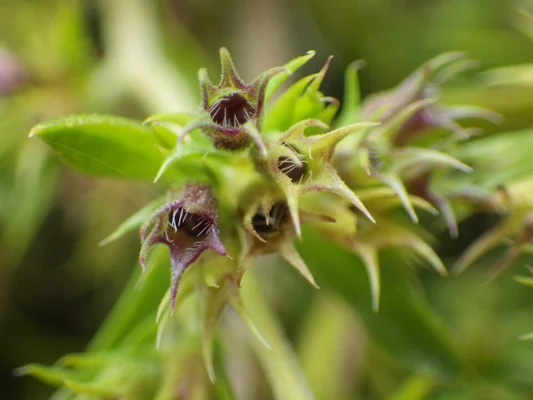
A protected spring start is useful in cooler UK gardens because very small seedlings are easier to tend in pots. If indoor space is limited, wait for settled warmth and sow outside instead of rushing a cold, wet bed.
Give the crop its best light in a northern or shaded garden. In an exposed position, shelter newly planted seedlings while they establish without enclosing them in a permanently humid space.
Harvest according to growth rather than a fixed date. An early protected batch may offer small pickings in June; a June sowing needs time to build a plant first. Drying extends kitchen use after the outdoor harvest ends.
Photo: Henna, CC BY-SA 1.0. Resized and optimised; cropped for display. Adapted image under the same licence.
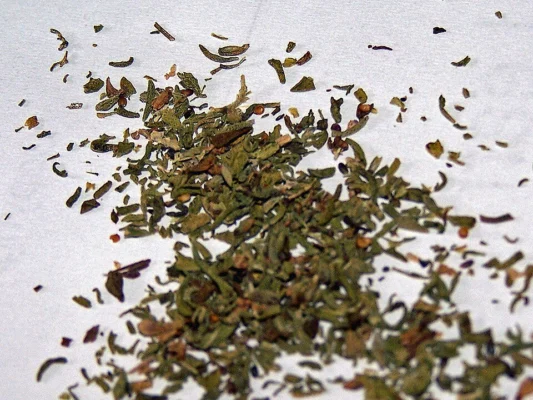
Deep covering, drying or unsuitable temperature can all reduce success with this small seed. Check the packet and allow a few weeks. Re-sow thinly into fresh, fine compost if the first attempt has failed.
Damping off can affect crowded seedlings in wet, poorly ventilated conditions. Use clean containers and fresh compost, improve airflow and avoid overwatering. Remove collapsed seedlings; they are unlikely to recover.
Check for insufficient light and crowded seedlings. Move pots to a brighter suitable position, give plants their proper spacing and pick gently once established to encourage branching.
Persistently saturated roots can struggle even when there is plenty of water. Check drainage holes and empty standing water. A badly rotted plant may need replacing; additional watering will not help.
An annual plant finishing its season is not necessarily diseased. Pick or dry sound leaves before decline becomes widespread, keep seed if required and sow a fresh crop next spring.
Seed is the practical way to renew summer savory each year. Small, labelled batches are easier to manage than sowing a whole large packet, particularly when you only need a few plants.
To keep your own seed, leave selected healthy plants to flower and let seed structures mature. Collect in dry conditions, finish drying under cover and label carefully. Allowing every plant to self-seed gives less control over where next year’s crop appears.
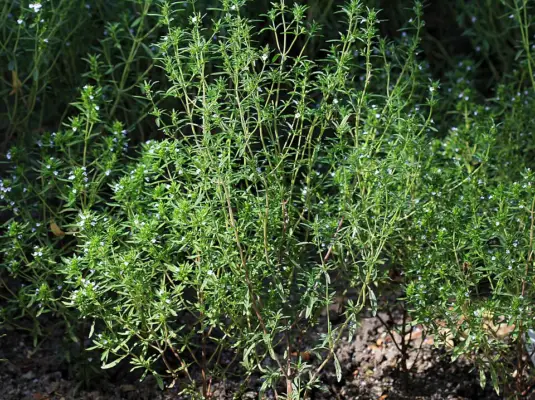
Common summer savory
The standard Satureja hortensis sold by many herb suppliers. This annual is the subject of the sowing and harvesting calendar above, providing a compact crop of peppery leaves during the warmer part of the year.
Summer savory, Satureja hortensis, growing in a garden.
Photo: Karelj, CC BY-SA 3.0. Resized and optimised; cropped for display. Adapted image under the same licence.
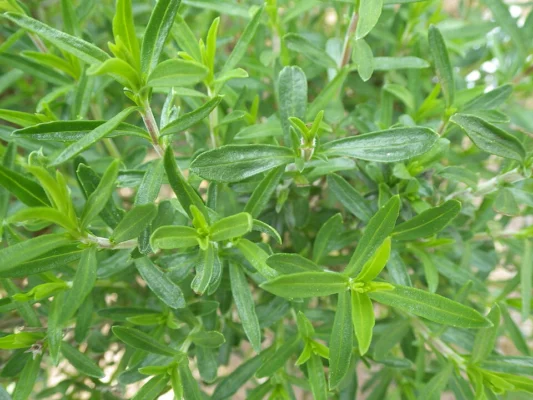
Summer savory Midget
A compact annual selection offered for containers and small herb gardens. Buy seed with the full name if that habit matters to you; a small generic plant is not proof that it belongs to this selection.
Illustrative summer savory plant; not confirmed as Midget.
Photo: Schlaghecken Josef, CC BY-SA 4.0. Resized and optimised; cropped for display. Adapted image under the same licence.
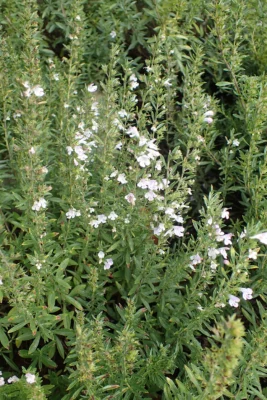
Winter savory — a different species
Satureja montana is a woody-based perennial with a more forceful peppery flavour. It can be useful for a longer-lived herb planting, but its winter survival and pruning should not be confused with the annual summer crop.
Winter savory, Satureja montana; shown as a separate perennial alternative.
Photo: Krzysztof Ziarnek, Kenraiz, CC BY-SA 4.0. Resized and optimised; cropped for display. Adapted image under the same licence.
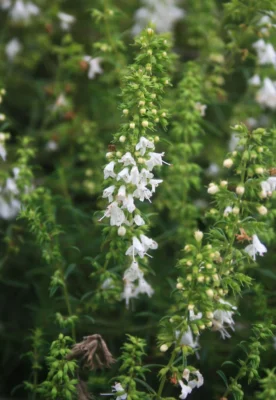
Creeping savory — a different species
Satureja spicigera is a low, spreading perennial suited to a sunny, well-drained edge or container. Its strongly flavoured foliage and mat-forming habit offer a different option from upright annual summer savory.
Creeping savory, Satureja spicigera; shown as a separate perennial alternative.
Photo: Franz Xaver, CC BY-SA 3.0. Resized and optimised; cropped for display. Adapted image under the same licence.
Choose Satureja hortensis when you want the annual summer crop described here. A labelled young plant can save propagation space, while a seed packet is economical if you want several plants or another sowing later.
Let some summer savory stems flower and insects can visit their small nectar-bearing blooms. If you want both flowers and leaves, leave part of the planting untrimmed while harvesting the remainder.
Flowering is not required before you can use the leaves. A few carefully chosen flowering plants can support seed saving and garden visitors without sacrificing every kitchen picking.
Published by Buy From Farmers Direct. Growing guidance reviewed 6 October 2026. The seasonal timeline uses the shared BFFD Growers Calendar record; adjust timings to your variety and local conditions.
It is an annual and normally dies after its growing season. New self-sown seedlings may appear, but they are a new generation. Sow again each spring for a planned crop.
No. Summer savory is Satureja hortensis, while winter savory is the perennial Satureja montana. They have related culinary uses but different lifespans and growing habits.
March or April under cover is a useful start. Outdoor sowing in May or June can work once conditions are warm enough. Follow the seed packet and adjust for local weather.
Yes. Choose a sunny position, a pot at least 20cm wide and deep, and well-draining peat-free compost. Check water more often than you would for an established plant in open ground.
Take small shoot tips once the plant is established, leaving enough leafy growth to recover. A larger cut for drying is best made while foliage is healthy, rather than stripping a weak young seedling.
Use the leaves fresh or dried as a peppery seasoning in bean and lentil dishes, soups, stuffings and cooked vegetables. Begin with a small amount and adjust to suit the food and your taste.
A sunny spot, good drainage and a light touch with small seedlings are the main requirements. Pick regularly while the annual plants are growing and dry a little of the crop to enjoy after summer.
Want to get food independence, support your local grower, get better prices and shop more privately?
Local food isn’t just something you find. It’s something you protect. A free account helps keep local supply visible, supported, and resilient.

….it takes 30 seconds for food lovers and 5 minutes for suppliers
We built this for people who care where their food comes from. For people who want to remain food secure. For Farmers to get to the local people, who deserve a better income and to deliver a better price for you. For the environmentally conscious and the privacy-conscious. An account simply helps us make the map and supplier reach more useful to you, without changing how open it is. You’re always in control.


Find local food. Stay connected to it. Create a free account to support local producers and be part of a growing food network.


