Celeriac develops a knobbly, rounded stem base with pale flesh and a celery flavour. It needs an early start and a long, steady growing season. Raise seedlings in warmth, plant into fertile soil and keep the roots supplied with moisture as the edible base swells.
Long season crop
Start indoors
Keep evenly moist
Autumn and winter harvest
Celery relative
| Botanical name | Apium graveolens var. rapaceum |
| Alternative group name | Apium graveolens Rapaceum Group |
| Family | Apiaceae |
| Crop harvested | Swollen stem base with attached roots |
| Life cycle | Biennial, usually harvested in its first season |
| Position | Full sun; light shade is possible |
| Soil | Fertile and moisture retentive |
| Drainage | Evenly damp, never permanently waterlogged |
| Main sowing month | March under warm protection |
| Seed treatment | Cover only lightly |
| Germination | Allow roughly three weeks or longer |
| Young plant temperature | Keep above 10°C |
| Planting window | Late May to early June after frost |
| Plant spacing | 30cm |
| Row spacing | 40 to 45cm |
| Planting depth | Crown at soil level |
| Main harvest | October to the following March |
| Earlier varieties | Some can be lifted from September |
| Winter option | Leave mature plants in suitable ground |
| Propagation | Seed or purchased young plants |
| Plant name | Crop type | Spacing |
Sow indoors
Plant outdoors
Harvest
Polytunnel | |||||||||||
|---|---|---|---|---|---|---|---|---|---|---|---|---|---|---|
| Jan | Feb | Mar | Apr | May | Jun | Jul | Aug | Sep | Oct | Nov | Dec | |||
| Celeriac | Root vegetables | Single 0.30m, In row 0.30m, Row gap 0.45m | Harvest | Harvest | Sow indoors, Harvest, Polytunnel | Polytunnel | Plant outdoors, Polytunnel | Plant outdoors | No activity recorded | No activity recorded | No activity recorded | Harvest | Harvest | Harvest |
Sow indoors: March. Plant outdoors: May, June. Harvest: January, February, March, October, November, December. Polytunnel: March, April, May.
The main plan is March sowing, planting in May or June and lifting from October through the following March. January to March harvests belong to the previous year’s planting. Some named varieties can crop from September. Polytunnel months indicate optional protected seedling care, not a requirement for a covered winter crop. An unheated tunnel must still meet the seedlings’ temperature needs.
Reserve space for most of the growing season. Celeriac will not fill a brief gap between summer crops. Decide how many individual plants your household will use before filling a seed tray.
A bed near a water supply makes care easier. On dry plots or where visits are infrequent, start with a few plants. Bought plugs can simplify the indoor stage.
Photo: Jamain, CC BY-SA 3.0. Resized and optimised; cropped for display. Adapted image under the same licence.
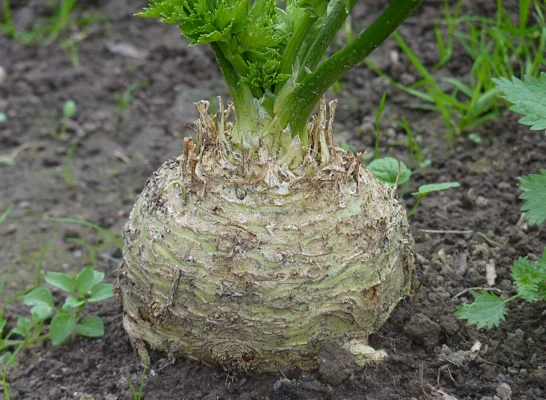
Choose fertile ground that holds moisture without staying saturated. Incorporate mature garden compost before planting. Avoid a site where water remains around the roots for days.
Keep the crop accessible for inspection and weeding. Mark row ends clearly. Avoid fitting extra plants into gaps simply because young transplants initially look far apart.
Rotate celeriac with celery and related root crops. Moving crop families between beds helps manage recurring soil problems. Record any leaf disease to inform the next season’s plan.
Pots are possible for a small trial but increase the watering burden. Give each plant generous root room, drainage holes and an accessible position. Tiny decorative pots are unsuitable.
Photo: Mrmatiko, CC BY-SA 3.0. Resized and optimised; cropped for display. Adapted image under the same licence.
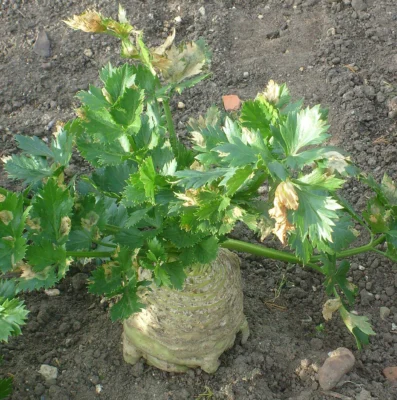
Prepare the seedling space before sowing. Celeriac germinates slowly enough that a labelled tray and a simple temperature check are worth the effort. Follow the chosen seed supplier’s germination instructions.
1.
Start a small, labelled sowing indoors in March, using clean modules or pots and peat free seed compost.
2.
Sow sparingly and cover only lightly so the tiny seed is not buried under a thick layer.
3.
Maintain warmth and gentle moisture; allow around three weeks before assuming the sowing has failed.
4.
Once seedlings can be handled, give each its own space and good light, keeping young plants above 10°C.
5.
Grow plants on without crowding, then acclimatise them gradually during suitable mild weather.
6.
After frost risk passes, usually late May or early June, prepare the final bed and water dry rootballs.
7.
Plant 30cm apart with rows 40 to 45cm apart, leaving the crown at soil level rather than buried.
8.
Water in thoroughly, label the row and check regularly while the plants establish.

Watering
Maintain steady moisture through summer. Check the soil beneath the leaf canopy, then water the root zone thoroughly when required. Repeated shallow splashes may wet the surface while leaving the active roots short of water.
Mulch moist soil to reduce evaporation and weeds, leaving the crown clear. Check beneath it in dry weather and arrange watering cover before holidays.

Feeding
Prepare fertility before planting with mature organic matter. If additional feeding is needed, choose a fertiliser suitable for vegetables and follow its label. More product cannot compensate for dry roots or an overcrowded planting.
Record feeding and growth observations. A small plant prompts a check of conditions, not an automatic deficiency diagnosis. Avoid adding several products at once.

Pruning
Celeriac does not need routine cutting back. As mature outer leaves fall outward to a horizontal position, remove them gradually; also remove side shoots and damaged foliage. Keep the healthy upright centre intact.
Wear gloves when handling foliage because sap and sunlight can irritate skin. Avoid tearing away healthy leaves in an attempt to speed up swelling.

Winter care
Established celeriac can usually remain outdoors for lifting as needed. On colder sites, straw around the plants helps keep soil workable. This winter hardiness applies to mature plants, not newly raised spring seedlings.
Lift in late autumn where heavy soil becomes waterlogged. Remove leaves and store sound roots in peat free compost or coir in a cool shed or garage. Inspect regularly.
Look for a swollen, rough surfaced base beneath a leafy crown, with a tangle of finer roots below. The harvested crop is commonly called a root vegetable, but the enlarged stem base is an important part of what you eat.
Celery and celeriac belong to the same species but have been selected for different crops. Ordinary celery is grown for leaf stalks; it is not a substitute seed choice for this guide. Keep plant labels because foliage alone is an unreliable cultivar identifier.
Photo: Jamain, CC BY-SA 3.0. Resized and optimised; cropped for display. Adapted image under the same licence.
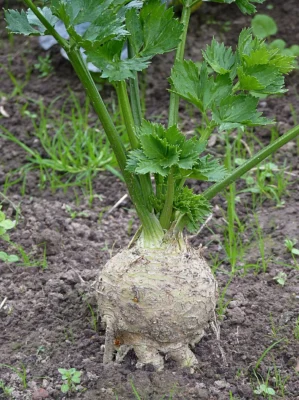
Check the named variety. Monarch and Prinz may crop from September; Ibis is described for October onwards. Plants will not necessarily reach the same size together.
Manage seedling temperature instead of rushing plants outdoors on a set date. Sheltered corners can still become cold at night. Record planting dates and subsequent cold spells.
Once the bases are a useful size, lift individual plants with a fork, loosening soil around them rather than pulling hard on the foliage. Choose what you need for the kitchen and leave suitable healthy plants to follow, where winter drainage allows.
Photo: Rasbak (Jan Bakker), CC BY-SA 3.0. Resized and optimised; cropped for display. Adapted image under the same licence.
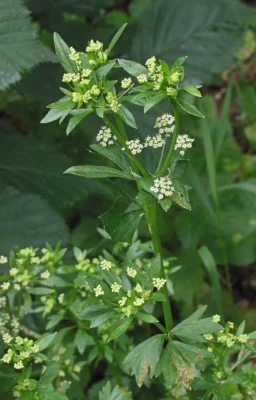
Review sowing date, spacing and moisture. A late start or repeated checks can restrict growth. Small sound celeriac remains useful; record likely causes to improve the next planting.
Cold during the young plant stage can trigger bolting before the stalk appears. Cutting it does not reset development. Protect the next batch from prolonged chilling and premature planting.
Celery leaf miner feeds within the leaf. Some damage can be tolerated. Insect proof mesh helps exclude the adult flies, but combine it with rotation so insects emerging from previously infested soil are not trapped inside.
Inspect for slugs and snails, especially after damp evenings. Check beneath nearby pots and covers. Identify the cause before resowing repeatedly, and protect replacement plants while they establish.
Celeriac can develop celery leaf spot. Remove affected leaves carefully and seek a clear diagnosis if damage spreads. Avoid treating every patch as the same problem; leaf mines, weather injury and disease need different responses.
Raise from seed or buy plugs. For a few plants, compare plugs with the space and temperature control needed for indoor care. Store unused seed according to its packet.
Saving seed takes a second season and a planned population, not just one forgotten root. Garden Organic explains that celery and celeriac depend on insect visits and need isolation for reliable seed saving. Keep this project separate from the ordinary first year food harvest.
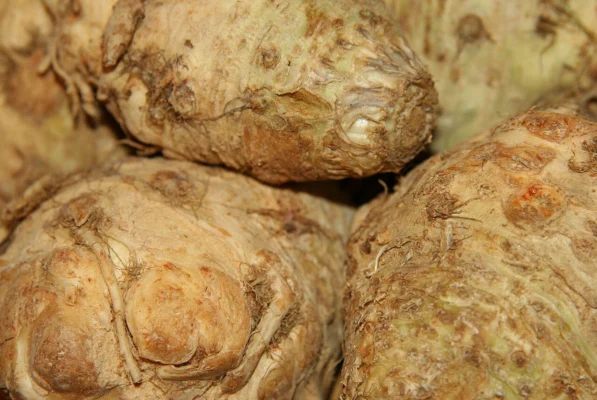
Monarch
Produces a relatively smooth, flatter rounded base with creamy flesh and a subtle nutty flavour. It stores well and can be harvested from September. A useful comparison for growers planning both fresh lifting and winter storage.
Illustrative celeriac photograph; the cultivar is not identified as Monarch.
Photo: Jonathunder, CC BY-SA 3.0. Resized and optimised; cropped for display. Adapted image under the same licence.
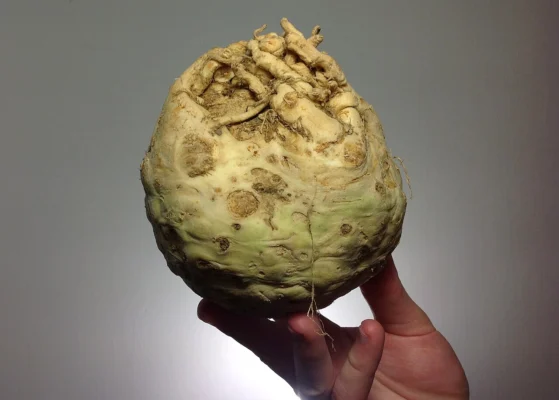
Prinz
A rounded, smooth selection with white flesh and a distinct celery flavour. RHS gives September onwards as its harvest period. Check local conditions and actual size before deciding which individual plants to lift.
Illustrative celeriac photograph; the cultivar is not identified as Prinz.
Photo: Radim Dudek, CC BY-SA 3.0. Resized and optimised; cropped for display. Adapted image under the same licence.
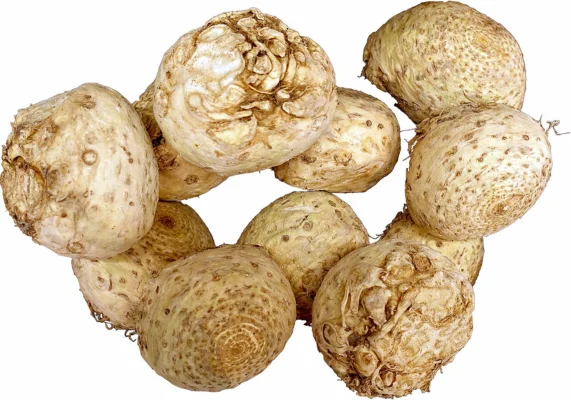
Brilliant
A smooth skinned choice with pale flesh, noted for storage quality. Consider it when you intend to lift part of the crop together. Sound handling and suitable storage conditions remain necessary whichever variety you choose.
Illustrative celeriac photograph; the cultivar is not identified as Brilliant.
Photo: Tiia Monto, CC BY-SA 3.0. Resized and optimised; cropped for display. Adapted image under the same licence.
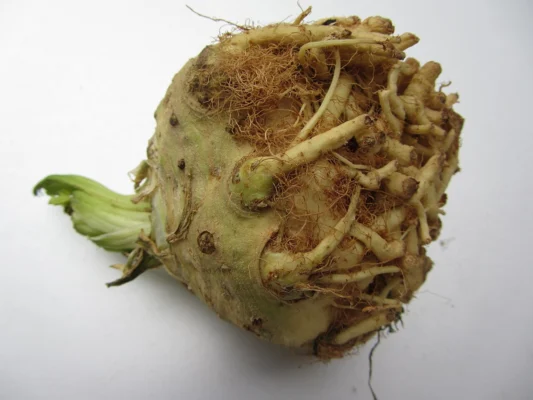
Ibis
A vigorous selection with smooth, rounded bases, useful standing ability and resistance to bolting. RHS lists harvesting from October onwards. Its resilience supports good cultivation; it does not remove the need to protect young plants from cold.
Illustrative celeriac photograph; the cultivar is not identified as Ibis.
Photo: L.Willms (Lüko Willms), CC BY-SA 3.0. Resized and optimised; cropped for display. Adapted image under the same licence.
Explore local growing suppliers through the BFFD map. Ask for the variety name and seedling availability before travelling, especially if you need plants after missing the indoor sowing stage.
The edible base develops without flowers being pollinated. Healthy plants retained into a second year can form small flower clusters visited by insects, but a flowering seed plant occupies space beyond the normal harvest.
Natural enemies help limit leaf miners, and some leaf damage need not end the crop. Maintain flowering habitat elsewhere while using targeted physical protection where needed. Check mesh regularly so it remains secure without trapping wildlife.
Published by Buy From Farmers Direct. Sources checked 5 October 2026. Growing references: RHS: growing celeriac; Johnny’s Selected Seeds: celeriac production; RHS: Monarch; RHS: Prinz; RHS: Brilliant; RHS: Ibis; Thompson & Morgan: Monarch seed instructions; RHS: bolting in vegetables; RHS: celery leaf mining fly; Garden Organic: planning and crop rotation; Garden Organic: seed saving guidelines, celery and celeriac; RHS: storing root vegetables; Garden Organic: harvesting and storing vegetables. The seasonal timeline uses the shared BFFD Growers Calendar record; adjust timings to your variety and local conditions.
March indoors is the main plan here. Some suppliers give a wider protected window for named varieties. The crop needs a long season, so late outdoor sowing is generally a poor substitute.
They are closely related forms of the same species, selected for different harvests. Choose celeriac seed for a swollen edible base, rather than ordinary celery seed intended to produce stalks.
Check for late sowing, crowding or repeated drying before adding feed. It may simply need more of its long growing season.
Yes, with generous root space and careful watering. Start with a small trial. Containers dry faster than a well prepared garden bed.
Mature plants usually can where drainage is suitable. Insulate soil on cold sites to make lifting easier. Lift and store the crop in late autumn if the bed becomes waterlogged.
No. Keep healthy upright foliage. Gradually remove horizontal outer leaves, side shoots and damaged foliage. Stripping the plant will not produce a larger base.
Use the BFFD growers calendar to plan your protected start, then keep personal notes on planting and lifting dates. Explore the directory for nearby growing suppliers.
Want to get food independence, support your local grower, get better prices and shop more privately?
Local food isn’t just something you find. It’s something you protect. A free account helps keep local supply visible, supported, and resilient.

….it takes 30 seconds for food lovers and 5 minutes for suppliers
We built this for people who care where their food comes from. For people who want to remain food secure. For Farmers to get to the local people, who deserve a better income and to deliver a better price for you. For the environmentally conscious and the privacy-conscious. An account simply helps us make the map and supplier reach more useful to you, without changing how open it is. You’re always in control.


Find local food. Stay connected to it. Create a free account to support local producers and be part of a growing food network.


