A natural luffa sponge is the fibrous inside of a mature fruit, grown on a vigorous climbing vine. Smooth luffa, Luffa aegyptiaca, is commonly sold as Luffa cylindrica for this purpose. It needs a long warm season, so a greenhouse or polytunnel gives UK gardeners the best chance of producing usable sponges before autumn cold stops growth.
Tender annual climber
Long warm season
Strong support needed
Insect pollinated flowers
Mature fruit makes sponges
| Main species | Luffa aegyptiaca, commonly sold as Luffa cylindrica |
| Related edible species | Luffa acutangula, angled or ridged luffa |
| Family | Cucurbitaceae |
| Life cycle | Annual vine |
| Hardiness | Tender; protect from frost |
| Typical trained height | At least 2m; vigorous plants can grow much longer |
| Best UK position | Sunny greenhouse or polytunnel |
| Soil or compost | Fertile, moist and freely drained |
| Container minimum | One plant in a pot about 30cm across or larger |
| Support | Sturdy trellis, wires or securely anchored strings |
| Recommended early sowing | March to April indoors with heat |
| Germination warmth | Usually around 25 to 30°C; follow the seed packet |
| Germination time | Often 1 to 4 weeks, sometimes irregular |
| Sowing depth | About 1 to 2cm |
| Planting window | Late May to June when sufficiently warm |
| Trained plant spacing | About 45 to 60cm, with room for the canopy |
| Pollination | Male and female flowers; insects transfer pollen |
| Young edible harvest | Usually summer; choose seed sold for culinary use |
| Sponge harvest | Autumn once internal fibres have matured |
| Fruit management | A few early fruits are more likely to mature than a large late crop |
| Plant name | Crop type | Spacing |
Sow indoors
Plant outdoors
Harvest
Polytunnel | |||||||||||
|---|---|---|---|---|---|---|---|---|---|---|---|---|---|---|
| Jan | Feb | Mar | Apr | May | Jun | Jul | Aug | Sep | Oct | Nov | Dec | |||
| Luffa | Cucurbits | Single 60cm with support, In row 60cm, Row gap 90cm; allow more for sprawling vines | No activity recorded | No activity recorded | Sow indoors | Sow indoors | Plant outdoors, Polytunnel | Plant outdoors, Polytunnel | Polytunnel | Harvest, Polytunnel | Harvest, Polytunnel | Harvest, Polytunnel | Harvest | No activity recorded |
Sow indoors: March, April. Plant outdoors: May, June. Harvest: August, September, October, November. Polytunnel: May, June, July, August, September, October.
March and April sowing requires indoor warmth, followed by protected growing on. Planting in May means a suitably warm greenhouse; June is safer for acclimatised plants outdoors. August and September cover young edible fruit, while sponge harvest is mainly October and may extend into November under suitable protection. The May to October polytunnel band describes the main protected season, not permission to expose plants to frost afterwards.
Luffa is a rewarding project if you have sunny protected space and can tend a climbing crop for most of the season. Growing a vine is easier than getting every fruit fully mature, so start with realistic expectations.
Decide whether your main aim is sponges or vegetables. Picking young fruit for food removes it from the future sponge crop; a fruit left to form strong fibres becomes unsuitable for eating.
Photo: Dinkun Chen, CC BY-SA 4.0. Resized and optimised; cropped for display. Adapted image under the same licence.
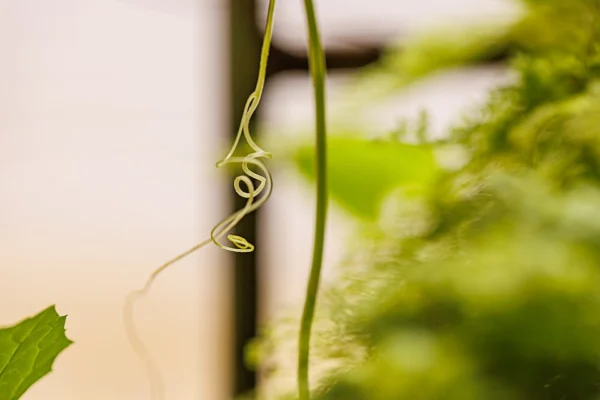
Give smooth luffa a greenhouse or polytunnel with as much useful light as possible. It can shade nearby plants heavily, so plan its route up the support before sowing.
Use a fertile greenhouse bed or a substantial container with drainage holes. One plant per large pot is manageable, provided watering and feeding are reliable.
Install supports strong enough for a leafy vine and several heavy fruits. Allow hanging fruit to develop freely rather than trapping it against wires or leaving it on wet soil.
Outdoor growing is an experiment for the warmest sheltered sites. A sunny wall may help, but a good outdoor cucumber season does not guarantee enough autumn warmth to finish luffa sponges.
Photo: Dinkun Chen, CC BY-SA 4.0. Resized and optimised; cropped for display. Adapted image under the same licence.
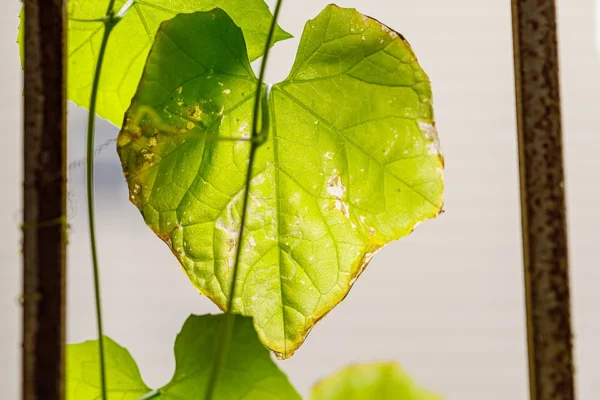
Start early enough to give the crop a long season, but only if you can keep the seedlings warm and well lit afterwards. Very early sowing in poor light is not a shortcut to strong plants.
1.
Choose labelled smooth luffa seed for sponges, or a culinary selection if young fruit is your priority. Check the supplier’s recommended sowing and growing conditions.
2.
In March or April, soak seeds in lukewarm water for a few hours or as the packet directs. Do not damage the embryo by cutting deeply into the seed.
3.
Sow on their sides about 1 to 2cm deep in small individual pots of moist peat free seed compost. A spare seed or two allows for uneven germination.
4.
Use a heated propagator to maintain steady warmth, commonly around 25 to 30°C. Keep compost moist without saturating it, and allow time for later seeds to emerge.
5.
After germination, provide bright light and continued warmth. Retain one strong seedling per pot and pot on before roots become tightly congested.
6.
Prepare the final greenhouse bed or large container and install supports. Plant with the root ball intact, at its previous depth, when the growing space is warm enough.
7.
Allow about 45 to 60cm between trained plants, with more room if the chosen strain is very vigorous. Water in and guide the first shoots onto the support with soft ties.
8.
Acclimatise any plants destined for outdoor growing over about two weeks, then plant only after frost risk has passed and nights are mild. Keep checking warmth, water and new growth.

Watering
Check the root zone frequently during active growth. Water thoroughly as needed to maintain even moisture, especially in containers, while allowing excess water to drain freely.
Water in the morning where practical and ventilate the growing space. Avoid repeated drought stress, but do not leave pots standing in water or create a permanently damp, crowded canopy.

Feeding
Prepare beds with well rotted organic matter, or use suitable container compost. Once flowering and fruiting develop, feed regularly with a liquid fertiliser suitable for fruiting vegetables, following its label.
Strong leafy growth alone does not prove that feeding is working towards a sponge harvest. Check pollination, crop load and light before adding more fertiliser to a vine that already fills its space.

Pruning
Guide new shoots regularly so leaves and fruit receive light and air. Pinching the main shoot after several leaves can encourage branching where the supplier recommends it; repeated severe cutting is unnecessary.
For sponges, concentrate on a few early fruits. Keeping around three or four promising fruits on a strong plant and removing late extras can improve their chance of maturing within the available season.

Winter care
Luffa is an annual crop, not a vine to overwinter outdoors. Harvest mature fruits before frost or sustained cold damages them, then clear the finished plant and clean its supports.
Dry harvested mature fruit in a warm, airy place, turning it and checking for deterioration. Once peeled and washed, let the fibre dry completely before storage or use.
Luffa climbs with curling tendrils and carries broad, often lobed leaves and bright yellow flowers. Male and female flowers are separate; a female flower has a small developing fruit behind its petals.
Smooth luffa fruit is broadly cylindrical, while angled luffa has conspicuous lengthwise ridges. Neither is a cucumber or bitter gourd, and unfamiliar ornamental gourds should not be treated as edible luffa.
Photo: Forest and Kim Starr, CC BY 3.0 us. Resized and optimised; cropped for display. Forest & Kim Starr
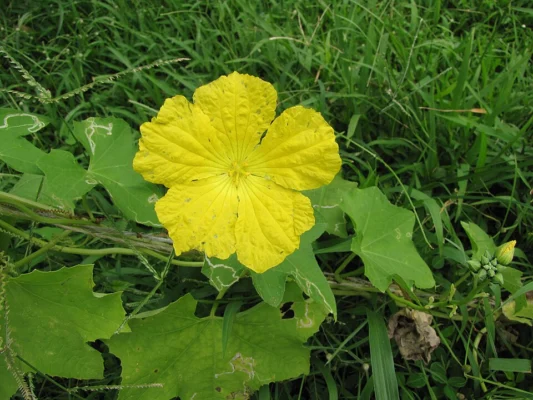
In southern gardens with a sunny greenhouse, early sowing and a small retained crop can produce mature fibres by autumn. Exact harvest dates vary with the strain, summer weather and growing space.
In cooler, northern or exposed locations, protected cultivation is particularly valuable. Prioritise a small number of early fruits and accept that some seasons may still finish before the crop is ready.
Autumn moisture is often as challenging as summer growth. Keep fruits away from wet surfaces, maintain ventilation and harvest before damaging cold, rather than waiting indefinitely for every skin to turn brown.
Photo: marinakvillatoro (Marina Kuperman Villatoro), CC BY 2.0. Resized and optimised; cropped for display.
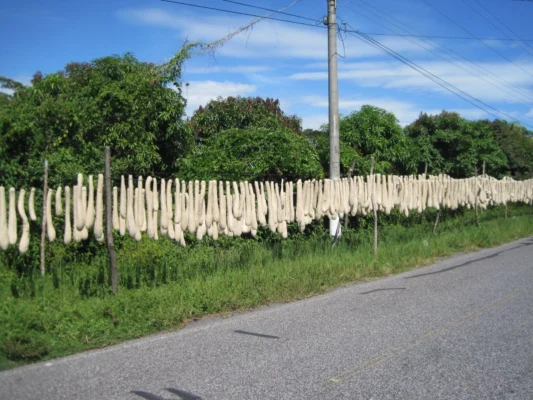
Insufficient steady warmth and saturated compost are common causes. Check the propagator temperature, follow the seed supplier’s advice and sow a few spares. Germination can be staggered, so a slow pot is not necessarily a failed one.
Early growth may produce mainly male flowers. Once female flowers appear, allow insect access or transfer pollen from a fresh male flower with a small brush. Poor warmth and stressed plants can also limit fruit set.
White powdery patches suggest mildew; pale speckling with fine webbing suggests spider mites. Inspect both leaf surfaces. Improve growing conditions and use an appropriate biological control if mites become established under glass.
Remove decaying fruit and improve air movement. Keep healthy fruits off damp surfaces and avoid stacking harvested fruit in a sealed container. Soft, rotten areas should not be mistaken for the normal loosening of a mature skin.
Size alone does not prove the internal fibres are mature. Too many late fruits or a short cool season can leave a disappointing crop. Retain fewer early fruits next time and extend the warm growing period where possible.
Raise fresh plants from seed each year. Start with a named species from a reputable supplier so its growing purpose and any selection for edible fruit are clear.
For seed saving, use fully mature fruit and dry sound, plump seeds before storing them in a labelled envelope. Flowering luffa plants can cross, so saved seed may vary when different types grow nearby; this does not alter this season’s fruit.
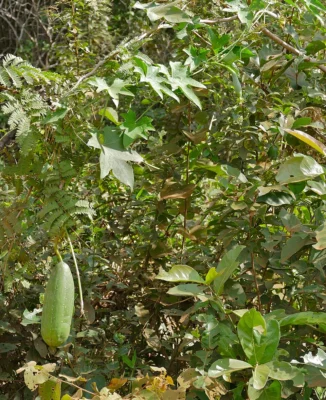
Smooth luffa
Luffa aegyptiaca is the usual sponge crop, widely offered under the name Luffa cylindrica. Choose stock suited to a protected UK growing season and give it plenty of time for fibres to develop.
Smooth luffa fruit growing on a vine identified as Luffa cylindrica.
Photo: Bernard DUPONT from FRANCE, CC BY-SA 2.0. Resized and optimised; cropped for display. Adapted image under the same licence.
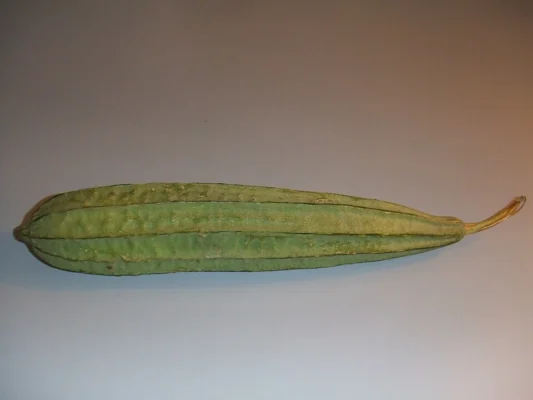
Angled luffa
Luffa acutangula has strongly ridged fruit and is commonly grown as a vegetable when young. Its ridges distinguish it from the smooth sponge type; check the supplier’s description before choosing for a particular use.
A harvested angled luffa fruit showing its prominent lengthwise ridges.
Photo: Hans B., Public domain. Resized and optimised; cropped for display.
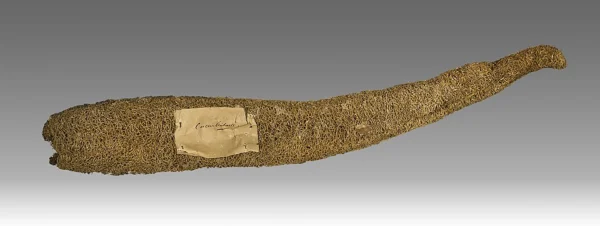
A mature sponge crop
A harvest choice rather than a separate variety. Leave selected fruits on the vine until a strong fibrous network forms, then peel away the mature skin, remove seeds and wash and dry the fibre.
A dried smooth luffa fibre specimen held in a museum collection.
Photo: Didier Descouens, CC BY-SA 4.0. Resized and optimised; cropped for display. Adapted image under the same licence.
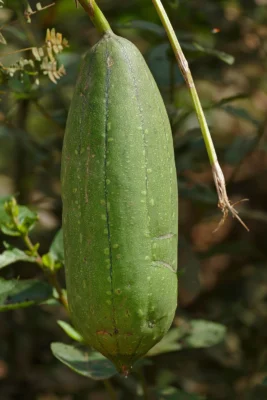
A young edible crop
Choose seed specifically described for culinary use, and harvest while fruit is tender and fibres have not developed. Some sponge selections are bitter; do not eat bitter fruit or assume all luffa stock is interchangeable.
Illustrative growing smooth luffa; this photograph does not certify eating maturity.
Photo: Bernard DUPONT from FRANCE, CC BY-SA 2.0. Resized and optimised; cropped for display. Adapted image under the same licence.
Ask whether the seed is intended mainly for sponges or young vegetables, and how it has performed in UK conditions. A packet showing a mature sponge does not promise that a late outdoor sowing will produce one.
Bees and other flower visiting insects can transfer pollen between luffa flowers. Allow access through open greenhouse doors or vents when conditions are suitable, or pollinate by hand if access is limited.
Inspect foliage before treating pests and avoid unnecessary spraying around flowers. Strong supports and regular tying also keep trailing growth and loose strings from becoming hazards around the growing area.
Published by Buy From Farmers Direct. Growing guidance reviewed 6 October 2026. The seasonal timeline uses the shared BFFD Growers Calendar record; adjust timings to your variety and local conditions.
Yes. The sponge is the fibrous framework inside a mature luffa fruit. It is revealed by removing the skin, seeds and remaining soft flesh, then washing and drying it.
It is possible in a warm sheltered site, but mature sponges are less reliable outdoors. A greenhouse or polytunnel gives a longer warm season, particularly in cooler parts of the country.
The first flowers may all be male, and female flowers need suitable pollen transfer. Look for the miniature fruit behind a female flower and try hand pollination when few insects reach the plants.
Wait for developed internal fibres and skin that begins to pale, loosen or dry, usually in autumn. Browner, drier fruit is often easier to peel, but harvest before frost or rot damages it.
No. A mature fruit with established fibres can finish drying indoors, but a very young fleshy fruit will not become a well formed sponge just by drying it. Size and colour alone are not enough to judge it.
Young tender fruit from culinary selections can be cooked as a vegetable. Mature sponge fruit is too fibrous, and some selections are bitter. Do not eat any bitter fruit or use unfamiliar gourds as substitutes.
Give luffa warmth, strong support and a long growing season, then focus on a few early fruits. Watching a green gourd become a usable sponge is rewarding, even when the first crop is small.
Want to get food independence, support your local grower, get better prices and shop more privately?
Local food isn’t just something you find. It’s something you protect. A free account helps keep local supply visible, supported, and resilient.

….it takes 30 seconds for food lovers and 5 minutes for suppliers
We built this for people who care where their food comes from. For people who want to remain food secure. For Farmers to get to the local people, who deserve a better income and to deliver a better price for you. For the environmentally conscious and the privacy-conscious. An account simply helps us make the map and supplier reach more useful to you, without changing how open it is. You’re always in control.


Find local food. Stay connected to it. Create a free account to support local producers and be part of a growing food network.


