Comfrey can turn a permanent corner of the garden into a useful supply of leaves for mulch, compost and plant feed. Its flowers also attract visiting insects. Choose the plant and its position carefully: a productive clump can live for many years, and pieces of root left after moving it can grow again.
Hardy perennial
Useful for plant feed
Permanent planting
Flowers for insects
Choose the variety carefully
| Botanical genus | Symphytum |
| Family | Boraginaceae |
| Plant type | Herbaceous perennial |
| Main garden use | Leaf material for mulch, compost and plant feed |
| Preferred feed cultivar | Bocking 14 |
| Bocking 14 propagation | Root cuttings or division, not seed |
| Position | Sun or partial shade |
| Soil | Deep, fertile and moisture retentive |
| Planning spacing | 90cm for a vigorous leaf crop |
| Usual planting range | 60 to 90cm, adjusted to vigour |
| Preferred planting months | March to May, or September |
| Leaf harvest window used | June to September, established plants |
| First season priority | Establish a strong root system |
| Flowers | Nodding tubular clusters; colour varies |
| Leaf texture | Coarse and hairy |
| Winter behaviour | Top growth dies back |
| Root behaviour | Fragments can regenerate |
| Containers | Restrict the productive root system |
| Culinary use | Not a food crop |
| Handling | Wear gloves when cutting or dividing |
| Plant name | Crop type | Spacing |
Sow indoors
Plant outdoors
Harvest
Polytunnel | |||||||||||
|---|---|---|---|---|---|---|---|---|---|---|---|---|---|---|
| Jan | Feb | Mar | Apr | May | Jun | Jul | Aug | Sep | Oct | Nov | Dec | |||
| Comfrey | Herbs | Single 90cm, In row 90cm, Row gap 90cm | No activity recorded | No activity recorded | Plant outdoors | Plant outdoors | Plant outdoors | Harvest | Harvest | Harvest | Plant outdoors, Harvest | No activity recorded | No activity recorded | No activity recorded |
Sow indoors: no months recorded. Plant outdoors: March, April, May, September. Harvest: June, July, August, September. Polytunnel: no months recorded.
The calendar shows spring and early autumn planting, with leaf cutting from June to September for established plants. No seed sowing band is shown because this guide’s preferred feed plant, Bocking 14, is propagated vegetatively. No tunnel band is needed for an established outdoor bed. Give new plants time to settle before regular cutting and stop harvesting early enough for autumn recovery.
Comfrey suits a garden or allotment where you will use its leaf crop and can give it a lasting position. A small number of productive plants is more useful than a large neglected patch that blocks paths or competes with vegetables.
It is a poor choice for a temporary bed that will be dug over repeatedly. Even a sterile cultivar can return from root fragments. Grow it as a garden resource, not as a culinary herb, and keep the label so its identity remains clear.
Photo: Ian Alexander, CC BY-SA 4.0. Resized and optimised; cropped for display. Adapted image under the same licence.
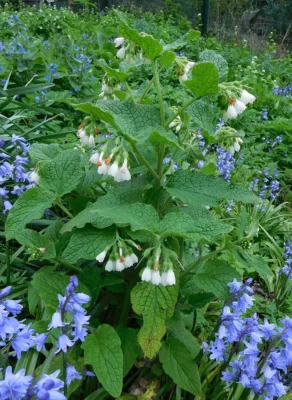
Choose deep soil where the roots can develop without frequent disturbance. Full sun supports a strong crop, while partial shade is acceptable where space is limited.
Prepare the site thoroughly before planting. Remove persistent weeds rather than expecting the comfrey leaves to solve an existing couch grass or bindweed problem.
Allow access for cutting, carrying leaves and weeding around young plants. Keep the mature spread clear of narrow paths and the growing space of smaller crops.
A large container can hold a plant, but restricting the roots also restricts its practical leaf production and increases watering needs. For a regular feed crop, a suitable permanent bed is usually easier to manage.
Photo: Michel Langeveld, CC BY-SA 4.0. Resized and optimised; cropped for display. Adapted image under the same licence.
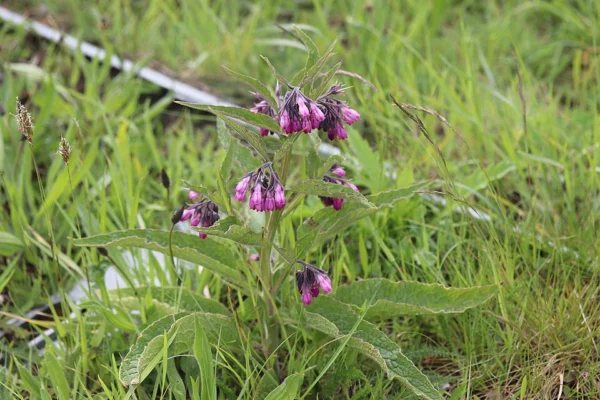
For plant feed, obtain genuine Bocking 14 from a reliable source. It is normally supplied as a plant, root cutting or division, so an offer of Bocking 14 seed needs questioning.
1.
Decide how you will use the leaves and choose a permanent position before buying plants or root pieces.
2.
Select correctly labelled material. Keep Bocking 14 separate from freely seeding common comfrey if avoiding seedlings is important.
3.
Clear perennial weeds and prepare a deep, workable soil. Improve poor ground with mature compost where appropriate.
4.
Plant in spring or early autumn while conditions support root establishment. Avoid working frozen or saturated ground.
5.
Set a rooted plant at its previous depth. Follow the supplier’s instructions for root pieces, which need different handling from a potted crown.
6.
Allow around 60 to 90cm between vigorous leaf crop plants. Use the larger spacing where soil is fertile and growth strong.
7.
Water after planting and keep the area weeded while the young plant develops. Mark root cuttings clearly before shoots appear.
8.
Prioritise establishment in the first season. Begin regular leaf harvests only when the plant has enough strength to recover between cuts.

Watering
Water new plants during dry spells until the roots are established. A deep rooted mature clump is more resilient, but a heavily harvested plant still needs moisture to replace its leaves.
Check the soil rather than watering to a rigid schedule. Poor growth in saturated ground calls for a drainage review, not more water.

Feeding
Comfrey does not create nutrients from nothing. Repeatedly removing its leaves exports nutrients from the bed, so maintain soil fertility with suitable organic matter and observe plant vigour.
Avoid a late push of soft growth with unnecessary feeding. Keep the growing area productive while allowing the plant to slow naturally towards winter.

Pruning
Wear gloves and cut established leafy growth with a clean sharp tool, leaving the crown intact. Carry leaves to the compost heap, use them as a suitable mulch or follow a reliable method for making plant feed.
Allow full regrowth between cuts and finish routine harvesting by September. Homemade liquid feed varies in strength with the method used, so follow a documented preparation and dilution method rather than guessing a universal ratio.

Winter care
The foliage normally dies back in winter. Leave the healthy root system undisturbed and mark the bed so dormant crowns are not accidentally dug through.
Remove material obstructing paths and keep drainage working. Established outdoor comfrey does not require a heated greenhouse or routine winter forcing.
Comfrey has substantial rough, hairy leaves and clusters of drooping tubular flowers. Flowers may be purple, pink, blue toned or pale cream depending on the species and cultivar.
These photographs show several comfrey forms. Do not identify an unknown plant for eating from their resemblance: this guide concerns garden cultivation and leaf material for the soil, not a food or medicinal harvest.
Photo: Reinhold Möller Ermell, CC BY-SA 4.0. Resized and optimised; cropped for display. Adapted image under the same licence.
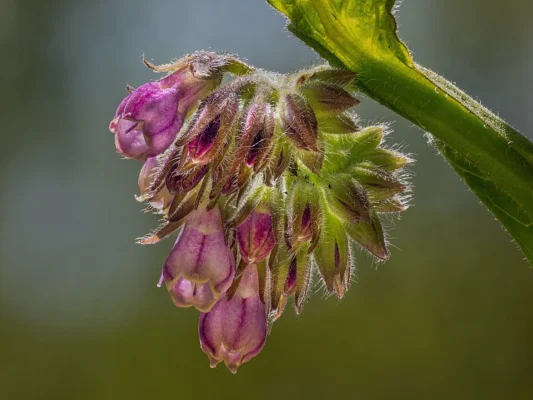
In warmer gardens, a vigorous established bed can regrow quickly between summer cuts. Keep enough moisture available and avoid taking the next cut simply because a fixed number of weeks has passed.
In cooler northern or upland gardens, expect slower spring growth and fewer useful cutting cycles. Give autumn recovery priority over squeezing in one last harvest.
On shallow chalky or very dry soil, comfrey may produce a disappointing leaf crop. Match the planting to the site and begin with a modest trial rather than dedicating a large area immediately.
Photo: Michel Langeveld, CC BY-SA 4.0. Resized and optimised; cropped for display. Adapted image under the same licence.
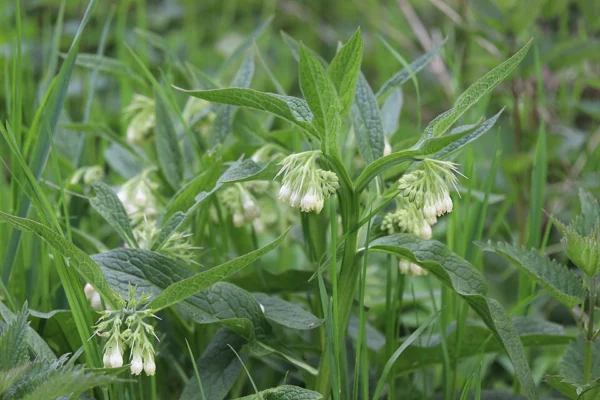
Small root pieces can regrow. Avoid chopping the area repeatedly with a rotavator. Monitor regrowth and remove roots carefully if you need to clear the planting.
Common comfrey can set seed freely. Remove flower stems before ripe seed scatters, or choose verified sterile Bocking 14 where a contained feed crop is the priority.
The plant may be young, dry or harvested too frequently. Pause cutting, assess moisture and fertility, and let a healthy leaf canopy rebuild.
Inspect affected leaves and distinguish leaf disease from normal ageing. Remove severely affected material, avoid crowding and allow healthy regrowth rather than harvesting a struggling plant repeatedly.
Check the planting material, depth, moisture and weed competition. Root pieces need time to produce shoots; keep their position marked and avoid digging them up repeatedly to check progress.
Divide a healthy established crown into rooted sections during a suitable planting season. Comfrey can also be increased from root cuttings, following a reliable method for cutting length and planting depth.
Bocking 14 is sterile, so preserve it through vegetative propagation. Common comfrey can be raised from seed, but that creates a different management choice because seedlings may spread around the garden.
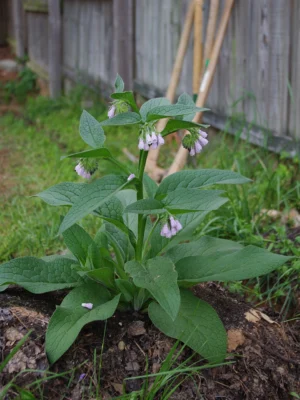
Bocking 14
The established choice for a managed leaf crop. This sterile cultivar does not produce a crop of self sown seedlings, although its roots can still regenerate if disturbed.
Photograph identified by its source as Bocking 14.
Photo: Finchj, CC BY-SA 3.0. Resized and optimised; cropped for display. Adapted image under the same licence.
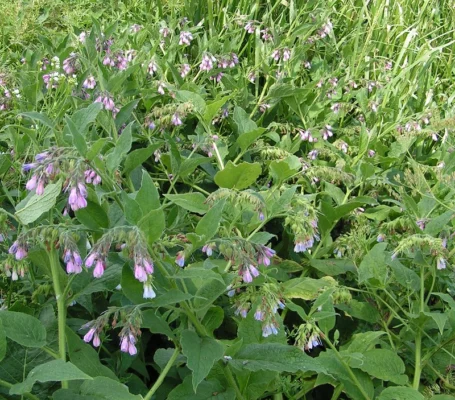
Russian comfrey
Russian comfrey is commonly described as Symphytum × uplandicum. Check the cultivar rather than assuming every plant sold under the broad common name has the characteristics of Bocking 14.
Russian comfrey; the cultivar is not specified.
Photo: Sannse, CC BY-SA 3.0. Resized and optimised; cropped for display. Adapted image under the same licence.
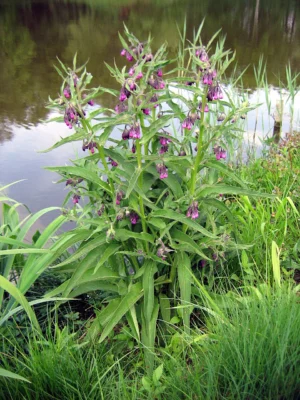
Common comfrey
Symphytum officinale is a vigorous plant with variable flower colour. It has wildlife value and useful leaves, but its ability to set seed needs consideration in a small garden.
Common comfrey, Symphytum officinale.
Photo: Agnieszka Kwiecień (Nova), CC BY 2.5. Resized and optimised; cropped for display.
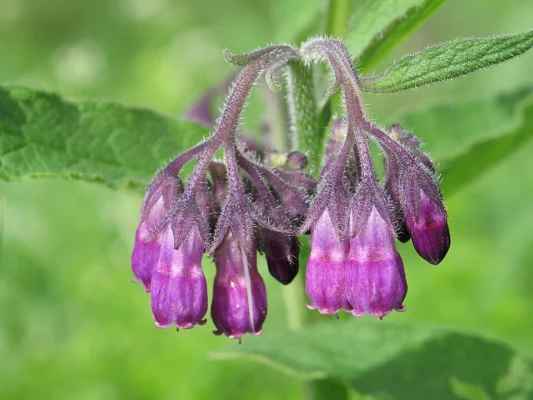
Ornamental comfreys
Types such as Symphytum grandiflorum are grown for flowers and ground cover. Choose them for that role after checking their spread, rather than treating every ornamental comfrey as the same feed crop.
Illustrative common comfrey flowers; this is not a photograph of Symphytum grandiflorum.
Photo: Robert Flogaus-Faust, CC BY 4.0. Resized and optimised; cropped for display.
For a productive feed bed, ask for correctly labelled Bocking 14 plants, divisions or root cuttings. Check the space you can dedicate before ordering. For an ornamental planting, compare mature height and spread as well as flower colour.
Comfrey flowers attract bees and other visitors. If flowers are a priority, leave part of the planting uncut while harvesting leaves from another section.
Balance flower retention with control of seed on fertile types. Bocking 14 makes this easier because it is sterile, but all comfrey still needs enough space and a sensible long term position.
Published by Buy From Farmers Direct. Sources checked 6 October 2026. Growing references: Garden Organic growing comfrey; Garden Organic harvesting and use; RHS Bocking 14; RHS common comfrey; RHS comfrey plant feed methods; RHS comfrey and wildlife. The seasonal timeline uses the shared BFFD Growers Calendar record; adjust timings to your variety and local conditions.
Bocking 14 is a widely recommended cultivar for leaf production and is sterile. Buy correctly labelled vegetative material rather than assuming an unlabelled plant has the same characteristics.
No. Genuine Bocking 14 is propagated by division or root cuttings because it is sterile.
Established plants can provide cuts during summer, allowing regrowth between harvests. This calendar uses June to September. Give new plants time to establish before regular cutting.
Common comfrey may spread by seed, and root fragments of comfrey can regrow. Sterile Bocking 14 avoids self seeding but still needs a carefully chosen permanent position.
Yes. Comfrey leaves can be added as part of a balanced compost mix or used in documented mulch and plant feed methods. Match quantities and dilution to the particular method.
No. Grow it here for garden use and flowers, not for eating. Wear gloves when handling its rough foliage or dividing roots.
A few correctly chosen comfrey plants can supply useful leaf material for years. Give them a lasting home, allow recovery between cuts and use the harvest as part of a wider soil care plan.
Want to get food independence, support your local grower, get better prices and shop more privately?
Local food isn’t just something you find. It’s something you protect. A free account helps keep local supply visible, supported, and resilient.

….it takes 30 seconds for food lovers and 5 minutes for suppliers
We built this for people who care where their food comes from. For people who want to remain food secure. For Farmers to get to the local people, who deserve a better income and to deliver a better price for you. For the environmentally conscious and the privacy-conscious. An account simply helps us make the map and supplier reach more useful to you, without changing how open it is. You’re always in control.


Find local food. Stay connected to it. Create a free account to support local producers and be part of a growing food network.


