Cauliflower rewards careful timing with a firm central curd, but the variety must match the season. Summer, autumn and overwintering plants follow different schedules. Start with a small batch, keep growth steady and protect the leaves that feed the developing head.
Brassica family
Choose the season
Steady moisture
One main curd
Protect young plants
| Botanical group | Brassica oleracea, Botrytis Group |
| Family | Brassicaceae |
| Crop harvested | Immature flower cluster, called the curd |
| Plant habit | Large leafy rosette with a central head |
| Main growing position | Full sun |
| Soil | Fertile, firm and moisture retentive |
| Drainage | Moist soil without waterlogging |
| Common head colour | White; coloured varieties also exist |
| Main sowing window | March to May, depending on variety |
| Protected sowing | Useful for early establishment |
| Outdoor sowing | Mid to late spring for suitable varieties |
| Summer and autumn spacing | 45 to 60cm between plants |
| Summer and autumn row gap | About 60cm |
| Winter and spring spacing | About 70cm each way |
| Transplant stage | Sturdy young plants with about five true leaves |
| Harvest stage | Firm curd before the sections separate |
| Harvest pattern | Usually one main head per plant |
| Crop rotation group | Brassicas |
| Propagation | Seed |
| Container option | Mini varieties with attentive watering |
| Plant name | Crop type | Spacing |
Sow indoors
Plant outdoors
Harvest
Polytunnel | |||||||||||
|---|---|---|---|---|---|---|---|---|---|---|---|---|---|---|
| Jan | Feb | Mar | Apr | May | Jun | Jul | Aug | Sep | Oct | Nov | Dec | |||
| Cauliflower | Brassicas | Single 0.60m, In row 0.60m, Row gap 0.60m | No activity recorded | No activity recorded | Sow indoors, Polytunnel | Sow indoors, Polytunnel | Sow indoors, Plant outdoors, Polytunnel | Plant outdoors | Plant outdoors, Harvest | Harvest | Harvest | Harvest | Harvest | Harvest |
Sow indoors: March, April, May. Plant outdoors: May, June, July. Harvest: July, August, September, October, November, December. Polytunnel: March, April, May.
This calendar shows a spring sown plan: sow March to May, plant out May to July and harvest July to December across suitable summer, autumn and early winter varieties. One variety will not crop throughout that period. The red band is labelled Sow indoors; outdoor seedbed sowing in mid to late spring is also possible. Polytunnel months mean optional seed raising. Overwintering spring cauliflower, including Jerome, follows its own later sowing schedule and is excluded from these harvest months.
Choose cauliflower when you can give a few plants generous space and check them regularly as heads form. The harvested head occupies much less room than the surrounding leaves.
Several plants from one sowing may be ready together. Plan the number around meals you can use promptly, then repeat a suitable sowing for another harvest.
Photo: Jeremy Keith, CC BY 2.0. Resized and optimised; cropped for display.
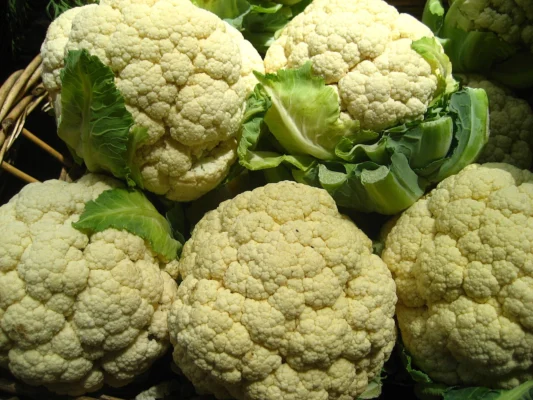
Select an open bed with good light, away from tree and shrub roots. Leave access to check each plant without trampling neighbouring roots.
Prepare fertile soil with mature organic matter. Firm planting means good contact around the roots, not treading wet ground into an airless surface.
Keep cauliflower within the brassica part of your rotation. Where club root has occurred, record the affected bed and avoid carrying its soil on boots, tools or transplants into clean ground. A resistant variety is useful but does not remove that hygiene need.
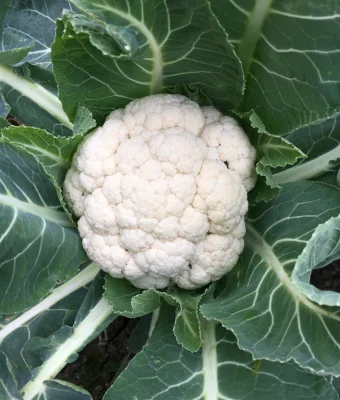
Buy seed or young plants with both a variety name and a cropping season. Plants labelled only cauliflower leave an important gap in the plan. Keep the label with the crop after transplanting.
1.
Choose a variety suited to your sowing month and intended harvest season.
2.
Prepare clean modules with peat free seed compost, or a fine outdoor seedbed at the appropriate time.
3.
Sow at the depth given on the packet and label the variety and date clearly.
4.
Keep compost evenly moist and give emerging plants good light; thin crowded seedlings promptly.
5.
Gradually harden off plants raised indoors before moving them outside.
6.
Transplant sturdy young plants before their roots become crowded, keeping the rootball intact.
7.
Allow the spacing for the seasonal type, firm gently around each plant and water the roots thoroughly.
8.
Cover with supported mesh, check that leaves do not touch it and secure all access points.

Watering
Avoid repeated drying out during establishment and head development. Water the root area thoroughly when needed, and check beneath mulch before deciding that the bed is wet enough. Leaves can conceal dry soil.
Make the mesh opening accessible for watering. Containers need closer attention than soil beds because their limited compost dries faster.

Feeding
Build fertility before planting. On poorer ground, an appropriate vegetable fertiliser can support growth when used according to its label. Do not add repeated doses simply because the curd has not appeared.
Check moisture, root health and the variety timetable before diagnosing a nutrient shortage. Record what you applied and when, rather than trying several products without tracking the results.

Pruning
Keep healthy leaves in place. They support the developing crop and can shelter a white curd. Where needed, bend outer leaves over the head to reduce sun discolouration, leaving space for air to circulate.
Cut the curd while it remains firm, retaining a few surrounding leaves for protection during handling. Do not wait for every head to reach supermarket size. Clear the finished plant rather than planning a second substantial head from it.

Winter care
Only a variety intended for winter or spring cropping should occupy the bed through winter. A summer variety is not converted into a winter crop by leaving it unharvested. Keep the original packet timetable available.
Check supports and covers after windy weather. Fold leaves over developing winter curds as appropriate and harvest before quality declines. Avoid repeatedly walking on saturated soil.
A cauliflower has broad brassica leaves around a dense central curd. White is familiar, but orange, purple and green selections also exist. Colour alone cannot establish the cultivar or its harvest season.
The pointed repeating cones of Romanesco look different from the usual rounded white curd. Green heading calabrese and purple sprouting broccoli have their own growing guides. This page compares conventional white cauliflower varieties, with clearly disclosed illustrative photographs.
Photo: Calliope (liz west), CC BY 2.0. Resized and optimised; cropped for display.
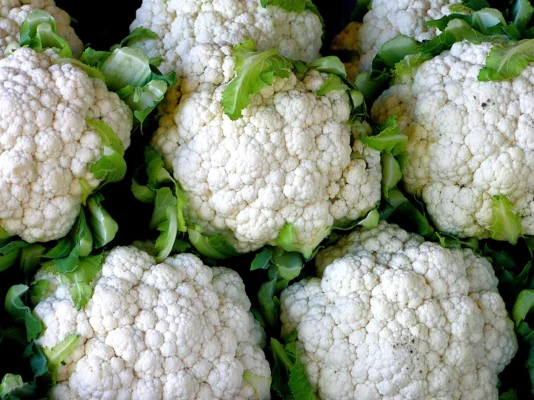
Match the variety to the local season rather than treating every seed packet alike. Raleigh is described for summer cropping, Moby Dick for autumn into early winter, and Jerome for the following spring. These are different planting plans.
In hot, dry spells, inspect developing curds more frequently and maintain root moisture. A head can lose its tight texture quickly. Moving the harvest forward is often more useful than waiting for a larger head.
In colder districts, use protected seed raising or wait for suitable outdoor conditions. Record sowing, transplanting and first harvest dates to identify varieties that fit your plot.
Photo: Peter Forster, CC BY-SA 2.0. Resized and optimised; cropped for display. Adapted image under the same licence.
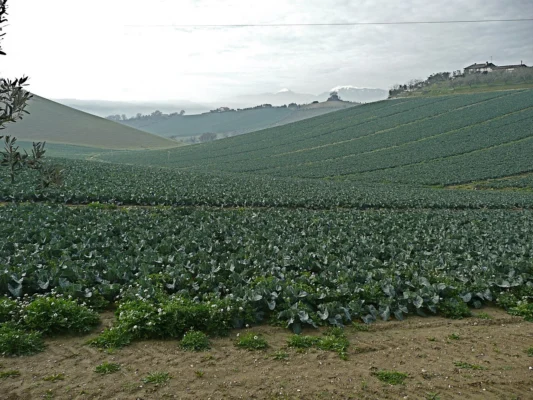
Stress or overgrown transplants can cause buttoning. Harvest what is usable. Next time, transplant younger plants promptly and avoid sharp checks in growth rather than trying to force an existing small head with extra feed.
The head may be overmature or affected by growing conditions. Inspect often once it forms and cut while compact. Record the date rather than relying only on the packet’s approximate maturity period.
Check both leaf surfaces and the centre for eggs or caterpillars. Remove them where practical and inspect the mesh for gaps. Netting pressed against foliage can still allow butterflies to lay eggs through it.
Inspect roots on a badly affected plant. Swellings suggest club root; damaged feeding roots may indicate cabbage root fly. Establish the cause before adding fertiliser, and avoid moving suspect soil around the plot.
Strong light can cause discolouration. Where the variety needs it, shelter the developing head with outer leaves. Coloured cauliflower varieties naturally differ, so check the label before treating normal colour as a fault.
Seed is the normal way to raise a new crop. Keep packets separate and label each batch, especially when growing several seasonal types. Bought plugs can simplify establishment when only a few plants are wanted.
Saving seed is a separate project requiring plants to flower rather than be harvested. Garden Organic identifies cauliflower as a biennial crop needing isolation for seed saving. It is not a reliable shortcut for reproducing an F1 hybrid or a single unidentified plant.
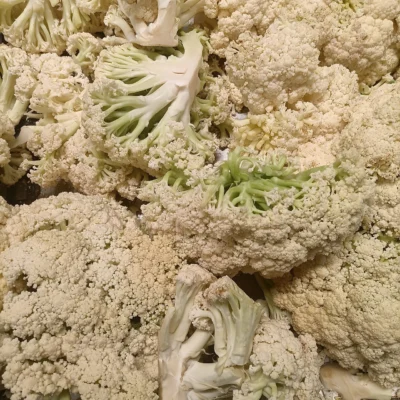
Raleigh
A summer selection with white domed curds and vigorous foliage. RHS describes a July to September harvest and useful resistance to pinking. Check the packet before choosing a sowing date.
Illustrative white cauliflower photograph; the cultivar is not identified as Raleigh.
Photo: Fumikas Sagisavas, CC0 1.0. Resized and optimised; cropped for display.
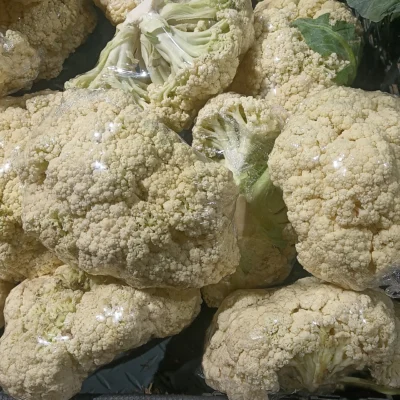
Clapton
An autumn choice producing substantial white heads, with resistance to club root. Resistance is a reason to consider it where that disease is a concern, alongside rotation and careful soil hygiene.
Illustrative white cauliflower photograph; the cultivar is not identified as Clapton.
Photo: Fumikas Sagisavas, CC0 1.0. Resized and optimised; cropped for display.
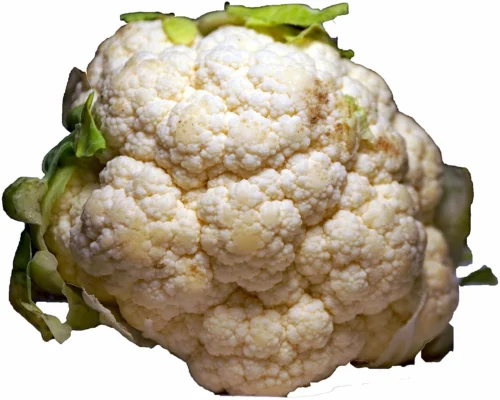
Moby Dick
A robust autumn and early winter selection. RHS gives a September to December harvest window. Its later cropping purpose should be considered when reserving bed space.
Illustrative white cauliflower photograph; the cultivar is not identified as Moby Dick.
Photo: Tiia Monto, CC BY-SA 4.0. Resized and optimised; cropped for display. Adapted image under the same licence.
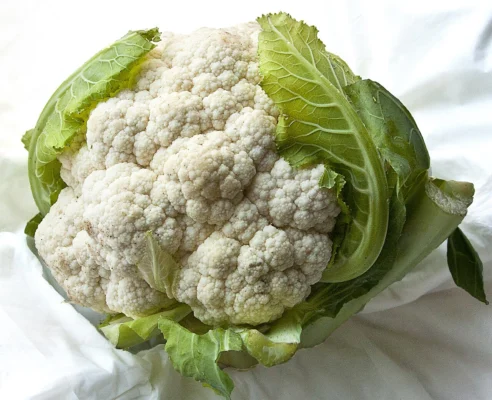
Jerome
An overwintering spring variety with white curds, normally harvested in late March and April. RHS gives May to June sowing and July to August planting, distinct from the main calendar on this page.
Illustrative white cauliflower photograph; the cultivar is not identified as Jerome.
Photo: liz west, CC BY 2.0. Resized and optimised; cropped for display.
Use the BFFD map to explore local growing suppliers. Ask for the named variety and harvest season, and check availability before travelling.
Protect the crop with maintained mesh while keeping other areas welcoming to wildlife. Check covers for trapped animals.
Cauliflower is harvested before flowers open, so pollination is unnecessary for curd formation. Deliberately retained flowering plants need separate space in the crop plan.
Published by Buy From Farmers Direct. Sources checked 5 October 2026. Growing references: RHS: growing cauliflower; Garden Organic: cauliflower; University of Maryland Extension: cauliflower growth and curd problems; RHS: Raleigh; RHS: Clapton; RHS: Moby Dick; RHS: Jerome; RHS: cabbage caterpillars; RHS: club root; RHS: cabbage root fly. The seasonal timeline uses the shared BFFD Growers Calendar record; adjust timings to your variety and local conditions.
March to May is the main window, but seasonal varieties differ. Early summer and overwintering spring crops use other schedules. Follow the named variety, not the word cauliflower alone.
Allow about 45 to 60cm between summer or autumn plants and 60cm between rows. Large winter and spring varieties need around 70cm each way. Mini varieties are a separate closer spaced option.
Check its intended harvest season first. An overwintering variety may be following its normal schedule. If it should already be cropping, review establishment, moisture and growing conditions before adding feed.
Many white varieties benefit from leaves folded over the developing curd to limit sun discolouration. Some varieties shelter themselves well. Leave airflow and keep checking maturity beneath the cover.
Plan for one main curd per plant. Unlike calabrese, cauliflower is not normally grown for repeated worthwhile side shoot harvests. Clear the finished crop when the main head has been taken.
Mini varieties are the more practical choice. Follow their container and spacing guidance, use suitable compost and keep moisture steady. A full sized plant needs substantial root space and careful watering.
Use the BFFD growers calendar to plan the seasonal type, then record your own sowing and harvest dates in your growing notes. Explore the directory for local suppliers.
Explore more growing guides: Broccoli (Green), Broccoli (Purple), Brussels Sprouts.
Want to get food independence, support your local grower, get better prices and shop more privately?
Local food isn’t just something you find. It’s something you protect. A free account helps keep local supply visible, supported, and resilient.

….it takes 30 seconds for food lovers and 5 minutes for suppliers
We built this for people who care where their food comes from. For people who want to remain food secure. For Farmers to get to the local people, who deserve a better income and to deliver a better price for you. For the environmentally conscious and the privacy-conscious. An account simply helps us make the map and supplier reach more useful to you, without changing how open it is. You’re always in control.


Find local food. Stay connected to it. Create a free account to support local producers and be part of a growing food network.


