Green heading broccoli, usually called calabrese in UK growing guides, forms a central dome of green buds followed by smaller side shoots. This page covers the summer and autumn crop. Purple sprouting broccoli follows a different calendar.
Green heading broccoli
Summer and autumn crop
Brassica family
Protect with mesh
Harvest closed buds
| Botanical group | Brassica oleracea, Italica Group |
| Family | Brassicaceae |
| Common growing name | Calabrese |
| Crop type | Grown as an annual vegetable |
| Typical height | About 50 to 90cm, depending on variety |
| Main head | A cluster of unopened flower buds |
| Light | Sun or light shade |
| Soil | Fertile, firm and freely drained |
| Soil reaction | Near neutral to alkaline; test before liming |
| Protected sowing | March and April |
| Outdoor sowing | April to June |
| Seed depth | About 1cm; follow the packet |
| Plant spacing | About 45cm |
| Row spacing | About 60cm |
| Planting stage | Young plants about 10 to 15cm tall |
| Main harvest | Usually July to October |
| Time to crop | Often three to four months from sowing |
| Further harvest | Side shoots after the main head |
| Crop protection | Fine insect mesh over supports |
| Rotation group | Brassicas |
| Plant name | Crop type | Spacing |
Sow indoors
Plant outdoors
Harvest
Polytunnel | |||||||||||
|---|---|---|---|---|---|---|---|---|---|---|---|---|---|---|
| Jan | Feb | Mar | Apr | May | Jun | Jul | Aug | Sep | Oct | Nov | Dec | |||
| Broccoli (Green) | Brassicas | Single 0.45m, In row 0.45m, Row gap 0.60m | No activity recorded | No activity recorded | Sow indoors, Polytunnel | Sow indoors, Plant outdoors, Polytunnel | Sow indoors, Plant outdoors | Sow indoors, Plant outdoors | Harvest | Harvest | Harvest | Harvest | No activity recorded | No activity recorded |
Sow indoors: March, April, May, June. Plant outdoors: April, May, June. Harvest: July, August, September, October. Polytunnel: March, April.
The calendar describes a normal spring sown calabrese crop, with protected sowing in March and April and outdoor sowing from April to June. Planting and harvest vary with the named variety and local weather. The polytunnel band means optional seed raising, not a requirement for a covered crop. These dates do not describe overwintering purple sprouting broccoli.
Calabrese provides familiar green heads within one season. Plan for the mature leaves and protection frame, which occupy considerably more ground than the harvested head.
Start with a modest batch. Several plants can mature together, so repeat sowings are often more useful than one large bed needing harvest at once.
Photo: Kolforn (Wikimedia), CC BY-SA 4.0. Resized and optimised; cropped for display. Adapted image under the same licence.
Choose good light, shelter from strong wind and soil beyond competing hedge roots. Aim for steady growth while leaves and heads develop.
Prepare fertile soil with well rotted compost before planting. It should support the roots firmly without becoming a compacted, airless mass. Do not work or tread on wet clay just to produce a firm surface.
Test soil acidity before adding lime. Calabrese dislikes strongly acidic conditions, but applying lime without knowing the pH can create other problems. Follow the test result and product instructions rather than copying a fixed dose from another garden.
Group calabrese with other brassicas in your rotation. Leave enough space to secure mesh at ground level and lift it easily for weeding and harvest checks.
Photo: Schlaghecken Josef, CC BY-SA 4.0. Resized and optimised; cropped for display. Adapted image under the same licence.
Modules reduce root disturbance, but young plants should not sit in tiny cells until they become crowded. Direct sowing into the final bed is useful for later batches because transplanting in warm conditions can check growth.
1.
Check that the packet describes green heading calabrese and matches your intended sowing season.
2.
Fill clean modules with peat free seed compost, or prepare a fine outdoor seedbed.
3.
Sow at the packet’s stated depth, commonly around 1cm, and label the date and variety.
4.
Keep evenly moist and thin module seedlings to one strong plant per cell.
5.
Gradually harden off indoor raised plants before moving them into outdoor weather.
6.
Plant when about 10 to 15cm tall, keeping each rootball intact and placing the lowest leaves near soil level.
7.
Allow roughly 45cm between plants and 60cm between rows, adjusting for the variety; firm and water well.
8.
Cover promptly with insect mesh on hoops and secure its edges without leaving access gaps.

Watering
Keep newly planted roots moist while they establish. During dry spells, water the soil thoroughly rather than repeatedly wetting only the surface. Check beneath any mulch before watering again.
Steady moisture matters as heads develop. A plant that repeatedly wilts may produce a disappointing head even if it later recovers. Containers need especially close attention because their compost dries faster than a prepared bed.

Feeding
Good soil preparation provides a useful foundation. If growth is slow on poor soil, an appropriate nitrogen fertiliser can help, used according to its label. First rule out dry roots, pests or disease.
Avoid extra feeding when growth is already strong. Fertiliser cannot reverse an opening head. Record soil preparation so next season’s feeding reflects what was actually supplied.

Pruning
There is no routine pruning before harvest. Keep healthy leaves because they support growth. Remove a damaged leaf only when necessary, rather than stripping plants to expose the centre.
Cut the central head while buds remain compact. Leave the plant and healthy foliage in place for side shoots, then harvest those promptly too. Clear exhausted plants when further useful shoots stop developing.

Winter care
The normal crop on this page finishes in autumn. Clear unwanted remains and plan the next crop for the bed. If roots show suspected club root, avoid spreading contaminated soil around the plot.
Some carefully chosen autumn sowings can overwinter under cover, but that is a separate method requiring suitable varieties and management. Do not assume ordinary calabrese has the winter cropping schedule of purple sprouting broccoli.
Calabrese has broad, often blue green leaves surrounding a central green head. What looks like a single vegetable is a dense group of developing flower buds. The head becomes looser as it approaches flowering.
Yellow petals indicate that buds have begun opening. Purple sprouting broccoli instead produces separate small shoots, often after a longer season. Romanesco has pointed, repeating cones and is another distinct choice, even when shops use the word broccoli.
Photo: Buddy431, CC BY-SA 3.0. Resized and optimised; cropped for display. Adapted image under the same licence.
In colder districts, begin in modules under bright, cool conditions or wait until outdoor soil is ready. Protect young plants from abrupt weather changes. Warm, dim indoor conditions can produce weak seedlings that are difficult to establish.
Hot spells make timely harvesting more urgent. Look into the centre every few days as the head develops, and check daily once buds start loosening. A smaller firm head is more useful than a large one that has opened into flowers.
For a longer season, compare the packet’s maturity period and repeat suitable sowings a few weeks apart. Keep the dates of first heads and side shoots. Your own records help refine sowing times for the conditions in your particular garden.
Photo: Schlaghecken Josef, CC BY-SA 4.0. Resized and optimised; cropped for display. Adapted image under the same licence.
Heat, drought or a check during establishment can reduce head quality. Harvest the usable buds promptly. Next time, plant young healthy seedlings on time and maintain steady moisture.
Inspect both sides of leaves for caterpillars and eggs before closing the mesh. Remove them by hand where practical. Check the cover for gaps and avoid assuming every hole is caused by the same pest.
Inspect a badly affected plant’s roots. Club root causes swellings; cabbage root fly can damage feeding roots. These need different responses, so establish the cause before adding fertiliser or replacing plants in the same spot.
Torn leaves and exposed veins can signal bird feeding. Support and secure protective mesh so birds cannot press it onto the leaves. Check the frame after wind or heavy rain.
Loose roots interrupt growth, especially beneath a heavy head. Firm suitable soil around the base and support exposed plants if necessary. Improve shelter or frame stability for the next planting.
Calabrese is normally raised from seed or bought as young plants. Sow only enough for the available space and preserve variety labels, especially when comparing early and later batches. Strong, uncrowded seedlings are more useful than oversized plants kept waiting.
Saving seed is more involved than leaving one head uncut. Brassica oleracea crops can cross with related varieties, and F1 hybrids do not reliably reproduce their original characteristics. Follow a dedicated brassica seed saving method if you want dependable results.
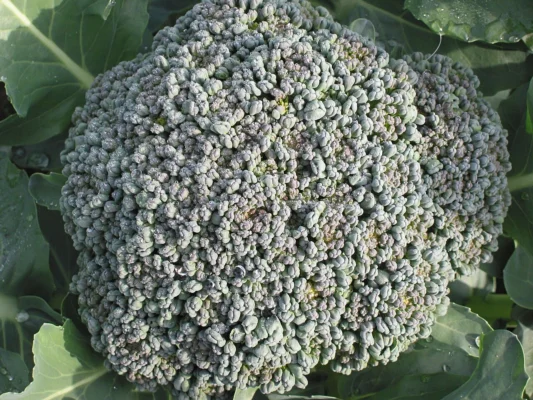
Calabrese 'Fiesta'
A choice for substantial domed heads followed by side shoots. RHS describes good heat tolerance, useful for summer cropping, although timely watering and harvesting still matter.
Verified photograph of calabrese 'Fiesta'.
Photo: Rasbak, CC BY-SA 3.0. Resized and optimised; cropped for display. Adapted image under the same licence.
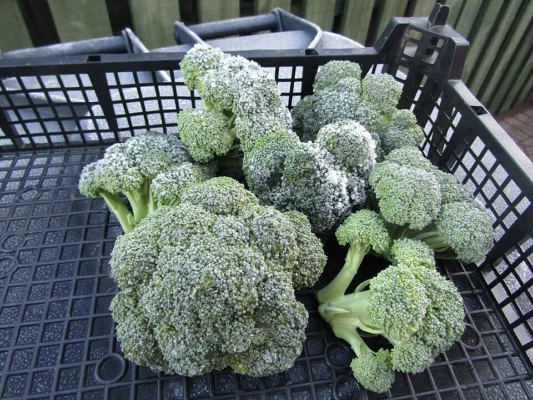
Calabrese 'Green Magic'
An early maturing option with dense green heads and subsequent side shoots. It can fit a plan for earlier picking. Match the seed supplier’s sowing instructions to your local conditions.
Illustrative green broccoli heads; cultivar unidentified, not a verified photograph of 'Green Magic'.
Photo: Kolforn (Wikimedia), CC BY-SA 4.0. Resized and optimised; cropped for display. Adapted image under the same licence.
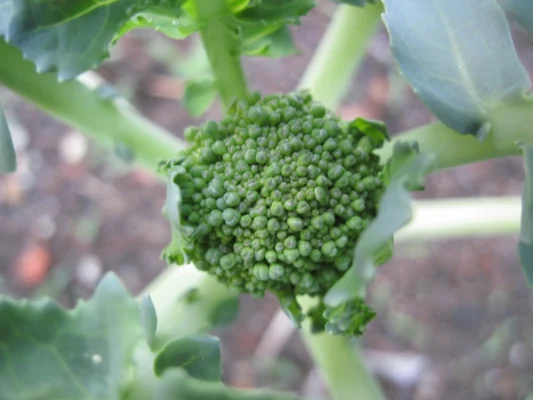
Calabrese 'Kabuki'
A compact, quick maturing choice that suits closer spacing and can be useful for autumn cropping. Compact does not mean maintenance free: allow access for watering and inspecting protected plants.
Illustrative developing broccoli head; cultivar unidentified, not a verified photograph of 'Kabuki'.
Photo: Rob Duval, CC BY-SA 3.0. Resized and optimised; cropped for display. Adapted image under the same licence.
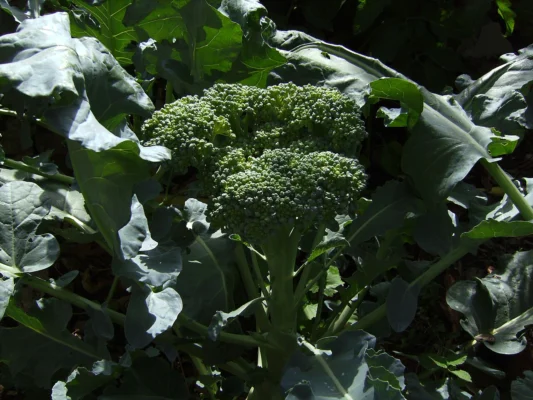
Calabrese 'Marathon'
A reliable summer cropping option producing dense heads. It is worth comparing with an earlier variety when planning successive batches, while following the individual packet’s timing.
Illustrative green broccoli head on its plant; cultivar unidentified, not a verified photograph of 'Marathon'.
Photo: Victor M. Vicente Selvas, CC BY-SA 3.0. Resized and optimised; cropped for display. Adapted image under the same licence.
Use the BFFD map to explore nearby nurseries and growing suppliers. Ask for green heading calabrese, confirm the variety and check availability before travelling.
Vegetable brassicas also feed insects and birds. Protect the crop with a secure physical barrier while providing flowers and habitat elsewhere in the garden. Calabrese does not need insects to visit its flowers to form the head you harvest.
If space allows, a healthy spare plant left to flower can provide insect forage. Keep that choice separate from the main harvest plan and monitor it rather than leaving a diseased crop standing.
Published by Buy From Farmers Direct. Sources checked 4 October 2026. Growing references: RHS: growing calabrese; Garden Organic: calabrese; University of Minnesota Extension: heading broccoli; RHS: Fiesta; RHS: Green Magic; RHS: Kabuki; RHS: Marathon; RHS: club root; RHS: cabbage caterpillars; RHS: cabbage root fly; RHS: hardening off; Garden Organic: brassica seed saving and isolation. The seasonal timeline uses the shared BFFD Growers Calendar record; adjust timings to your variety and local conditions.
Usually, yes. The large green heads sold as broccoli are called calabrese in many UK gardening guides. Check seed labels because sprouting broccoli follows a different cropping pattern.
The usual window is March to June: March and April under cover, then April to June outside. The packet’s variety specific dates and your soil conditions take priority over a general calendar.
About 45cm between plants and 60cm between rows is a useful general layout. Compact varieties may suit closer spacing. Crowding usually means smaller heads and makes crop inspection harder.
Cut it when well formed and firm, while the buds remain closed. Do not wait for a target diameter if buds are loosening. Warm weather can shorten the useful picking window.
Many calabrese varieties produce smaller side shoots afterwards. Leave healthy leaves and roots in place, water as needed and keep picking the new heads before they flower.
It is possible with a compact variety and a generous container, but water and nutrient supply need careful attention. Avoid crowding several plants into a small pot. A prepared bed is often easier to manage.
Use the BFFD calendar to plan calabrese separately from purple sprouting broccoli. Record sowing and harvest results in your own growing notes, and find local suppliers through the directory.
Explore more growing guides: Broccoli (Purple), Brussels Sprouts, Cabbage (Autumn).