Annual vinca, Catharanthus roseus, brings glossy foliage and bright summer flowers to a warm, sheltered spot. Also called Madagascar periwinkle, it is a tender perennial usually grown for one season in Britain. It is different from the hardy, spreading Vinca major and Vinca minor used as ground cover. Warmth, light and careful watering are the foundations of success.
Catharanthus roseus
Tender summer bedding
Sunny sheltered position
Pots and borders
Not an edible plant
| Botanical name | Catharanthus roseus |
| Family | Apocynaceae |
| Common names | Annual vinca, Madagascar periwinkle |
| Plant type | Tender perennial grown as an annual |
| Origin | Madagascar |
| UK use | Summer bedding and containers |
| Position | Full sun |
| Exposure | Sheltered |
| Soil | Moderately fertile and freely drained |
| Typical height | About 20 to 50 cm, by cultivar |
| Typical spacing | About 25 to 30 cm, by cultivar |
| Sowing | Spring under warm protection |
| Planting out | After frost risk, when weather is warm |
| Flowering | Summer into early autumn |
| Frost tolerance | Not frost hardy |
| Watering | Moderate; avoid saturated roots |
| Deadheading | Usually unnecessary |
| Propagation | Seed or suitable stem cuttings |
| Winter | Warm protected conditions if retained |
| Edibility | No; harmful if swallowed |
| Plant name | Crop type | Spacing |
Sow indoors
Plant outdoors
Harvest
Polytunnel | |||||||||||
|---|---|---|---|---|---|---|---|---|---|---|---|---|---|---|
| Jan | Feb | Mar | Apr | May | Jun | Jul | Aug | Sep | Oct | Nov | Dec | |||
| Annual vinca | Unusual & exotic | Single 0.30m, In row 0.30m, Row gap 0.30m | No activity recorded | No activity recorded | Sow indoors, Polytunnel | Sow indoors, Polytunnel | Polytunnel | Plant outdoors, Polytunnel | Harvest | Harvest | Harvest | No activity recorded | No activity recorded | No activity recorded |
Sow indoors: March, April. Plant outdoors: June. Harvest: July, August, September. Polytunnel: March, April, May, June.
The calendar shows March and April sowing under warm protection, June planting out and July to September flowering as a cautious UK starting point. Adjust for local weather and the seed supplier's instructions. May planting is only appropriate where nights and soil are reliably warm and frost risk has passed. Harvest means ornamental flowering, not edible produce. March to June polytunnel entries refer to propagation and establishment; an unheated tunnel does not provide reliable protection from cold nights. The 30 cm spacing suits many bedding forms but check the cultivar.
Choose annual vinca for a sunny patio, a warm courtyard or a sheltered summer border. It can suit gardeners who want flowers without frequent deadheading, provided they can avoid cold planting conditions and wet compost.
It is a less forgiving choice for a cool, shaded corner or ground that stays wet. In a northern or exposed garden, try a few plants in a movable container first. That makes it easier to judge the warmth and shelter available before committing a whole border.
Photo: David J. Stang, CC BY-SA 4.0. Resized and optimised; cropped for display. Adapted image under the same licence.
Find the warmest practical position with plenty of daylight and protection from strong wind. Do not copy the shady woodland placement often recommended for hardy periwinkles: annual vinca has different needs.
Use a pot with unobstructed drainage holes and a suitable compost without peat. A decorative outer pot must not become a reservoir after rain or watering. Check it regularly and empty any collected water.
In a border, avoid compacted hollows and places receiving runoff from paving. Improve the planting area before the plants arrive. If the ground is persistently wet, a container is usually easier to manage than a small amended planting hole.
Leave enough room for air to pass between plants as they mature. A crowded display may look full immediately, but it makes it harder to inspect stems, judge moisture and remove a failing plant without disturbing its neighbours.
Photo: David J. Stang, CC BY-SA 4.0. Resized and optimised; cropped for display. Adapted image under the same licence.

Young plants are the simplest route when you cannot provide steady warmth for seed. Whether bought or raised at home, keep them sheltered until both the weather and the planting position are ready.
1.
Buy correctly labelled Catharanthus roseus plants or seed. Confirm that the name does not refer to Vinca major or Vinca minor.
2.
For spring sowing, use clean containers and fresh seed compost, following the packet's depth, temperature and light requirements.
3.
Keep the seed compost evenly moist, never saturated, and provide the recommended warmth through germination.
4.
Move seedlings into good light and pot them on carefully once they are large enough to handle.
5.
Acclimatise young plants gradually to outdoor conditions during settled weather, returning them to protection on cold nights.
6.
Wait until frost risk has passed and the site is warm. Do not use a calendar date as the only planting test.
7.
Plant at the same level as the original rootball, usually around 30 cm apart unless the cultivar needs different spacing.
8.
Water in, let surplus water drain, and label the planting. Check the root area before each later watering.

Watering
During active growth, water when the compost or root area begins to dry, then allow excess water to escape. A container in full sun may need checking frequently, while the same plant in a cool spell may use very little water.
Avoid routinely wetting the foliage late in the day. A plant that wilts in damp soil needs investigation rather than another automatic watering. Look for poor drainage, damaged roots or a darkened stem base.

Feeding
Use a balanced liquid feed during growth according to its instructions, taking account of any fertiliser already in the compost. The RHS suggests a monthly feeding routine for plants grown under glass.
Keep feeding proportionate to the size and growth of the plant. Adding extra fertiliser to a cold, waterlogged pot does not make the roots work properly. Correct the growing conditions first and reassess the new growth.

Pruning
Annual vinca usually sheds spent flowers without needing regular deadheading. Remove fallen debris from crowded pots and inspect the plant while watering, rather than repeatedly cutting healthy stems for the sake of tidiness.
Trim damaged growth with clean tools. If retaining a plant under glass, modest shaping may help manage its size, but avoid a severe cut while it is cold or struggling. Keep tools clean between unhealthy and healthy plants.

Winter care
In most UK gardens, treat annual vinca as a seasonal display and replace it the following year. It is not a hardy perennial that can be expected to return after frost.
To retain a healthy specimen, move it into a bright, adequately warm protected space before cold weather arrives. Water less in winter and maintain ventilation without cold draughts. A tunnel or greenhouse without heat is not automatically suitable.
Look for smooth, glossy leaves in opposite pairs and flat flowers with five spreading lobes, often arranged like a small pinwheel. Many cultivated colours have a contrasting central eye. A narrow floral tube sits behind the visible face of the flower.
Hardy periwinkles can share similar flower colours and the common name vinca, but they belong to a different genus. Check the full label and growth habit. A bed of creeping Vinca minor is not evidence that Catharanthus will survive outdoors through a British winter.
Photo: David J. Stang, CC BY-SA 4.0. Resized and optimised; cropped for display. Adapted image under the same licence.
British growing conditions make establishment timing particularly important. A plant associated with hot summer bedding overseas can stall in a damp, cold May. In many gardens, waiting until June gives a more dependable start than planting straight after the last predicted frost.
Glass or plastic cover can improve daytime warmth, but minimum night temperature still matters. Use a thermometer when raising seedlings and avoid assuming a sunny afternoon means the same space remains warm overnight.
For a first attempt, make the trial easy to interpret. Keep a note of the cultivar, container, planting date and watering pattern. Compare performance in the actual position you have rather than expecting every UK region to behave like a warm coastal garden.
Photo: David J. Stang, CC BY-SA 4.0. Resized and optimised; cropped for display. Adapted image under the same licence.
Cold soil and cool nights can slow tender plants. Check temperatures and provide suitable shelter. Do not compensate with frequent watering when roots are using little moisture.
Poor drainage or excessive watering can damage roots. Check the container base and empty trapped water. If roots are extensively rotten, remove the plant and avoid reusing affected compost for another vulnerable plant.
Annual vinca can suffer root, stem and foliage diseases, including Phytophthora problems. Isolate affected pots, remove dead plants and seek an accurate diagnosis if losses continue. Improve drainage and hygiene rather than assuming a resistant cultivar is immune.
Damping off is favoured by unsuitable wet growing conditions and contamination. Use clean trays, fresh compost and appropriate spacing. Remove affected seedlings and improve ventilation without chilling the remaining plants.
Insufficient light is one possible cause. Check the plant's position, growing temperature and feeding regime. Move a container gradually into better light and avoid an abrupt move that scorches foliage.
Sow purchased seed in spring with the warmth and covering recommended for that cultivar. Keep young plants growing steadily and allow enough time for them to develop before outdoor planting. Very early sowing is unhelpful if you cannot supply suitable light and temperature.
Catharanthus can also be propagated from appropriate stem cuttings under protection. Start with healthy plants and clean tools, and respect any propagation restrictions on protected cultivars. Seed collected from hybrids may not reproduce the parent plant's exact appearance.
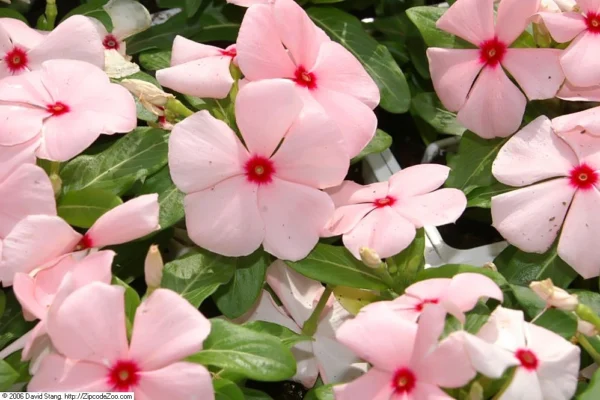
Catharanthus roseus ‘Cooler Apricot’
A Cooler selection with soft apricot toned flowers. Its pale colour is useful beside deeper colours in a container. It remains a tender summer plant despite the series name Cooler.
Photo: David J. Stang, CC BY-SA 4.0. Resized and optimised; cropped for display. Adapted image under the same licence.
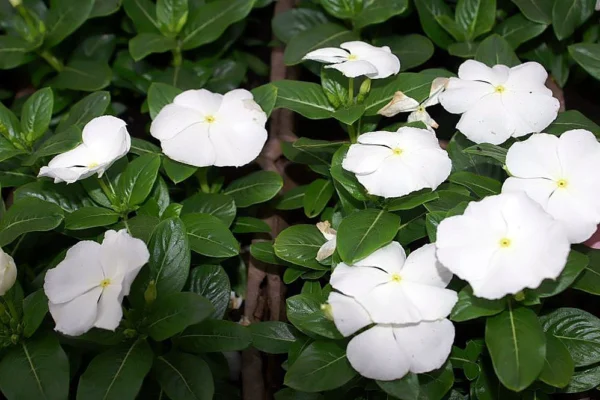
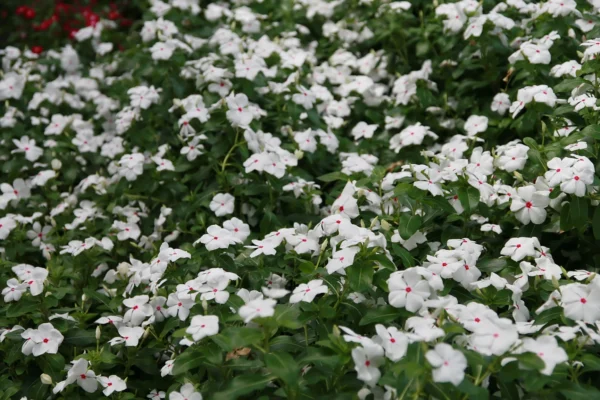
Catharanthus roseus ‘Cooler Coconut’
A white flowered Cooler selection for a restrained summer display. Check the label when buying because the same selection may be listed with Coconut and Cooler in the opposite order.
Photo: David J. Stang, CC BY-SA 4.0. Resized and optimised; cropped for display. Adapted image under the same licence.
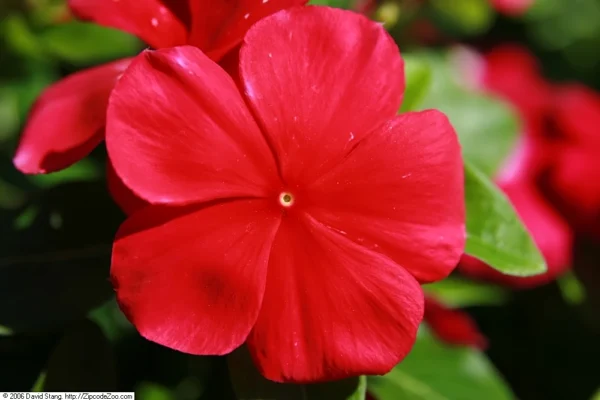
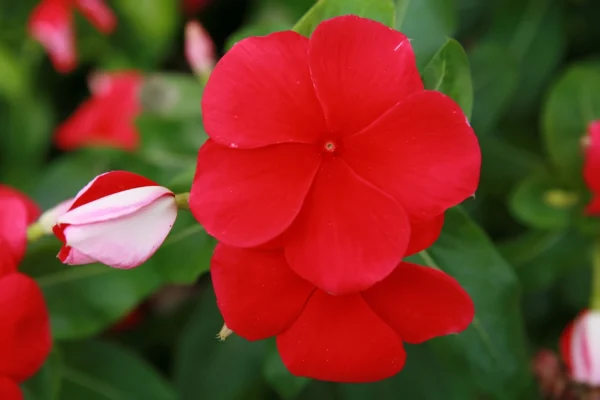
Catharanthus roseus ‘Pacifica Dark Red’
A Pacifica selection with rich red flowers for warmer colour schemes. Give it the same sunny position and drained root conditions as other annual vincas; colour does not change its frost sensitivity.
Photo: David J. Stang, CC BY-SA 4.0. Resized and optimised; cropped for display. Adapted image under the same licence.
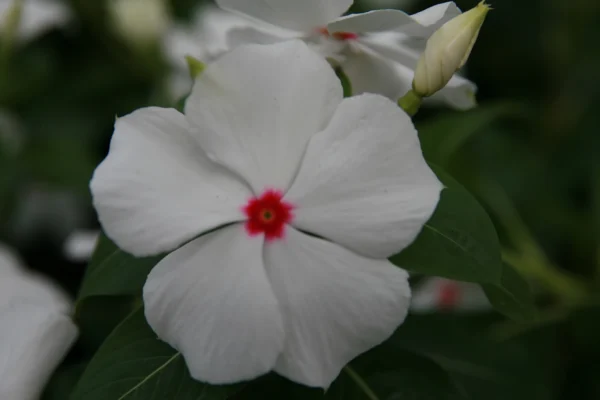
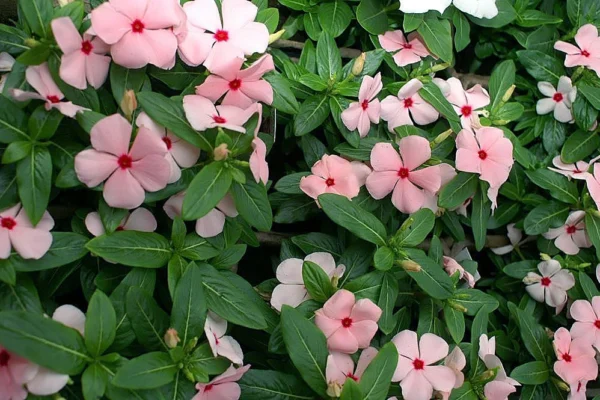
Catharanthus roseus ‘Titan Polka Dot’
A Titan selection with white flowers and a contrasting central eye. Titan plants are bred for prominent flowers and branching. Do not assume this older Titan selection has every resistance trait claimed for newer Titan ium products.
Photo: David J. Stang, CC BY-SA 4.0. Resized and optimised; cropped for display. Adapted image under the same licence.
Explore the BFFD map for local growers and plant suppliers. Ask specifically for Catharanthus roseus and check available cultivars, collection arrangements and whether young plants still need protected growing conditions.
Annual vinca is grown primarily for ornamental summer colour. Flowers may receive insect visits, but avoid treating a single bedding plant as a complete wildlife planting scheme. Combine the display with a wider sequence of locally suitable flowering plants.
Keep Catharanthus separate from edible crops at harvest and do not use its flowers as food decoration. The plant contains harmful compounds and is not a home remedy. Choose a position where children and animals are unlikely to chew it.
Published by Buy From Farmers Direct. Sources checked 4 October 2026. Growing references: RHS: Catharanthus roseus; NC State: annual vinca; Clemson Extension: annual vinca; Clemson Extension: vinca diseases; RHS: damping off; RHS: sowing seeds indoors; RHS: Apricot Cooler; RHS: Coconut Cooler; PanAmerican Seed: Titan series. The seasonal timeline uses the shared BFFD Growers Calendar record; adjust timings to your variety and local conditions.
No. Annual vinca is Catharanthus roseus, a tender plant grown for summer colour. Vinca minor is a different, hardy perennial commonly used as spreading ground cover. Their watering, siting and winter care should not be copied from one to the other.
Yes, during warm summer weather in a sunny, sheltered position. Plant it out after frost risk has passed and the site has warmed. In cooler gardens, a container that can be moved under suitable protection is useful.
Not reliably outdoors in Britain. Although it is perennial in a suitable climate, frost kills it. Treat it as annual bedding or overwinter a healthy plant in a bright, adequately warm protected space.
Usually not. The flowers are generally self cleaning. Remove damaged material and fallen debris when necessary, but regular removal of every spent flower is not essential for the display.
Start by checking soil moisture and drainage. Cold, wet roots are a common concern, but several problems can cause yellowing. Check the stem base, roots, light and feeding rather than assuming the plant simply needs more water.
No. Catharanthus roseus is an ornamental plant containing harmful compounds. Do not eat its flowers or leaves, add them to drinks or use them as a home treatment. Keep it away from edible harvests.
Give annual vinca warmth, light and a root zone that drains well, then use the Growers Calendar to plan your summer display. The BFFD directory can help you begin a conversation with local plant suppliers about suitable young plants.
Explore more growing guides: Alyssum, Aster (China), Amaranthus.
Want to get food independence, support your local grower, get better prices and shop more privately?
Local food isn’t just something you find. It’s something you protect. A free account helps keep local supply visible, supported, and resilient.

….it takes 30 seconds for food lovers and 5 minutes for suppliers
We built this for people who care where their food comes from. For people who want to remain food secure. For Farmers to get to the local people, who deserve a better income and to deliver a better price for you. For the environmentally conscious and the privacy-conscious. An account simply helps us make the map and supplier reach more useful to you, without changing how open it is. You’re always in control.


Find local food. Stay connected to it. Create a free account to support local producers and be part of a growing food network.


