Aubergines reward warmth, steady care and a long growing season. Their handsome leaves and purple flowers make them attractive plants even before the fruits develop. In most UK gardens, a greenhouse or polytunnel gives the strongest prospect of a worthwhile crop. Start with a few plants, choose an early variety and make room for regular watering and harvesting.
Tender summer crop
Best under cover
Full sun
Suitable for pots
Harvest glossy fruits
| Botanical name | Solanum melongena |
| Family | Solanaceae |
| Other names | Eggplant and brinjal |
| UK growing habit | Usually grown as an annual |
| Hardiness | Frost tender |
| Typical height | About 60 cm to 1 m, sometimes taller |
| Position | Warm, sunny and sheltered |
| Best protection | Greenhouse or polytunnel |
| Soil | Fertile, moist and well drained |
| Sowing | Indoors in late winter or early spring |
| Seed warmth | At least 21°C for germination |
| Final pot | At least 30 cm diameter |
| Plants per pot | One |
| Ground spacing | About 60 cm |
| Support | Canes and soft ties |
| Main harvest | August and September |
| Fruit colours | Purple, white, green and striped forms |
| Feeding | Potassium rich feed once flowering |
| Propagation | Seed or purchased young plants |
| Common pests | Aphids, whitefly and spider mites |
| Plant name | Crop type | Spacing |
Sow indoors
Plant outdoors
Harvest
Polytunnel | |||||||||||
|---|---|---|---|---|---|---|---|---|---|---|---|---|---|---|
| Jan | Feb | Mar | Apr | May | Jun | Jul | Aug | Sep | Oct | Nov | Dec | |||
| Aubergine | Unusual & exotic | Single 0.60m, In row 0.60m, Row gap 0.60m | No activity recorded | Sow indoors | Sow indoors | Plant outdoors | Plant outdoors, Polytunnel | Plant outdoors, Polytunnel | Polytunnel | Harvest, Polytunnel | Harvest, Polytunnel | Harvest, Polytunnel | No activity recorded | No activity recorded |
Sow indoors: February, March. Plant outdoors: April, May, June. Harvest: August, September, October. Polytunnel: May, June, July, August, September, October.
February and March sowing means indoors with warmth and good light. April planting applies to heated glass, May to suitably warm unheated protection, and late May or June to outdoor planting after frost. August and September are the main harvest months; October cropping requires favourable protected conditions. May to October polytunnel marks a possible protected growing season, not a promise of frost protection or continuous harvest.
Aubergines suit gardeners who can check a protected crop regularly. Start with a single large pot. Several small fruits may be more useful in the kitchen than waiting for one exhibition sized specimen.
An exposed allotment or shaded balcony is a difficult starting point. If you lack warm seed raising space, buy healthy young plants in spring. Arrange their final position before ordering so they are not held in tiny pots while nights remain cold.
Photo: Eric Polk, CC BY-SA 4.0. Resized and optimised; cropped for display. Adapted image under the same licence.
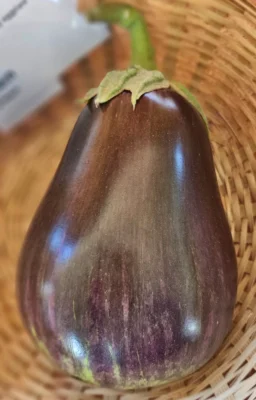
Give plants your brightest warm growing space. A greenhouse extends the useful season, while an outdoor trial needs a sunny, sheltered site in a mild district. Protection does not remove the need to monitor temperature.
In a greenhouse, leave access to water and inspect each plant. Plan its mature width alongside tomatoes or cucumbers instead of filling every gap with another small seedling. Crowded leaves make problems harder to see.
Use fertile soil with drainage and enough organic matter to hold moisture. Rotate aubergines with other crops where practical because they share soil problems with tomatoes, peppers and potatoes. Fresh container compost is useful where greenhouse soil is suspect.
Choose a stable pot with drainage holes and compost without peat. A pot at least 30 cm across accommodates one plant. Keep its base draining freely, and position it where a cane can support the eventual fruit load.
Photo: Ranjithsiji, CC BY-SA 3.0. Resized and optimised; cropped for display. Adapted image under the same licence.

Prepare supports, containers and a warm final position before moving plants. A forecast of cold nights is a reason to delay outdoor planting.
1.
Sow indoors in February or March, following the packet depth and using clean pots and fresh compost.
2.
Provide at least 21°C for germination, then move emerged seedlings promptly into good light.
3.
Grow seedlings on in bright conditions, aiming for about 16 to 18°C, and avoid letting compost dry completely.
4.
Pot seedlings individually once they have their first true leaves, handling them gently.
5.
Gradually acclimatise plants before moving into unheated protection or outdoors.
6.
Plant at their existing depth, with around 60 cm between plants in the ground.
7.
Insert a sturdy cane and secure the stem with a loose soft tie.
8.
Water in and label each variety, recording the planting date for next season’s comparison.

Watering
Check the root area frequently while plants grow and fruit. Container demand increases quickly in hot weather. Water enough to moisten the compost through its depth, then allow excess water to drain. A dry surface alone does not tell you how wet the whole pot is.
If using drip irrigation, check that every outlet works and adjust the supply as plants enlarge. Ventilate warm structures and monitor humidity. Watering the roots and managing greenhouse air are separate jobs; one cannot compensate fully for neglecting the other.

Feeding
Once container plants flower, use a potassium rich liquid feed at the recommended dilution, commonly every fortnight. Measure accurately; concentrated feed is not a reliable way to speed a disappointing crop.
Enriched border soil may need less supplementary feeding. Excess nitrogen can encourage leaves at the expense of timely fruiting. Consider soil fertility, plant colour and growth together before adding another product.

Pruning
Pinching the main growing tip at around 30 cm encourages branching. Continue tying in stems as the plant grows. Support heavily loaded side branches before fruit weight bends them sharply.
On large fruited varieties, retain around five or six developing fruits and remove further flowers. Small fruited selections can carry more. Late in summer, stop encouraging new fruit that cannot mature before conditions deteriorate.

Winter care
UK gardeners normally clear aubergines after the crop finishes. They are not hardy outdoor perennials here. Pick usable fruit before frost, remove spent plants and review which varieties justified their space.
Clean empty pots, reusable ties and the growing area before the next crop. Keep a note of pests rather than simply moving an infested plant indoors. Plan next year’s seed order around available light and warmth.
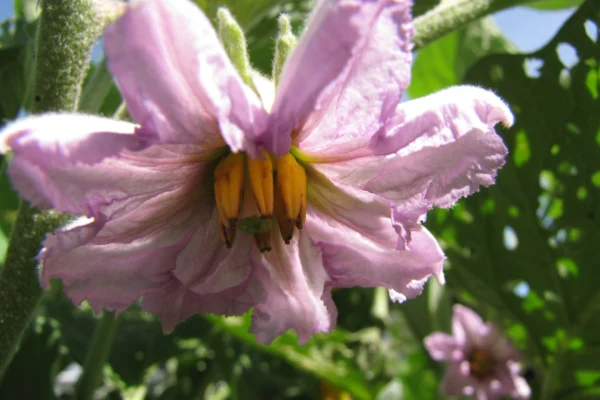
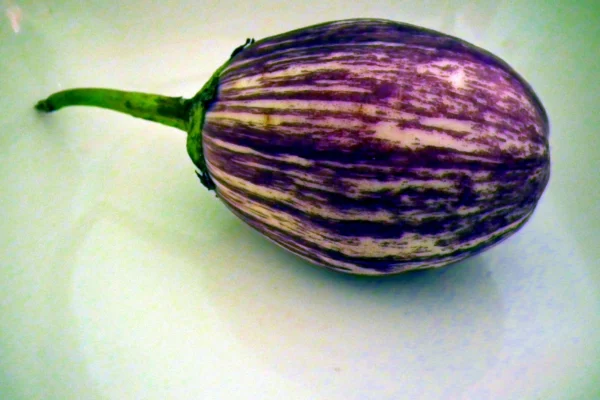
Aubergines have broad leaves, branching stems and usually purple, sometimes white, flowers. Fruit shape varies from long and narrow to rounded or egg shaped. The familiar dark purple fruit is only one form of this diverse crop.
Harvest fruit while the skin is still glossy and the size is appropriate for its variety. Cut the stalk with secateurs, leaving a short piece attached. Do not pull against a loaded branch. Some plants carry small spines, so handle the calyx and stems carefully.
Photo: Forest & Kim Starr, CC BY 3.0 US. Resized and optimised; cropped for display.
A warm summer can transform an outdoor crop, but results vary greatly between seasons. In cooler or exposed regions, reserve protected space if you want dependable progress. A successful tomato summer does not automatically guarantee equally good aubergines.
Use a minimum and maximum thermometer to understand the growing space. A warm afternoon can hide a cold night. Early sowing only helps if the seedlings can continue growing in sufficient warmth and light.
Pick regularly and use fruit promptly for the best kitchen quality. Compare the first harvest date as well as total yield when judging varieties. Keep a small record of sowing, planting and harvest dates to refine the calendar for your own garden.
Photo: Ramesh NG, CC BY-SA 2.0. Resized and optimised; cropped for display. Adapted image under the same licence.
Cold conditions, uneven moisture or poor pollination can limit cropping. Check the growing environment first. Open greenhouse doors and vents on warm days for insect access; gentle hand pollination with a small brush can also help.
Inspect leaf undersides for glasshouse spider mites, especially in hot, dry conditions. A hand lens helps distinguish them. Suitable biological controls are available, but choose one matched to the pest and follow the supplier’s temperature requirements.
Glasshouse whitefly can leave sticky honeydew and encourage black sooty mould. Inspect new plants before introducing them. Early biological control is more useful than waiting until every plant is heavily affected.
Check drainage and root condition rather than immediately adding more water. Persistent wilting can involve root or soil disease. Isolate a suspect pot and seek a diagnosis if the cause remains unclear.
Dull skin can indicate that harvest has been delayed. Check fruit frequently and judge against the expected size of that variety. Do not wait for a small fruited cultivar to reach supermarket aubergine dimensions.
Seed is the usual home propagation method. Buy a named variety with suitable maturity and fruit size, label the sowing clearly and raise only as many plants as your warm space can hold. Keep spare seedlings briefly rather than overcrowding the main crop.
Seed saved from an F1 hybrid will not reliably reproduce the parent variety. Saving aubergine seed also means leaving fruit beyond its normal eating stage. For a first attempt, fresh purchased seed or a healthy young plant gives a clearer starting point.
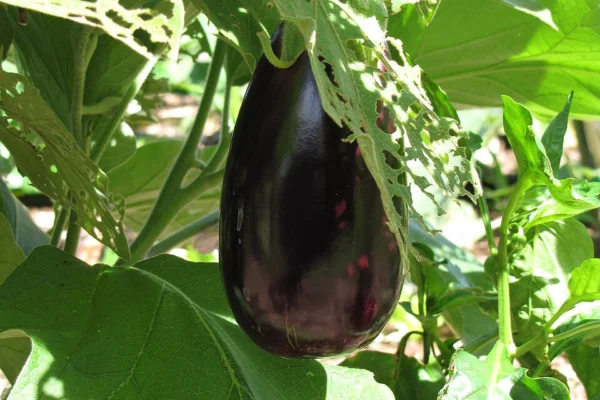
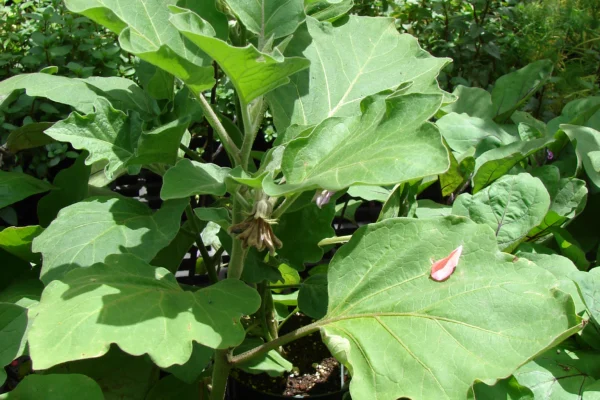
Solanum melongena ‘Black Beauty’
A longstanding selection with large purple black, egg shaped fruits and a bushy plant that can approach 1 m. Allow adequate support and a long warm season. Useful for gardeners who want the familiar substantial aubergine shape.
Photo: Forest & Kim Starr, CC BY 3.0 US. Resized and optimised; cropped for display.
Solanum melongena ‘Bonica’
An early cropping selection with large glossy dark fruits. Give it room and support, particularly under glass where growth can be strong. Choose it for a substantial fruit crop rather than assuming every early variety makes a tiny patio plant.
Illustrative aubergine photograph: Black Beauty plant, not Bonica.
Photo: Forest & Kim Starr, CC BY 3.0. Resized and optimised; cropped for display.
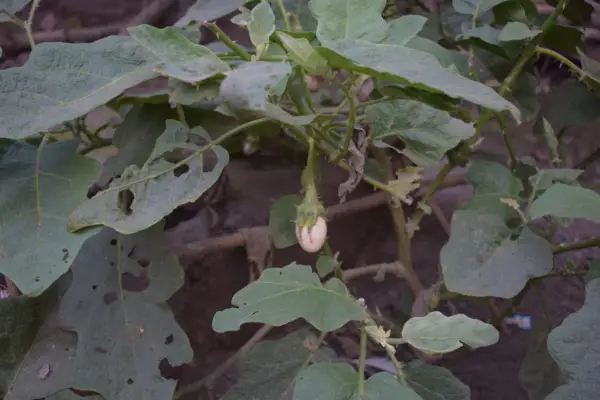
Solanum melongena ‘Clara’
Produces white, egg shaped fruit, sometimes with slight ribbing. It offers a clear contrast with dark varieties and can reach around 1 m. Keep the label nearby because fruit colour alone cannot establish the identity of a named cultivar.
Illustrative white aubergine photograph; cultivar not identified.
Photo: Anup Sadi, CC BY-SA 4.0. Resized and optimised; cropped for display. Adapted image under the same licence.
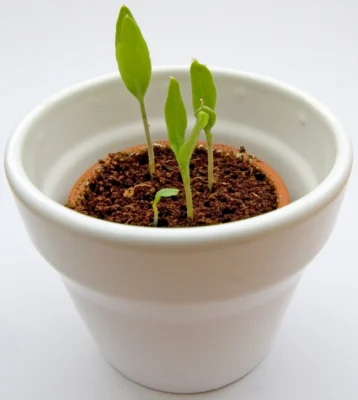
Solanum melongena ‘Kaberi’
A useful container option producing small, egg sized fruits that mature relatively quickly. It suits gardeners who prefer modest individual harvests. Still provide warmth, adequate root space and support rather than treating small fruit as a sign of cold tolerance.
Illustrative aubergine seedlings; cultivar not identified as Kaberi.
Photo: Michael Bemmerl, CC BY 3.0 DE. Resized and optimised; cropped for display.
Use the BFFD map to find local growers and suppliers. Ask which varieties they raise and whether they sell young plants or harvested aubergines. Confirm seasonal availability before travelling.
Allow pollinating insects access to protected flowers on suitably warm days. Keep other flowering plants in the wider garden so the crop sits within a varied growing space. Avoid trapping visiting insects inside a closed structure unnecessarily.
Look closely before treating pests. Useful predators may already be present, and biological controls can help manage greenhouse problems. Sticky traps also catch unintended insects, so use them thoughtfully for monitoring rather than as a complete solution.
Published by Buy From Farmers Direct. Sources checked 4 October 2026. Growing references: RHS aubergine growing guide; Garden Organic aubergine guide; University of Minnesota growing eggplant; RHS vegetables in greenhouses; RHS Black Beauty profile; RHS Bonica profile; RHS Clara profile; RHS Kaberi profile; RHS glasshouse red spider mite; RHS glasshouse whitefly. The seasonal timeline uses the shared BFFD Growers Calendar record; adjust timings to your variety and local conditions.
Start indoors, provide a long warm season and grow under cover where possible. Choose an early variety, support the plant and maintain steady moisture. Outdoor crops depend much more on location and summer weather.
Yes. Use one plant in a pot at least 30 cm across, with drainage holes and suitable compost. Compact or small fruited selections are convenient, but they still need regular watering and feeding.
February or March indoors is a practical starting point. January sowing only makes sense with suitable heated growing facilities. Buying young plants is useful if you cannot provide enough light and warmth.
A greenhouse or polytunnel is the most useful option in much of the UK. A sheltered sunny outdoor site can work in mild districts or warm summers, but results are less dependable.
Harvest once each fruit reaches its variety’s expected size and still has glossy skin. Cut its stalk rather than pulling. Most UK crops begin yielding in late summer.
Do not routinely strip them as if training a cordon tomato. Branches carry the crop. Support them and manage fruit numbers according to variety and the time left in the season.
Use the growers calendar to plan sowing and planting, then adjust it using your own greenhouse temperatures and harvest notes. The BFFD directory can help you explore local growers alongside your home crop.
Explore more growing guides: Basil, Beans (French), Beetroot.
Want to get food independence, support your local grower, get better prices and shop more privately?
Local food isn’t just something you find. It’s something you protect. A free account helps keep local supply visible, supported, and resilient.

….it takes 30 seconds for food lovers and 5 minutes for suppliers
We built this for people who care where their food comes from. For people who want to remain food secure. For Farmers to get to the local people, who deserve a better income and to deliver a better price for you. For the environmentally conscious and the privacy-conscious. An account simply helps us make the map and supplier reach more useful to you, without changing how open it is. You’re always in control.


Find local food. Stay connected to it. Create a free account to support local producers and be part of a growing food network.


