Banksias bring evergreen foliage, striking flower spikes and woody seed heads to a collection of unusual plants. In Britain, success starts with a realistic choice of species and winter shelter. A specimen thriving in a mild coastal garden is not proof that every banksia will survive an inland winter. Match the plant to the place before planning its display.
Evergreen shrubs
Full sun
Excellent drainage
Species choice matters
Winter protection
| Botanical name | Banksia species |
| Family | Proteaceae |
| Plant type | Evergreen shrubs and trees |
| Origin | Mostly Australia |
| Garden use | Specimen or protected container |
| Light | Full sun or full light under glass |
| Soil | Well drained, usually acid to neutral |
| Feeding | Low phosphorus or phosphate free feed |
| Height | Highly variable with species and provenance |
| Spread | Check the exact plant before buying |
| Flower colours | Cream, yellow, orange or red |
| Flower season | Varies by species and growing conditions |
| Foliage | Evergreen; leaf shape varies |
| Seed heads | Woody clusters of follicles |
| UK hardiness | Species specific; many need protection |
| Planting season | Spring after local frost risk |
| Sowing | Spring under suitable warmth |
| Propagation | Seed or suitable cuttings |
| Pruning | Usually light, species dependent |
| Edible crop | Grown here as an ornamental |
| Plant name | Crop type | Spacing |
Sow indoors
Plant outdoors
Harvest
Polytunnel | |||||||||||
|---|---|---|---|---|---|---|---|---|---|---|---|---|---|---|
| Jan | Feb | Mar | Apr | May | Jun | Jul | Aug | Sep | Oct | Nov | Dec | |||
| Banksia | Unusual & exotic | Species dependent; allow mature spread, commonly 2m or more for shrubs | Polytunnel | Polytunnel | Sow indoors, Polytunnel | Sow indoors, Polytunnel | Plant outdoors | Plant outdoors, Harvest | Harvest | Harvest | Harvest | Harvest, Polytunnel | Harvest, Polytunnel | Harvest, Polytunnel |
Sow indoors: March, April. Plant outdoors: May, June. Harvest: June, July, August, September, October, November, December. Polytunnel: January, February, March, April, October, November, December.
The spring sowing and planting windows assume protected propagation and planting after frost risk. The calendar’s Harvest band marks a broad possible flower display, not an edible crop or a guarantee: flowering seasons differ between species. Protected winter months mean a suitable bright shelter; an unheated polytunnel is not automatically frost free.
Banksia suits a gardener who can give an individual plant attention and space. Before ordering, ask for its full botanical name, likely mature size and the conditions in which the nursery has overwintered it. A small sale pot can conceal the eventual scale of a tree.
Choose an open, sunny position with room to inspect the plant. Avoid tucking it behind a dense shrub where light and access are poor.
Drainage matters as much as warmth. A pocket of improved compost in heavy, wet ground can still collect water. In such a position, use a suitable container or a genuinely well drained raised planting area rather than assuming extra grit in the hole will solve the problem.
For containers, use a freely draining peat free mix appropriate to the species. Check whether the compost already contains fertiliser. A product sold for acid loving plants is not automatically low in phosphorus, so read its nutrient information.
A greenhouse or conservatory should offer good light and ventilation. Leave room around the foliage and keep the drainage holes clear. A sunny enclosed space can overheat in spring even while nights remain too cold for a tender plant outdoors.
Photo: Donald Hobern, CC BY 2.0. Resized and optimised; cropped for display.
Buy a healthy, accurately labelled plant and prepare its permanent position or next container before removing it from the nursery pot.
1.
Confirm the species, mature dimensions and winter requirements with the supplier. Retain the label for future pruning and feeding decisions.
2.
Plan a spring move when the weather is settling. Gradually accustom protected plants to outdoor light and air before leaving them out.
3.
Water the nursery pot if needed, then allow excess water to drain. Handle the plant by its container and root ball.
4.
Prepare a container with unobstructed drainage, or a sunny garden position whose soil drains freely through winter.
5.
Remove the pot carefully and avoid unnecessary tearing or washing of the roots. Keep the root ball supported.
6.
Set the plant at its existing depth. Do not bury the stem base beneath a thick new layer of compost or soil.
7.
Backfill gently and water to settle the planting. Check that water escapes instead of remaining in a saucer.
8.
Record the name and planting date. Inspect moisture and wind stability regularly while the roots establish.

Watering
Water a newly planted banksia according to the moisture in its root ball, not simply the appearance of the surrounding soil. A dry nursery root ball can remain dry within a damp border.
Container plants need regular checks in warm weather. Water thoroughly when needed, then let surplus water escape. In cool weather, reduce the frequency as growth slows, without letting the whole root ball become completely dry.

Feeding
Use a low phosphorus or phosphate free feed suitable for banksias, following its label and the advice for the species. Avoid routinely adding bonemeal or a general high phosphate planting fertiliser. More nutrition does not necessarily mean a healthier plant.
Record what the compost contains and when you feed. If growth deteriorates, examine roots, drainage and temperature before adding another product.

Pruning
Prefer light shaping of young growth where needed. Keep enough leafy growth to maintain the plant and check the species before cutting into old wood. Banksias differ in their ability to recover from severe pruning.
Banksia ericifolia lacks the woody basal structure that allows some other banksias to regenerate after heavy cutting. Do not treat all species as hedge plants. Remove clearly dead or damaged material carefully and retain attractive seed heads if desired.

Winter care
Move a tender potted specimen into its planned shelter before damaging cold arrives. Use the actual minimum temperature in that shelter when assessing its suitability. A fleece cover slows heat loss but cannot turn a prolonged freeze into frost free conditions.
Keep winter light levels as high as practical and ventilate during suitable weather. Inspect plants after cold spells, but wait for the extent of injury to become clear before removing apparently damaged growth.
Banksia flower spikes consist of many individual flowers packed together. Their spent heads can become persistent woody structures bearing seed follicles. These are often called cones, although they are not the true cones of conifers.
Leaves can be broad, narrow, toothed or almost needle like, depending on the species. Coast and silver banksias often show pale leaf undersides. Flower colour alone is insufficient to identify an unknown plant, so keep a reliable nursery label.
Photo: Hesperian, CC BY-SA 4.0. Resized and optimised; cropped for display. Adapted image under the same licence.
In exceptionally mild, sheltered gardens, selected banksias may grow outdoors permanently. The RHS rates Banksia integrifolia subsp. monticola H3, a rating for coastal and relatively mild UK conditions. That is not a promise of survival in every British garden.
In inland or northern locations, a protected container plant is a more controllable trial than an expensive permanent planting. Consider how you will move the pot as it becomes heavier, and whether its eventual height fits the winter space.
Published Australian flowering dates and descriptions of frost tolerance reflect Australian conditions. Use UK species guidance for winter decisions. Record your own flowering dates so the shared calendar becomes a planning aid rather than a fixed expectation.
Photo: JJ Harrison, CC BY-SA 3.0. Resized and optimised; cropped for display. Adapted image under the same licence.
Check compost moisture, drainage and the feeding history. Unsuitable soil chemistry or excess phosphorus may contribute. Do not assume every yellow leaf calls for more fertiliser.
Root damage or Phytophthora may be involved. Improve the growing conditions and seek a diagnosis for a valuable plant. Avoid moving suspect soil into other pots.
Insufficient light or crowding can encourage an open habit. Improve access to sunlight gradually and reassess neighbouring plants before attempting a severe cut back.
Frost or drying wind may have injured exposed foliage. Protect the plant from further exposure and assess new growth before deciding how much to prune.
Inspect for slugs and snails, particularly around sheltered pots. Remove hiding places immediately beside the plant and protect vulnerable growth using an appropriate method.
Spring is a useful UK starting point for seed under protection. Use clean pots and a very freely draining seed compost, and follow species specific germination instructions. Sow modest numbers so each seedling can receive enough light and individual attention.
Cuttings preserve a named selection more reliably than seed. The timing and method vary, and suitable warmth may be needed. Ask the supplier for a protocol for the exact plant rather than applying instructions for an unrelated banksia.
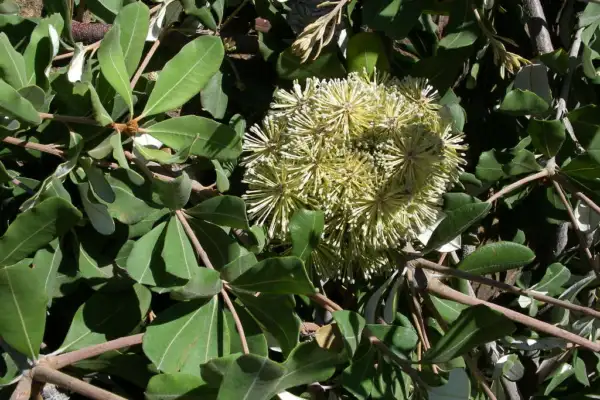
Banksia integrifolia
Coast banksia has leathery leaves with pale undersides and creamy yellow flower spikes. It can become a substantial tree. Ask about provenance and subspecies, especially if considering outdoor UK cultivation.
Photo: PDH, CC BY-SA 3.0. Resized and optimised; cropped for display. Adapted image under the same licence.
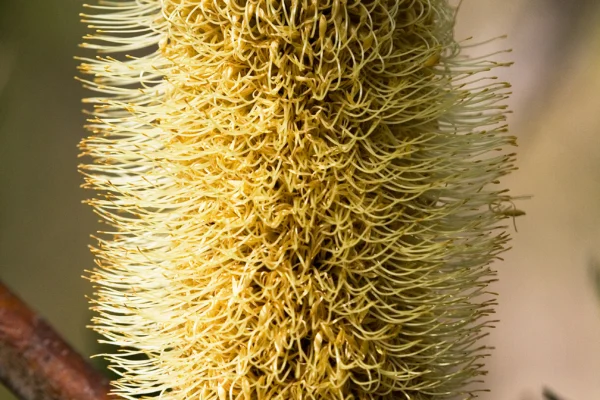
Banksia marginata
Silver banksia is notably variable in size and form. The RHS profile takes a cautious H2 approach and recommends frost free conditions. Buy a plant with known dimensions rather than relying on a generic species photograph.
Photo: JJ Harrison, CC BY-SA 3.0. Resized and optimised; cropped for display. Adapted image under the same licence.
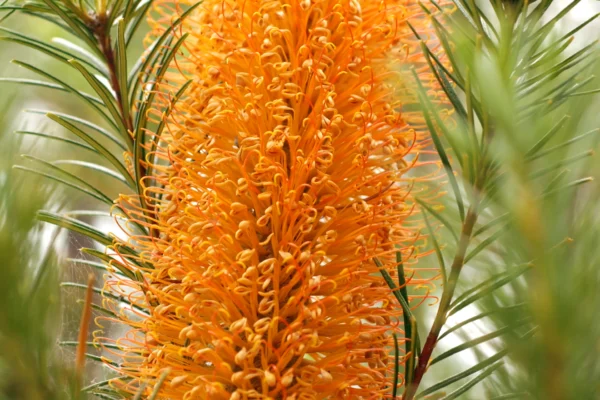
Banksia ericifolia
Heath banksia combines fine, narrow foliage with orange to reddish flower spikes. The RHS rates it H3 and describes tolerance of light frost. Give it shelter and avoid heavy pruning into old growth.
Photo: Carl Davies, CSIRO, CC BY 3.0. Resized and optimised; cropped for display.
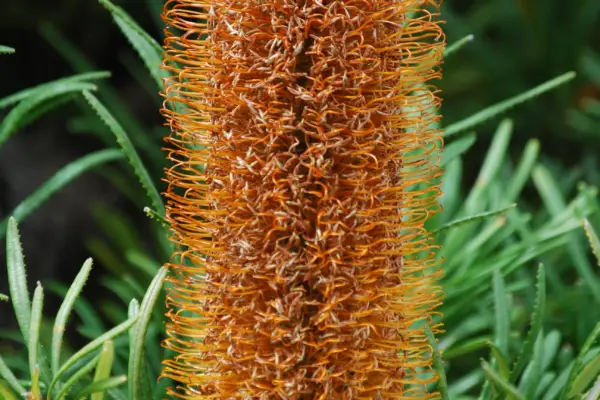
Banksia spinulosa
Hairpin banksia has narrow leaves and conspicuous hooked styles within its flower heads. Forms differ in colour and stature. Check the exact selection and its UK protection needs before choosing it for a pot.
Photo: Cs california, CC BY-SA 3.0. Resized and optimised; cropped for display. Adapted image under the same licence.
Use the BFFD map to explore specialist plant growers. Ask about the full species name, provenance, mature size and winter requirements, then confirm availability before travelling.
Banksia nectar supports birds and other animals in its native range. That does not establish an identical wildlife role in Britain, where the visiting animals and flowering conditions differ. Observe what actually uses your plant.
Keep a wider sequence of locally suitable flowering plants nearby. Avoid allowing the requirements of one unusual specimen to displace the mixed planting that provides cover and flowers through much of the year.
Published by Buy From Farmers Direct. Sources checked 4 October 2026. Growing references: RHS: Banksia marginata; RHS: Banksia ericifolia; RHS: Banksia integrifolia subsp. monticola; Australian National Botanic Gardens: Banksias; Australian National Botanic Gardens: Banksia spinulosa; Australian National Botanic Gardens: Banksia ericifolia; Australian Native Plants Society: Banksia propagation. The seasonal timeline uses the shared BFFD Growers Calendar record; adjust timings to your variety and local conditions.
Some selected plants can grow outside in mild sheltered gardens. Species, provenance, drainage and local minimum temperatures matter. Many banksias are better treated as protected container specimens elsewhere.
There is no single hardiness rating for the genus. For example, the RHS rates B. ericifolia and B. integrifolia subsp. monticola H3, while its B. marginata profile uses H2.
Yes, provided the species and eventual size suit a container. Use a draining mix, monitor watering and arrange a bright winter position with the protection that plant needs.
Choose a low phosphorus or phosphate free product suitable for the plant and follow its directions. Check the compost’s existing feed content before adding anything else.
Use light shaping at an appropriate time for the species. Do not give an unidentified banksia a hard cut back: some regenerate from old growth much less reliably than others.
A young plant may need more time, while insufficient light or unsuitable conditions can also delay flowering. Confirm its species, age and expected season before changing the feeding routine.
Explore local plant growers through BFFD and use the Growers Calendar alongside the requirements of your labelled banksia. A careful first specimen is the best way to learn what your garden can support.
Explore more growing guides: Azalea, Bay, Big Bluestem.