Garlic turns a handful of planted cloves into a summer crop that can last well into winter. Start with a named variety suited to your planting season, give it sunshine and drainage, then lift the bulbs while their skins remain intact. This guide covers ordinary bulb garlic, Allium sativum, including both hardneck and softneck types.
Plant individual cloves
Autumn or spring varieties
Sunny position
Needs good drainage
Dry thoroughly for storage
| Botanical name | Allium sativum |
| Family | Amaryllidaceae |
| Crop | Edible bulbs divided into cloves |
| Usual propagation | Individual cloves, not true seed |
| Main types | Hardneck and softneck |
| Position | Full sun |
| Soil | Fertile and well drained |
| Soil acidity | Avoid strongly acidic soil below pH 6 |
| Autumn planting window | October to December, depending on variety |
| Spring planting window | January to March for suitable varieties |
| Clove orientation | Flat base down, pointed tip up |
| Typical soil cover | About 2.5cm above the tip |
| Plant spacing | 15cm |
| Row spacing | 30cm |
| Container depth | At least 25cm |
| Main mature bulb harvest | June to August |
| Hardneck extra crop | Tender flower stalks called scapes |
| Initial drying time | Usually two to four weeks |
| Storage | Dry, cool and well ventilated |
| Greenhouse requirement | Not needed for an ordinary outdoor crop |
| Plant name | Crop type | Spacing |
Sow indoors
Plant outdoors
Harvest
Polytunnel | |||||||||||
|---|---|---|---|---|---|---|---|---|---|---|---|---|---|---|
| Jan | Feb | Mar | Apr | May | Jun | Jul | Aug | Sep | Oct | Nov | Dec | |||
| Garlic | Alliums | Single 15cm, In row 15cm, Row gap 30cm | Plant outdoors | Plant outdoors | Plant outdoors | No activity recorded | No activity recorded | Harvest | Harvest | Harvest | No activity recorded | Plant outdoors | Plant outdoors | Plant outdoors |
Sow indoors: no months recorded. Plant outdoors: January, February, March, October, November, December. Harvest: June, July, August. Polytunnel: no months recorded.
The planting band combines two routes: autumn varieties planted in October to December and suitable spring varieties planted in January to March. It is not a single window for every cultivar. There is no seed sowing band because cloves are planted. June to August represents the main mature bulb harvest; very early varieties or green garlic can be ready sooner.
Garlic is useful in a small vegetable patch because plants are narrow and the dried harvest occupies little kitchen space. Allow for several months of bed occupancy when planning the next crop.
Choose softneck varieties if storage is a priority, or add a hardneck for its larger cloves and edible scapes. Growing two labelled varieties makes comparison easier than mixing all your planting material together.
Photo: Paolo Neo, Public domain. Resized and optimised; cropped for display.
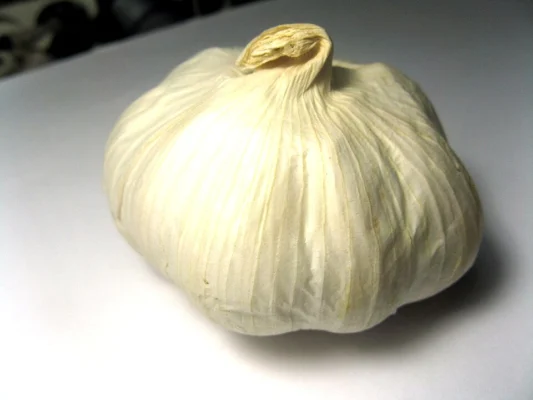
Pick a sunny, open bed that drains freely after rain. Avoid low patches where water collects, especially for cloves that will remain outside throughout winter.
Remove perennial weeds before planting and improve poor soil with well rotted organic matter. Keep fresh manure away from the planting holes.
Use crop rotation with other alliums, including onions and leeks. Where white rot is already present, an ordinary short rotation is not enough to make the soil suitable again.
Containers offer an alternative where garden soil is unsuitable. Use drainage holes, peat free compost and a depth of at least 25cm, with room to keep normal spacing between cloves.
Photo: Cecilemckee, CC BY-SA 4.0. Resized and optimised; cropped for display. Adapted image under the same licence.
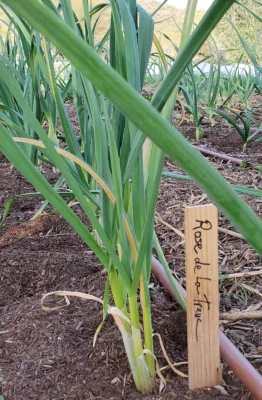
Buy bulbs sold for planting and follow their variety label. Keep them cool, dry and ventilated until you are ready to split and plant them.
1.
Choose the planting season first. Use an autumn variety for overwintering, or one explicitly suited to late winter and early spring if planting after Christmas.
2.
Prepare workable ground and remove weeds. Wait if the soil is frozen or saturated rather than forcing cloves into a wet planting hole.
3.
Separate the bulb gently into sound cloves shortly before planting. Retain their papery skins and discard any that are soft, damaged or mouldy.
4.
Make planting holes with room for the flat basal plate. Position each clove with its pointed end upright and cover the tip with about 2.5cm of soil.
5.
Allow roughly 15cm between cloves and 30cm between rows. Label each variety so its harvest and storage performance can be assessed separately.
6.
Firm lightly and water if the ground is dry. If birds pull cloves out, use a securely fitted temporary cover until roots anchor them.
7.
For wet winter ground, start cloves individually in modules kept cool and protected from excessive rain. Plant out with intact roots when conditions improve in spring.
8.
Check establishment, drainage and weeds through winter and spring. A quiet period above ground does not necessarily mean that a clove has failed.

Watering
Water during dry spring and early summer weather while leaves and bulbs are actively growing. Direct water to the soil and check containers more frequently than beds.
As mature bulbs develop and foliage begins to yellow, stop routine watering. Do not keep a crop wet simply because it has reached its expected harvest month.

Feeding
Good soil preparation provides a useful foundation. Where a feed is needed, follow a vegetable fertiliser’s label and the planting supplier’s advice rather than repeatedly adding strong doses.
Avoid excessive nitrogen, particularly where rust has been troublesome. Yellow foliage may indicate maturity, wet roots or disease as well as a nutrient shortage.

Pruning
Keep healthy leaves until harvest. On hardneck plants, cut off emerging scapes while tender so resources remain available for bulb growth; the young stalks can be cooked.
There is no need to bend or knot the leaves to force ripening. Lift a sample bulb when lower foliage yellows and judge development before harvesting the whole row.

Winter care
Autumn planted garlic normally stays outside: cool conditions help many varieties divide into cloves. Good drainage is more important than moving hardy plants into a warm room.
For harvested garlic, cure bulbs in a single layer with good airflow, protected from rain and excessive heat. After roughly two to four weeks, check that skins and foliage are thoroughly dry before trimming and storing.
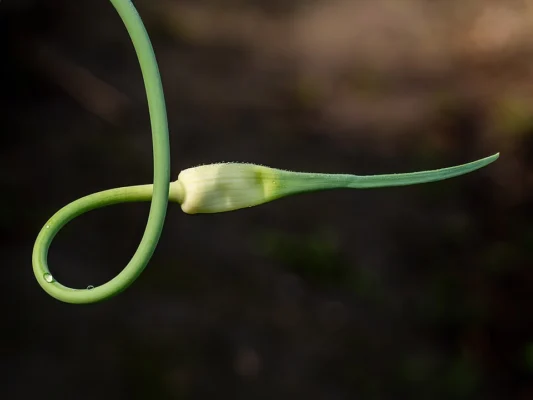
Garlic produces upright, narrow, flat leaves from a bulb made of separate cloves. Hardneck types develop a firm central flower stalk, often curling as it grows; softnecks usually lack this rigid stem.
Elephant garlic is a different allium, more closely related to leeks, and needs its own spacing. Wild garlic and garlic chives are also separate crops. Use labelled planting stock rather than identifying unfamiliar plants by smell alone.
Photo: Ermell, CC BY-SA 4.0. Resized and optimised; cropped for display. Reinhold Möller
Across much of the UK, autumn planting gives garlic time to establish before spring growth. In colder gardens, compare varieties proven locally and avoid assuming that every garlic sold for cooking will suit your conditions.
In wet western gardens and on clay, raised beds, containers or a cool module start can prevent months in saturated ground. Avoid working wet beds, which can worsen compaction.

Raised orange pustules suggest rust, which can reduce growth in a severe attack. Avoid crowding and excessive nitrogen, and clear affected crop debris after harvest.
White fluffy growth and tiny black resting bodies can indicate white rot. Do not keep affected bulbs for planting. Avoid moving contaminated soil on tools or footwear; the disease can persist for many years.
Allium leaf miner can damage leaves and bulbs. Where it occurs, combine rotation with well fitted insect mesh during adult activity, especially spring and autumn. Mesh over already infested ground is insufficient.
Review the variety, planting date, cold exposure, spacing and water supply. A single round bulb can result from insufficient chilling; growing time and general plant vigour also affect size.
Harvest damage, split skins and incomplete drying shorten storage life. Remove deteriorating bulbs promptly, improve airflow and keep damaged bulbs out of the long term store.
Each planted clove can form a new bulb. Keep the cultivar name with any home saved planting material and select sound cloves from healthy, well developed bulbs.
Garlic described as seed garlic usually means bulbs or cloves for planting. Bulbils formed on some flower stalks take longer to produce a full crop and are unnecessary for a straightforward first harvest.
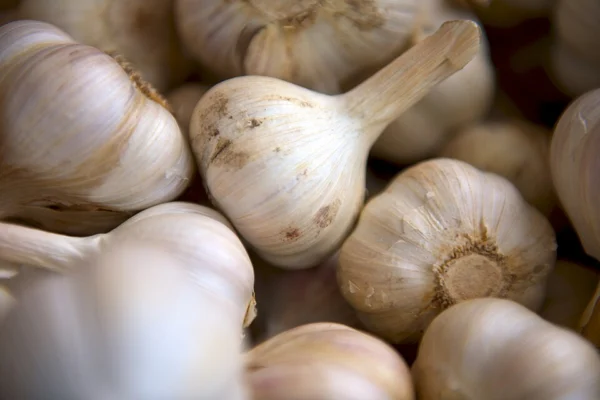
Solent Wight
A softneck silverskin associated with good keeping quality. The Garlic Farm lists October to February planting and July to August harvest, with winter planting particularly suitable.
Illustrative garlic bulbs; not confirmed Solent Wight.
Photo: Matthew Pilachowski, CC0. Resized and optimised; cropped for display.

Carcassonne Wight
A hardneck with pink skinned cloves. Its supplier lists October to December planting and June to July harvest, making it a useful contrast to a later softneck crop.
Illustrative purple skinned garlic; not confirmed Carcassonne Wight.
Photo: Topi Pigula, CC BY-SA 4.0. Resized and optimised; cropped for display. Adapted image under the same licence.
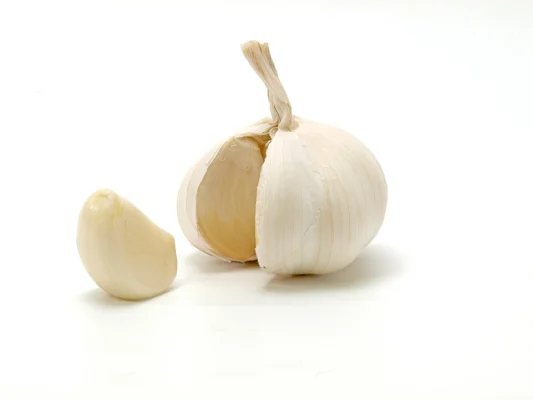
Germidour
A widely grown softneck with large bulbs. It is available for autumn planting; use the supplier’s own instructions for the stock you buy.
Illustrative bulb and clove; not confirmed Germidour.
Photo: Dubravko Sorić (SoraZG), CC BY 2.0. Resized and optimised; cropped for display.
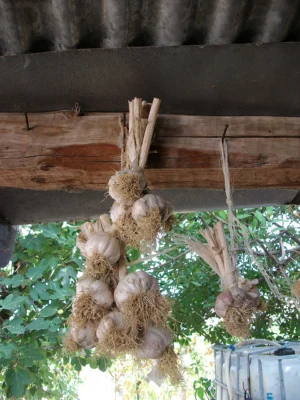
Cristo
A white softneck sold for autumn or spring planting. It offers flexibility when autumn planting is missed, although a suitable spring date still matters.
Illustrative garlic hanging to dry; not confirmed Cristo.
Photo: CosyCobra, CC BY-SA 4.0. Resized and optimised; cropped for display. Adapted image under the same licence.
Buy firm, healthy planting bulbs from a reputable supplier. Compare planting dates, likely harvest and keeping qualities. Supermarket bulbs can sprout, but their variety and suitability for UK growing may be unknown.
Garlic grown for bulbs needs no insect pollination, and its scapes are usually removed. Provide flowers elsewhere in the garden if you want a dependable resource for visiting insects.
Fit any protective mesh securely and check it often. A varied planting and regular observation are more useful than assuming garlic will repel every pest from neighbouring vegetables.
Published by Buy From Farmers Direct. Sources checked 6 October 2026. Growing references: RHS garlic growing guide; The Garlic Farm growing guide; Garden Organic garlic guide; The Garlic Farm Solent Wight; The Garlic Farm Carcassonne Wight; RHS Plants Cristo; RHS Plants Germidour; RHS leek rust; RHS onion white rot; RHS allium leaf miner. The seasonal timeline uses the shared BFFD Growers Calendar record; adjust timings to your variety and local conditions.
Most autumn varieties go in from October to December. Suitable spring varieties can be planted from January to March. Follow the cultivar label and avoid frozen or waterlogged soil.
It may grow, but named planting stock is a better starting point because its variety and planting season are known. Cooking bulbs may be unsuited to local conditions or carry disease.
Separate it into individual cloves with their skins intact. Plant the flat base down and pointed tip up. Each healthy clove has space to develop its own bulb.
Hardnecks usually have larger cloves around a rigid central stalk and produce edible scapes. Softnecks commonly contain more cloves, have flexible necks and generally store longer.
Look for yellowing lower leaves and check a sample bulb. Lift before the outer skins break apart. Loosen soil with a fork rather than pulling hard on the stem.
Cure intact bulbs with good airflow and protection from rain for about two to four weeks. Once thoroughly dry, keep them cool, dry and ventilated. Use damaged bulbs promptly and check the store regularly.
Keep varieties labelled, harvest gently and give drying enough space and time. Those simple habits help turn a successful summer crop into useful garlic for many months.
Explore more growing guides: Chives, Chives (Garlic), Carrot.
Want to get food independence, support your local grower, get better prices and shop more privately?
Local food isn’t just something you find. It’s something you protect. A free account helps keep local supply visible, supported, and resilient.

….it takes 30 seconds for food lovers and 5 minutes for suppliers
We built this for people who care where their food comes from. For people who want to remain food secure. For Farmers to get to the local people, who deserve a better income and to deliver a better price for you. For the environmentally conscious and the privacy-conscious. An account simply helps us make the map and supplier reach more useful to you, without changing how open it is. You’re always in control.


Find local food. Stay connected to it. Create a free account to support local producers and be part of a growing food network.


