Bulb onions turn a sunny patch of ground into a useful kitchen store. Start with sets for straightforward planting, or choose seed for a wider range of varieties. The main jobs are keeping weeds down, watering during growth and drying the mature bulbs carefully before storage.
Grow from sets or seed
Sunny position
Good storage crop
Spring or autumn planting
Yellow, red and white bulbs
| Botanical name | Allium cepa, Cepa Group |
| Family | Amaryllidaceae |
| Crop | Mature bulb onions |
| Life cycle | Usually grown as an annual crop; flowers in its second year |
| Starting methods | Seed, small bulbs called sets, or young plants |
| Position | Full sun |
| Soil | Fertile, well drained and weed free |
| Indoor seed sowing | January to March for the main crop |
| Outdoor seed sowing | March to April as the soil warms |
| Spring set planting | March to April |
| Autumn set planting | September to October, overwintering varieties only |
| Overwintering seed | Late summer to early autumn for suitable varieties |
| Seed depth | About 1 to 1.5cm; follow packet guidance |
| Typical germination | Around two to three weeks, depending on conditions |
| Individual plant spacing | 10 to 15cm |
| Row spacing | About 25 to 30cm |
| Set planting depth | Pointed tip just visible above the soil |
| Autumn planted harvest | Usually June to July |
| Maincrop harvest | July to early autumn, sometimes October |
| Before storage | Dry thoroughly for about two weeks |
| Plant name | Crop type | Spacing |
Sow indoors
Plant outdoors
Harvest
Polytunnel | |||||||||||
|---|---|---|---|---|---|---|---|---|---|---|---|---|---|---|
| Jan | Feb | Mar | Apr | May | Jun | Jul | Aug | Sep | Oct | Nov | Dec | |||
| Onion | Alliums | Single 10 to 15cm, In row 10 to 15cm, Row gap 25 to 30cm; multisown clumps 25 to 30cm apart | Sow indoors, Polytunnel | Sow indoors, Polytunnel | Sow indoors, Plant outdoors, Polytunnel | Sow indoors, Plant outdoors | Plant outdoors | Harvest | Harvest | Sow indoors, Harvest, Polytunnel | Sow indoors, Plant outdoors, Harvest, Polytunnel | Plant outdoors, Harvest | No activity recorded | No activity recorded |
Sow indoors: January, February, March, April, August, September. Plant outdoors: March, April, May, September, October. Harvest: June, July, August, September, October. Polytunnel: January, February, March, August, September.
January to April sowing covers the main seed crop; August and September apply only to seed varieties bred for overwintering. Spring planting includes sets and seed raised plants, while September and October are for suitable autumn onions. June and July harvests come from overwintered crops. The polytunnel band indicates optional propagation, not a requirement for growing mature bulbs.
Bulb onions suit vegetable beds, allotments and large containers. Choose varieties for everyday cooking, larger mild bulbs or long storage rather than growing more of one type than you will use.
This guide covers onions grown to mature bulbs. Spring or salad onions are usually harvested young for their slender stems and need their own sowing and harvesting approach.
Photo: Adoscam, CC BY-SA 4.0. Resized and optimised; cropped for display. Adapted image under the same licence.
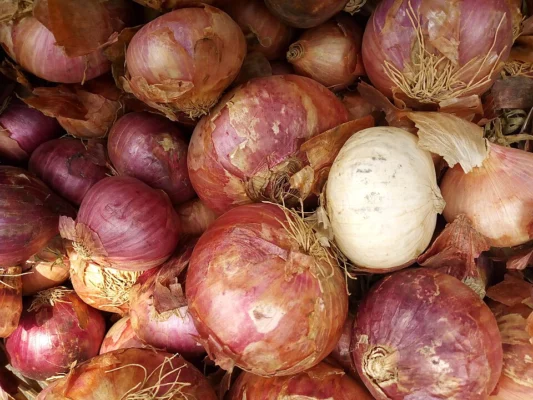
Choose open ground with plenty of sun. Onions have relatively limited roots and do poorly when crowded by weeds or shaded by larger crops.
Improve poor soil with well rotted compost ahead of planting, avoiding fresh manure. The surface should be firm enough to support the crop but loose enough to place sets without forcing them.
Avoid winter waterlogging, especially for autumn planting. If the soil stays cold and saturated, spring planting or starting sets in modules under cover is usually more reliable.
Use a container at least 45cm wide and deep, with drainage and peat free soil based compost. Space bulbs as in the ground and check moisture regularly as the pot fills with roots.
Image from the BFFD media library.
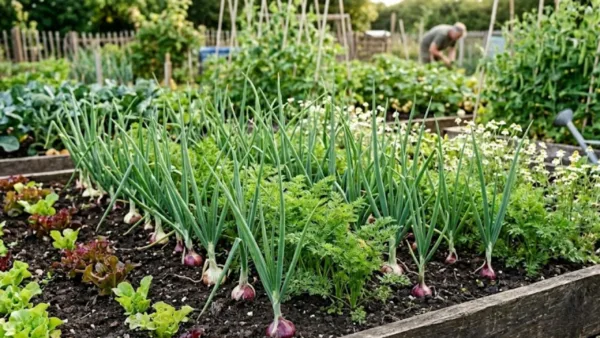
Choose a starting method and season before buying. Ordinary spring sets and specially selected overwintering onions are not interchangeable.
1.
Select sound, firm sets or fresh seed of a suitable variety. Heat treated spring sets reduce the risk of bolting. Keep unplanted sets cool, dry and airy.
2.
For a main seed crop, sow under cover from January to March, about 1 to 1.5cm deep unless the packet specifies otherwise. Give early sowings gentle warmth and good light.
3.
Raise single plants in modules, or sow three or four seeds per cell for smaller clustered bulbs. Keep seedlings growing without letting the compost become saturated.
4.
Alternatively, sow directly outdoors in March or April as the soil warms. Thin progressively to about 10 to 15cm between individual plants.
5.
Harden off seed raised plants and transplant in spring. Keep multisown clumps together, allowing about 25 to 30cm between clumps rather than single plant spacing.
6.
For spring sets, prepare rows about 25 to 30cm apart and place sets 10 to 15cm apart with their tips just showing. Firm gently and water in.
7.
For an earlier crop the following year, plant labelled overwintering sets in September or October. Follow the variety’s timing and avoid ground that becomes waterlogged.
8.
Protect newly planted sets from birds until they root, securing covers carefully. Label varieties and keep the rows weed free from the start.

Watering
Water during prolonged dry spells while roots and leaves are growing, particularly after planting and while bulbs develop. Containers dry faster than garden beds.
Stop regular watering once the bulbs have swollen and the crop starts maturing. Aim water at the soil; prolonged wet foliage and damp ripening conditions make storage more difficult.

Feeding
Well prepared soil often provides enough nutrition for the crop. On poor ground, autumn planted onions may benefit from an appropriate nitrogen feed in late winter, following its instructions.
Avoid heavy late feeding, especially after July, because soft growth and thick necks reduce keeping quality. Feed young container or module plants only as needed to maintain steady growth.

Pruning
Leave healthy green leaves intact and do not bend them over to force ripening. Remove flower stems promptly and mark any bolted bulbs to use first.
Hand weed close to bulbs so a hoe does not damage them. When foliage naturally yellows and falls, lift carefully with a fork before the leaves disappear completely.

Winter care
Established overwintering varieties can remain outside in suitable soil. Check that frost has not lifted newly rooted sets and avoid working the bed while it is saturated.
For stored onions, dry bulbs until necks and leaves are papery, then keep in a cool, dry, ventilated place. Use slatted trays, mesh bags or plaits and inspect regularly, removing any soft or rotting bulbs.
Bulb onions have upright, hollow, tubular leaves arising from a swelling base. Mature bulbs develop papery yellow, brown, red or white skins around fleshy layers.
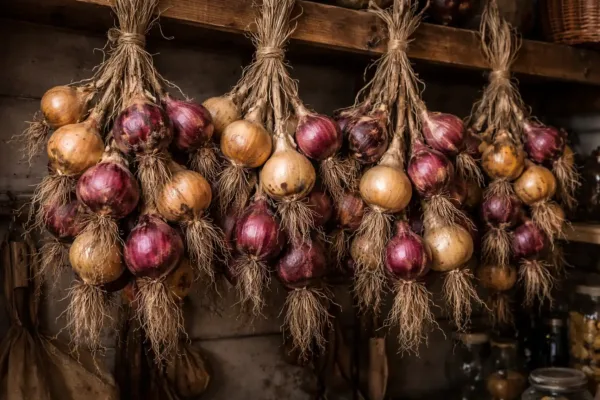
Most spring planted sets are lifted from July to September, with some seed crops later. Autumn planted onions normally mature in June or July, helping bridge the gap before the main harvest.
In wetter districts, lift during a dry spell and finish drying in a well ventilated shed or greenhouse. Air should circulate around the bulbs; protect them from rain while their necks dry.
Storage depends on variety and bulb condition. Autumn onions generally keep for a shorter time, while good maincrop storage varieties can last well into spring. Eat thick necked, bolted or damaged but otherwise sound onions first.
Image from the BFFD media library.
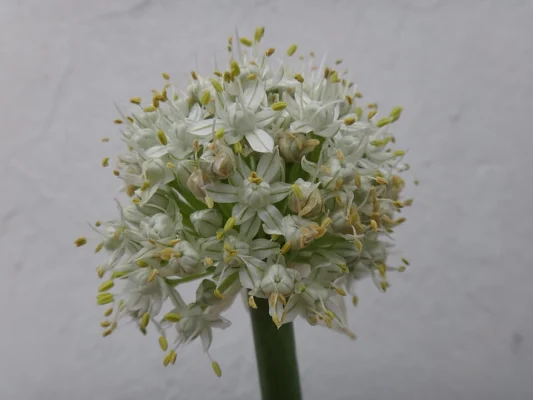
Cold exposure and other stress can trigger bolting, especially in sets. Remove the stalk and use that bulb promptly. Choose suitable planting dates and heat treated spring sets to reduce the risk next time.
Birds often tug exposed tips before the sets have rooted. Replant sound bulbs gently and use well secured fleece or netting temporarily. Do not bury the sets deeply to hide them.
Onion white rot may also produce tiny black resting bodies. Remove affected plants and keep contaminated soil off tools and footwear. It persists for years, so ordinary short crop rotation will not clear an infected bed.
Allium leaf miner can damage onions, with larvae or brown pupae inside stems and bulbs. Use suitable insect proof mesh during the spring and autumn risk periods, combined with rotation so flies do not emerge beneath the cover.
Neck rot can appear weeks after harvest. Dry onions thoroughly, avoid bruising and late nitrogen feeding, and keep thick necked bulbs out of long storage. Inspect the crop and discard decaying onions promptly.
For an annual kitchen crop, buy sets or sow fresh seed. Most bulb onions enlarge into one harvested bulb per planted set, unlike shallots that commonly divide into clusters.
Seed saving is a separate second year project. Keep healthy open pollinated onions, allow a group to flower and isolate them from other flowering onion varieties. Do not choose premature bolters; seed from F1 varieties may not produce plants like their parents.
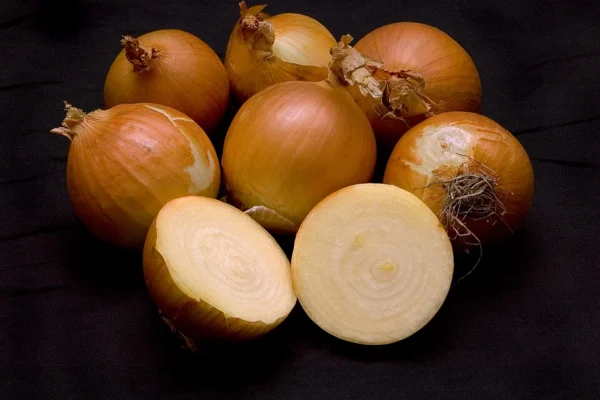
Sturon
A familiar spring planting onion with golden skin and a rounded bulb. It is valued for dependable cropping and good keeping quality when mature bulbs are properly dried.
Illustrative yellow onions; the source does not confirm Sturon.
Photo: Andrew c at English Wikipedia, CC BY-SA 3.0. Resized and optimised; cropped for display. Andrew c
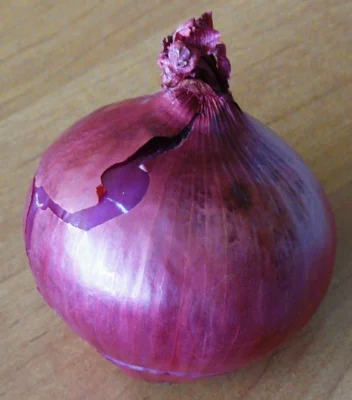
Red Baron
A red onion with firm flesh, red rings and a strong flavour. It matures in mid to late summer and can store well after careful drying.
Red Baron onion, identified by the original photographer.
Photo: MOs810, CC BY-SA 4.0. Resized and optimised; cropped for display. Adapted image under the same licence.
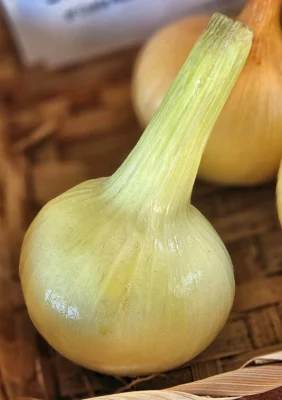
Ailsa Craig
Often raised from seed for large, mild flavoured bulbs with pale golden skin. Give large bulbs extra spacing and plan to use them earlier than long keeping storage varieties.
Illustrative exhibition onion; not confirmed as Ailsa Craig.
Photo: Eric Polk, CC BY-SA 4.0. Resized and optimised; cropped for display. Adapted image under the same licence.
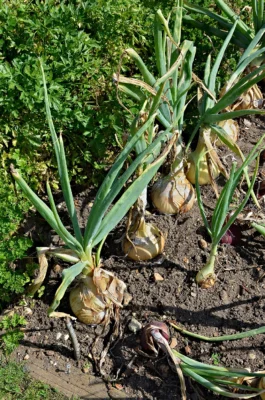
Senshyu Yellow
An overwintering Japanese type with golden, semi-globe bulbs and white flesh. Plant its sets in September or October for an earlier harvest, commonly in June.
Illustrative maturing bulb onions; not confirmed as Senshyu Yellow.
Photo: JLPC, CC BY-SA 3.0. Resized and optimised; cropped for display. Photo: JLPC / Wikimedia Commons
Compare spring sets, overwintering sets and seed varieties. A reliable storage onion plus a smaller planting of red or mild onions gives useful variety without putting every bulb into the same keeping schedule.
A few onions deliberately left to flower can attract visiting insects, but keep this separate from the main storage crop. For seed saving, account for pollen arriving from other flowering onions.
Temporary bird covers and insect mesh should be secured without loose loops. Inspect beneath them regularly and remove unnecessary protection once the vulnerable stage has passed.
Published by Buy From Farmers Direct. Growing guidance reviewed 6 October 2026. The seasonal timeline uses the shared BFFD Growers Calendar record; adjust timings to your variety and local conditions.
Usually. Sets are small immature bulbs that establish quickly. Seed takes more time and care but gives a wider choice of varieties and makes it easier to raise a large number of plants.
No. Choose a variety specifically sold for overwintering. Plant according to its directions and avoid saturated soil. Ordinary spring sets are more liable to bolt after unsuitable cold exposure.
Place each set so its pointed tip is just visible above the soil. Make a small hole in firm ground rather than forcing the bulb down and damaging its base.
For mature storage bulbs, look for natural yellowing and toppling of the leaves. Lift carefully in dry conditions before all the foliage dies. Do not bend healthy leaves over to accelerate the process.
Weed competition, close spacing, late sowing and poor early growth can all limit size. Long days trigger bulbing, so plants need enough healthy leaves beforehand. A small sound onion is still useful in the kitchen.
Choose a storage variety, lift without bruising and dry it thoroughly. Store only sound bulbs with dry necks, using good airflow and cool conditions. Use bolted, thick necked or damaged bulbs first.
Start with the right variety for your planting season, keep competition low and let bulbs mature naturally. Careful drying turns a successful onion bed into a useful supply for the months ahead.
Explore more growing guides: Chives, Chives (Garlic), Carrot.
Want to get food independence, support your local grower, get better prices and shop more privately?
Local food isn’t just something you find. It’s something you protect. A free account helps keep local supply visible, supported, and resilient.

….it takes 30 seconds for food lovers and 5 minutes for suppliers
We built this for people who care where their food comes from. For people who want to remain food secure. For Farmers to get to the local people, who deserve a better income and to deliver a better price for you. For the environmentally conscious and the privacy-conscious. An account simply helps us make the map and supplier reach more useful to you, without changing how open it is. You’re always in control.


Find local food. Stay connected to it. Create a free account to support local producers and be part of a growing food network.


