Plums give fruit for eating fresh, cooking and preserving. Choose a European variety and rootstock suited to your space. Protect blossom from frost and prune in spring or summer to reduce disease risks.
European plum varieties
Choose rootstock and size
Check self fertility
Thin heavy crops
Prune in spring or summer
| Botanical group | Prunus domestica cultivars |
| Family | Rosaceae |
| Plant type | Hardy deciduous fruit tree |
| Fruit type | Stone fruit |
| Uses | Dessert, cooking or both |
| Position | Full sun with shelter |
| Soil | Fertile, moisture retaining and well drained |
| Preferred planting | Dormant season, late autumn to early spring |
| Flowers | White blossom, usually March to April |
| Pollination | Variety dependent; many are self fertile |
| Pixy rootstock | Semi dwarfing; bush trees about 3 to 4m |
| VVA-1 rootstock | Semi dwarfing; bush trees about 3m |
| St Julien A rootstock | Semi vigorous; bush trees about 4.5 to 5m |
| Typical tree spacing | About 4m on Pixy or 5m on St Julien A |
| Container size | At least 50cm wide and deep |
| First crops | Usually after several years, depending on the tree |
| Main harvest range | July to October across early and late varieties |
| Young tree pruning | Spring, after buds begin opening |
| Established tree pruning | Summer in dry conditions |
| Picking stage | Fully coloured and slightly soft |
| Plant name | Crop type | Spacing |
Sow indoors
Plant outdoors
Harvest
Polytunnel | |||||||||||
|---|---|---|---|---|---|---|---|---|---|---|---|---|---|---|
| Jan | Feb | Mar | Apr | May | Jun | Jul | Aug | Sep | Oct | Nov | Dec | |||
| Plum | Orchard fruit | Typically about 4m on Pixy or 5m on St Julien A for bush trees; confirm cultivar and trained-form spacing | Plant outdoors | Plant outdoors | Plant outdoors | No activity recorded | No activity recorded | No activity recorded | Harvest | Harvest | Harvest | Harvest | Plant outdoors | Plant outdoors |
Sow indoors: no months recorded. Plant outdoors: January, February, March, November, December. Harvest: July, August, September, October. Polytunnel: no months recorded.
The calendar shows dormant tree planting from November to March and harvest from July to October across different varieties. One tree crops for only part of this span; those below mainly cover August to October. Container trees allow other planting dates. Seed and polytunnel rows are intentionally empty.
Plums suit gardens with room for a permanent tree and households able to use a glut. Many varieties crop as a single tree.
Heavy crops may need thinning and branch support. Small containers, frost pockets and waterlogged ground make the tree harder to manage and the harvest less dependable.
Photo: APictche, CC BY-SA 4.0. Resized and optimised; cropped for display. Adapted image under the same licence.
Choose a sunny sheltered position with fertile soil that drains well. Avoid low lying frost pockets: the tree is hardy, but early blossom is easily damaged.
Check the rootstock before buying. Pixy and VVA-1 reduce vigour, yet still produce substantial trees. St Julien A needs more space and suits a larger garden.
A fan against a south or west facing wall saves ground space. Install supports first and plant 25 to 35cm out. Conventional espalier training does not suit plums.
Use a compact cultivar on suitable stock in a stable pot at least 50cm wide and deep. Provide loam based peat free compost and clear drainage.
Photo: Gerda Arendt, CC0. Resized and optimised; cropped for display.
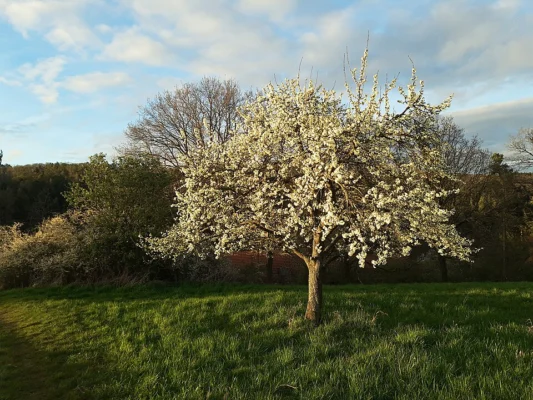
Choose the variety, rootstock and tree form together. Confirm whether the cultivar needs a pollination partner and allow room for harvesting and future pruning.
1.
Buy a healthy named grafted tree from a reputable nursery. Record its rootstock, expected size and flowering group.
2.
Plant during dormancy where practical, avoiding frozen or saturated ground. Keep bare roots protected from drying until planting.
3.
Clear a generous circle of grass and weeds. Dig a hole wide enough to spread the roots without forcing them into a narrow space.
4.
Water a container tree before unpotting, or soak bare roots for about half an hour. Check that roots are moist and undamaged.
5.
Install a stake or the supports for a trained tree. Pixy usually needs permanent support; larger rootstocks may need staking for their first several years.
6.
Keep the original soil mark level with the surrounding ground and leave the graft union above it. Backfill and firm gently.
7.
Water well, attach a flexible tie and mulch the cleared ground, leaving space around the trunk. Check ties as the trunk thickens.
8.
Follow a formative pruning plan in spring after buds open. Continue watering through dry weather while roots establish, rather than pruning a newly planted plum in winter.

Watering
Water thoroughly in dry spells during establishment. Older ground grown trees need less attention, but prolonged dryness while fruit swells can reduce the crop.
Check pots and wall trained trees regularly because restricted roots and rain shadows increase drying. Keep compost evenly moist without allowing containers to stand in water.

Feeding
Apply well rotted organic mulch in late winter or spring, keeping it away from bark. Trees in fertile, regularly mulched ground may need no additional feed.
Container trees need regular nutrients during growth. Follow a suitable fruit fertiliser’s directions; a high potassium liquid feed every fortnight from April to August is one RHS option.

Pruning
Prune young trees in spring after the buds open, and established trees in summer, commonly July. Choose dry weather with a dry spell forecast. Avoid routine autumn and winter pruning because of silver leaf and bacterial canker risks.
Remove damaged, crossing and congested growth while preserving a balanced framework. Spread major renovation over several summers. Late fruiting varieties should not have routine pruning delayed into autumn simply to wait for harvest.

Winter care
Check stakes, ties, guards and drainage. Remove shrivelled rotten fruit remaining on the tree, but leave routine branch pruning for the appropriate growing season.
Protect exposed container roots from prolonged freezing and keep drainage holes clear. In spring, cover reachable blossom on frosty nights, then remove covers during the day for insect access.
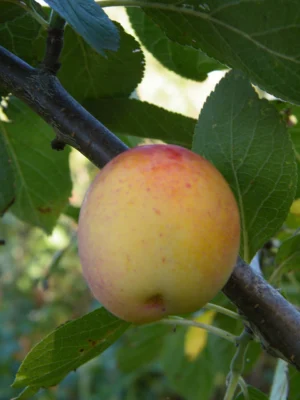
European plums have oval toothed leaves, white spring flowers and fleshy fruit surrounding a single hard stone. Depending on cultivar, skins can be yellow, red, purple or blue, often with a waxy bloom.
This guide concerns named European plums. Japanese plums, ornamental flowering plums and cherry plums are different groups with different requirements. Keep the nursery label: fruit colour alone does not identify a cultivar.
Photo: APictche, CC BY-SA 4.0. Resized and optimised; cropped for display. Adapted image under the same licence.
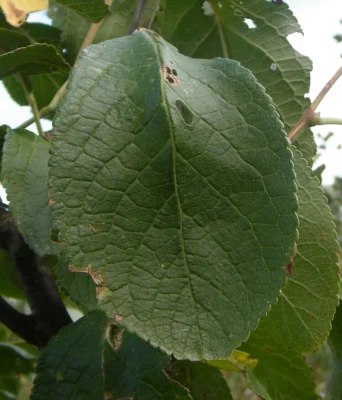
Choose a later flowering cultivar where spring frosts are frequent, while also considering whether a late crop will ripen well locally. A sheltered wall can improve conditions in a cooler garden.
Thin heavy crops in early summer to roughly one fruit every 5 to 8cm, or pairs about 15cm apart. Support heavily laden branches before they bend dangerously; preventing breakage is easier than repairing it.
Allow fruit to develop its colour and soften slightly on the tree, then pick gently over several visits. Use ripe plums promptly, or remove stones and freeze or preserve sound surplus fruit.
Photo: PROPOLI87, CC BY-SA 4.0. Resized and optimised; cropped for display. Adapted image under the same licence.
Silver leaf disease can cause these symptoms and dark staining inside affected wood, although drought or cold can also silver leaves. Seek confirmation and remove infected wood promptly with clean tools. Summer pruning reduces infection risk.
Bacterial canker may cause dead bark, dying shoots and small holes in leaves. Gum alone has other possible causes. Confirm the problem; affected branches may need removal to healthy wood in summer.
Remove rotting and mummified fruit promptly from the tree and ground. Infection spreads through wounds and between touching fruit. Thin crowded clusters, handle the harvest gently and keep damaged fruit out of storage.
Plum moth larvae feed around the stone, often in the earliest ripening fruit. Some losses can be tolerated. Pheromone traps help monitor activity but usually do not control the problem alone.
Check frost damage, pollination compatibility, spring weather and moisture. Even a self fertile plum benefits from insect visits. Some early fruit drop is normal; sustained drought or an excessive crop can increase it.
Named plums are normally grafted or budded onto a suitable rootstock, preserving their fruit characteristics and controlling vigour. Buying a nursery tree is the simplest way to obtain a known combination.
A stone may produce a large seedling with unpredictable fruit and a long wait. Shoots below the graft belong to the rootstock, not the named plum.
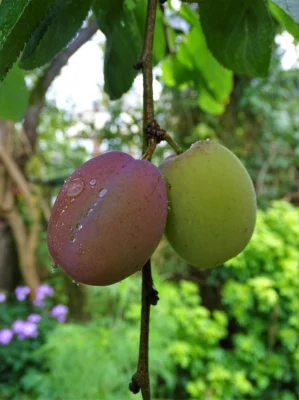
Victoria
A self fertile choice for both fresh eating and cooking, usually harvested in August or September. Thin excessive fruit early, as generous crops can strain branches and reduce fruit size.
Illustrative photograph labelled Victoria plums in a Sheffield garden.
Photo: Neil Theasby, CC BY-SA 2.0. Resized and optimised; cropped for display. Victoria plums in a Sheffield suburban garden by Neil Theasby
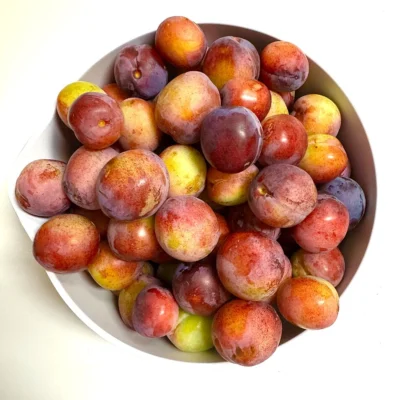
Opal
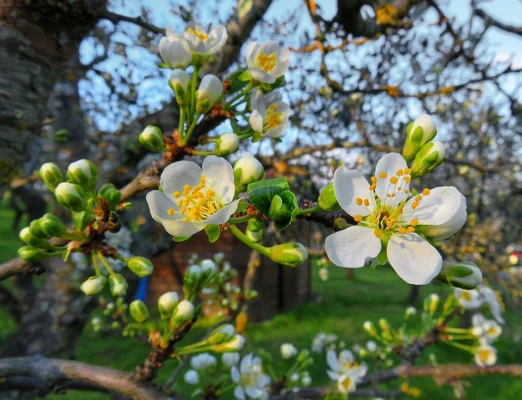
Blue Tit
A relatively compact, self fertile blue plum with later flowering and a typical mid August crop. It is useful to compare for smaller spaces, with the right rootstock and training.
Illustrative European plum blossom; not verified as Blue Tit.
Photo: PROPOLI87, CC BY-SA 4.0. Resized and optimised; cropped for display. Adapted image under the same licence.
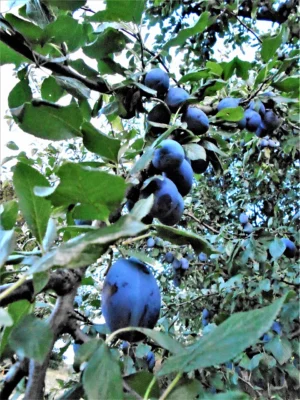
Marjorie’s Seedling
A vigorous, self fertile plum giving blue fruit in late September or October. Useful for cooking and jam, it has some bacterial canker resistance, which does not mean immunity.
Illustrative Stanley plums; not Marjorie’s Seedling.
Photo: Silverije, CC BY-SA 4.0. Resized and optimised; cropped for display. Adapted image under the same licence.
Compare flowering time, harvest season, self fertility and rootstock. Decide whether you want fresh dessert fruit, cooking plums or a variety useful for both.
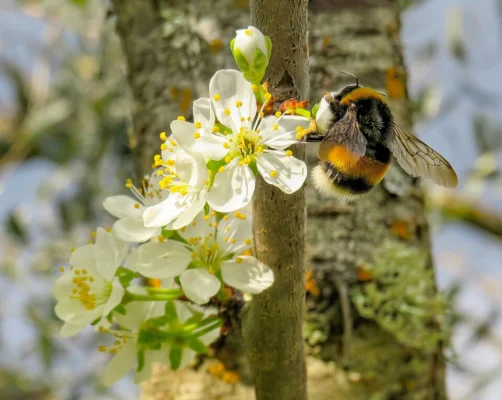
Spring blossom supports visiting insects, which transfer pollen even on self fertile trees. Avoid blocking flower access with coverings once daytime temperatures recover.
Share some fruit with wildlife where practical. If using netting, secure it taut and check frequently to prevent entanglement.
Published by Buy From Farmers Direct. Growing guidance reviewed 6 October 2026. The seasonal timeline uses the shared BFFD Growers Calendar record; adjust timings to your variety and local conditions.
Many varieties, including Victoria and Opal, are self fertile. Others need a compatible plum flowering at the same time; check before buying.
Avoid routine winter pruning. Young trees are pruned in spring after buds open; established trees are generally pruned in summer.
Pixy and VVA-1 reduce vigour compared with St Julien A. Cultivar, soil and training still affect the final size.
An excessive crop can leave small fruit and snap branches. Thin early and support any branches still carrying a heavy load.
Look for the cultivar’s full colour and slight softness. Pick over several visits as individual fruit ripens.
No. Physical damage and environmental stress can also cause gum. Sunken dead bark and shoot dieback need closer investigation.
Allow enough space, protect early blossom and thin heavy crops. Appropriate spring or summer pruning helps keep the tree productive.
Explore more growing guides: Cherry (Dwarf), Cherry (Fan), Cherry (Semi Dwarf).
Want to get food independence, support your local grower, get better prices and shop more privately?
Local food isn’t just something you find. It’s something you protect. A free account helps keep local supply visible, supported, and resilient.

….it takes 30 seconds for food lovers and 5 minutes for suppliers
We built this for people who care where their food comes from. For people who want to remain food secure. For Farmers to get to the local people, who deserve a better income and to deliver a better price for you. For the environmentally conscious and the privacy-conscious. An account simply helps us make the map and supplier reach more useful to you, without changing how open it is. You’re always in control.


Find local food. Stay connected to it. Create a free account to support local producers and be part of a growing food network.


