Sorrel is a hardy perennial leaf crop with a distinctly sharp, lemony flavour. A few plants can supply small pickings for mixed salads and cooking over many seasons. Keep the soil comfortably moist and harvest young leaves regularly for the best texture.
Hardy perennial leaves
Sun or partial shade
Good in containers
Pick young leaves
Remove unwanted flower stems
| Main culinary species | Rumex acetosa, R. scutatus and red-veined R. sanguineus |
| Family | Polygonaceae |
| Plant type | Hardy perennial herb |
| Harvested part | Young leaves |
| Flavour | Sharp and lemony; use sparingly |
| Position | Sun or partial shade |
| Soil | Fertile and moisture retentive, without waterlogging |
| Indoor sowing | March and April |
| Outdoor sowing | Mid-spring to early summer |
| Seed depth | Cover lightly, following the packet |
| Germination conditions | Bright conditions around 15°C |
| Germination time | Often one to three weeks |
| Young crop spacing | About 20–30cm |
| Mature common sorrel | A clump around 45–60cm across |
| French sorrel spread | Can eventually spread to about 1m |
| Container size | At least 30cm wide and 20cm deep |
| Main picking season | Spring to autumn once established |
| First seedling harvest | Allow roughly 12 weeks and adequate growth |
| Renewing clumps | Divide in spring or autumn when crowded |
| Winter habit | Growth often dies back before returning in spring |
| Plant name | Crop type | Spacing |
Sow indoors
Plant outdoors
Harvest
Polytunnel | |||||||||||
|---|---|---|---|---|---|---|---|---|---|---|---|---|---|---|
| Jan | Feb | Mar | Apr | May | Jun | Jul | Aug | Sep | Oct | Nov | Dec | |||
| Sorrel | Salad & leaves | Single 30cm, In row 30cm, Row gap 45cm for a young leaf crop; allow up to 100cm spread for mature French sorrel | No activity recorded | No activity recorded | Sow indoors, Harvest, Polytunnel | Sow indoors, Plant outdoors, Harvest, Polytunnel | Sow indoors, Plant outdoors, Harvest | Sow indoors, Plant outdoors, Harvest | Harvest | Harvest | Plant outdoors, Harvest | Plant outdoors, Harvest | No activity recorded | No activity recorded |
Sow indoors: March, April, May, June. Plant outdoors: April, May, June, September, October. Harvest: March, April, May, June, July, August, September, October. Polytunnel: March, April.
March–April sowing can begin under cover; outdoor sowing follows as soil warms, usually April to June. The planting band includes spring and early-summer young plants plus autumn divisions. March–October picking applies to established plants in suitable conditions, not newly sown seedlings. The protected band shows spring seed raising. Winter fleece may extend occasional picking in mild weather, but year-round leaves are not guaranteed.
Sorrel fits a perennial herb bed, a vegetable-bed edge or a pot near the kitchen. Two or three productive plants are usually enough when leaves are used as an accent.
Choose the species for its habit as well as its leaves. French sorrel spreads outwards, while red-veined sorrel makes decorative rosettes that suit an edible border.
Photo: Malte, CC BY-SA 3.0. Resized and optimised; cropped for display. Adapted image under the same licence.
Choose partial shade on a hot, dry site, or sun where the soil retains moisture. Consistent moisture helps keep new growth tender.
Remove persistent weeds before planting a long-lived clump. Improve very sandy or poor soil with mature garden compost.
Avoid a position that stays saturated in winter. A container must have open drainage holes even though sorrel appreciates moisture.
Allow room beyond initial seedling spacing. French sorrel can cover much more ground as it matures; a pot makes its spread easier to manage.
Photo: Henry Brisse, CC BY-SA 3.0. Resized and optimised; cropped for display. Adapted image under the same licence.
Buy seed or plants labelled with their botanical name. Culinary Rumex sorrels are the focus here; unrelated plants also sold or described as sorrel may need different care.
1.
Choose common, French or red-veined culinary sorrel. Keep the label so you can plan its eventual size and recognise the intended crop.
2.
For a spring indoor start, fill modules or small pots with moist peat free seed compost. Sow sparingly and cover to the depth stated on the packet.
3.
Keep the pots bright and around 15°C, with compost moist rather than soaked. Remove a propagator cover after seedlings emerge to improve airflow.
4.
When seedlings have several leaves, move crowded plants into individual small pots. Give them space and light so they remain sturdy.
5.
For direct sowing from mid-spring to early summer, prepare a fine surface, sow a short row and water gently. Thin crowded seedlings to about 20–30cm.
6.
Gradually acclimatise indoor-raised plants to outdoor conditions before planting in late spring or early summer. Delay during severe weather rather than rushing the move.
7.
Plant at the previous compost level, firm gently and water well. Start young leaf crops around 30cm apart, allowing wider spacing for permanent spreading French sorrel.
8.
For pot growing, choose at least 30cm width and 20cm depth. Use a draining, moisture-retentive peat free mix suitable for a perennial planting, and check watering frequently.

Watering
Keep seedlings and recent transplants watered until rooted. Established garden clumps usually manage normal rainfall, but prolonged drought reduces tender leaf production.
Containers dry more quickly than open ground. Water thoroughly when needed and let excess drain away; do not leave the pot standing in a full saucer.

Feeding
Apply a modest spring mulch of mature compost around garden clumps, keeping the crown clear. This supports soil condition and slows moisture loss.
A container crop may need a balanced liquid feed during active growth once the compost’s nutrients run low. Follow its label and avoid feeding a stressed, waterlogged plant.

Pruning
Cut away unwanted flower stems to favour leaves and reduce self-seeding. Common sorrel can produce tall spikes that stand well above its leafy clump.
Remove coarse, damaged or tired leaves to encourage fresh growth. Pick from several parts of the plant and leave enough healthy foliage for recovery rather than repeatedly stripping a small seedling.

Winter care
These culinary sorrels normally overwinter outside in the UK. Leaf growth may disappear in cold weather; mark the crown so it is not accidentally dug out.
Clear collapsed leaves if they are smothering the crown and check pot drainage. A light fleece or cloche can extend some picking, but ventilate covers and expect slow growth during short days.
Common sorrel has elongated green leaves with an arrow-like base; French sorrel has smaller shield-shaped leaves. Red-veined sorrel is recognised in cultivation by contrasting red veins across green leaves.
These descriptions help compare labelled garden plants; they are not a guide to eating unidentified wild leaves. Wood sorrels are Oxalis, and sheep’s sorrel is another Rumex with a spreading habit outside this main planting advice.
Photo: Flocci Nivis, CC BY-SA 4.0. Resized and optimised; cropped for display. Adapted image under the same licence.
Established clumps often supply leaves early in spring, while new sowings need time to build roots and foliage. Start with light picking once seedlings are well grown, often around twelve weeks after sowing.
Choose young, sound leaves and use them promptly. A little adds acidity to mixed leaves, sauces or soups; sorrel contains oxalic acid, so treat it as a small culinary addition rather than eating large quantities.
If a clump becomes crowded or leaves remain small despite adequate care, lift and divide it in spring or autumn. Replant vigorous rooted sections and water them in; the useful interval varies, often around three to five years.
Photo: Agnieszka Kwiecień, Nova, CC BY-SA 4.0. Resized and optimised; cropped for display. Adapted image under the same licence.
Slugs and snails can damage seedlings and fresh growth. Inspect vulnerable plants, remove nearby hiding places where practical and hand-pick pests when active.
Small colonies are usually manageable. Encourage predators, rinse off a troublesome cluster or remove a badly affected tip; routine spraying is seldom necessary.
Age, flowering and dry conditions reduce leaf quality. Remove tired growth, check moisture and allow a new flush before picking again.
Sorrel can self-seed freely. Cut flower stems before seed matures, remove unwanted seedlings while small and keep only plants you have space to grow.
Check for poor drainage, a blocked container or thick wet material over the crown. Reduce saturation and remove decaying growth; repeatedly adding feed will not correct a root-zone problem.
Sow fresh seed for new culinary plants or divide a healthy established clump. Division is useful when retaining the appearance of a named selection.
Common sorrel has male and female flowers on separate plants, so one isolated plant may not produce seed. Wind pollination can mix compatible plants; seed-raised offspring need not exactly match a named parent.
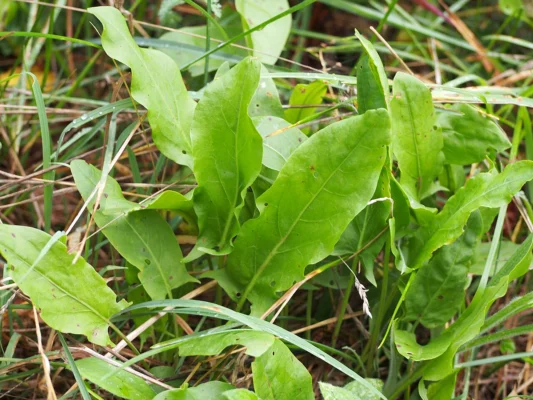
Common sorrel
Rumex acetosa is the familiar upright, sharp-flavoured garden sorrel. It forms a lasting clump and can send flower stems well above the leaves.
Common sorrel leaves.
Photo: Agnieszka Kwiecień, Nova, CC BY-SA 4.0. Resized and optimised; cropped for display. Adapted image under the same licence.
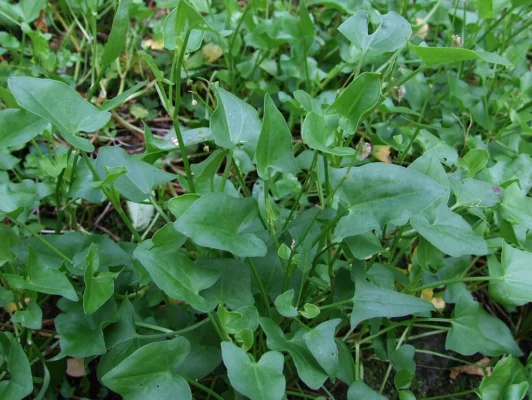
French sorrel
Rumex scutatus has shield-shaped leaves and a lower, spreading habit. Allow it room in a perennial bed or use a container to keep its footprint manageable.
French sorrel with its characteristic shield-shaped leaves.
Photo: Jerzy Opioła, CC BY-SA 4.0. Resized and optimised; cropped for display. Adapted image under the same licence.
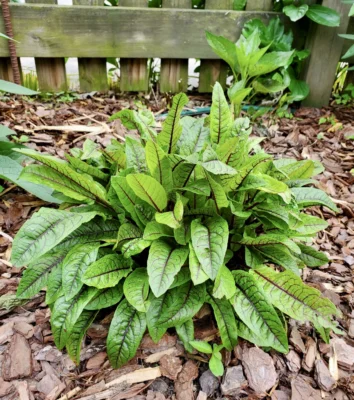
Red-veined sorrel
Red-veined Rumex sanguineus brings attractive red markings to young salad leaves and mixed borders. Pick tender leaves sparingly while keeping the rosette growing.
Cultivated red-veined sorrel.
Photo: Linda Snider, CC BY 4.0. Resized and optimised; cropped for display.
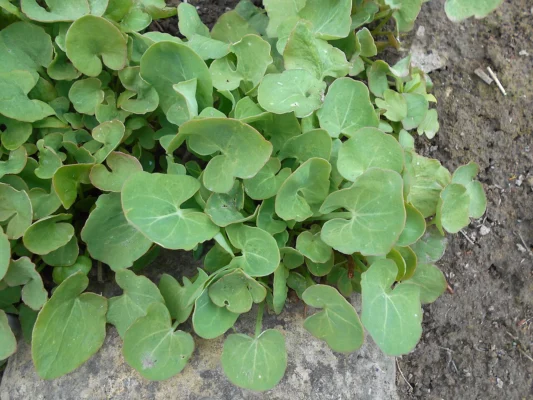
Silver Shield
A named French sorrel selection with silvery-green foliage. It offers the same useful combination of leaf cropping and low ground cover, with space for its spreading habit.
French sorrel shown for illustration; this photograph does not verify the Silver Shield selection.
Photo: Salicyna, CC BY-SA 4.0. Resized and optimised; cropped for display. Adapted image under the same licence.
Choose leaf appearance and growth habit to suit the space. A healthy perennial clump is more useful than sowing a large quantity that will soon need thinning.
Common sorrel is a food plant for small copper butterfly caterpillars. A separate wildlife clump can retain some leaves while the kitchen plants are picked more regularly.
Sorrel is mainly wind-pollinated, so grow nectar-rich flowers elsewhere for bees. Leaving some stems for seed adds habitat interest, but also increases the likelihood of seedlings.
Published by Buy From Farmers Direct. Growing guidance reviewed 6 October 2026. The seasonal timeline uses the shared BFFD Growers Calendar record; adjust timings to your variety and local conditions.
Yes. The main culinary Rumex sorrels are hardy perennials, although leaves may die back in winter before new growth appears in spring.
Partial shade is suitable and can help on a hot, drying site. Avoid a very dark position that produces weak growth.
Wait until plants have a useful amount of healthy foliage, often around twelve weeks. Pick lightly at first and leave enough leaves for further growth.
Usually, if young leaves are the priority. Removing flower stems also helps prevent unwanted self-seeding.
Yes, in a sufficiently large draining container. Water carefully, feed during growth when needed and divide or repot a congested clump.
They are different species. French sorrel is Rumex scutatus, with shield-shaped leaves and a spreading habit; common sorrel is the more upright R. acetosa.
Give sorrel a permanent position, pick young leaves in small amounts and renew crowded clumps when needed. Regular, modest care keeps this sharp-flavoured perennial useful for years.
Explore more growing guides: Basil, Coriander, Fennel (Herb).