Tomatillos produce firm, tangy fruits inside papery husks, making a useful home-grown ingredient for salsa and cooking. Raise them in spring warmth, give the branching plants room and grow at least two together. In cooler UK gardens, a greenhouse or polytunnel improves the chance of a worthwhile crop.
Tender summer crop
Grow at least two plants
Papery-husked fruit
Sun and shelter
Support spreading branches
| Botanical names | Physalis philadelphica and P. ixocarpa in cultivation |
| Family | Solanaceae |
| UK crop habit | Frost-tender annual |
| Edible part | The developed fruit, with its husk removed |
| Fruit character | Firm and tangy; green or purple according to type |
| Position | Full sun and shelter |
| Soil | Fertile, moist but well drained |
| Indoor sowing | March to April |
| Seed depth | Light covering, about 0.5cm or packet guidance |
| Germination warmth | Around 20°C; follow the seed supplier’s range |
| Emergence | Often one to two weeks |
| Planting out | Late May to June after frost risk |
| Practical spacing | Allow about 75–100cm between supported plants |
| Mature size | Often around 1–1.2m tall and wide |
| Pollination | Insects carry pollen between neighbouring plants |
| Plant numbers | At least two independently raised plants |
| Support | Stakes, a cage or a supporting frame |
| Main UK harvest | August to October, before damaging frost |
| Harvest sign | Firm fruit fills its papery husk |
| Winter routine | Clear spent plants and start again from seed |
| Plant name | Crop type | Spacing |
Sow indoors
Plant outdoors
Harvest
Polytunnel | |||||||||||
|---|---|---|---|---|---|---|---|---|---|---|---|---|---|---|
| Jan | Feb | Mar | Apr | May | Jun | Jul | Aug | Sep | Oct | Nov | Dec | |||
| Tomatillo | Unusual & exotic | Single 90cm, In row 90cm, Row gap 100cm; allow more room for large spreading plants | No activity recorded | No activity recorded | Sow indoors, Polytunnel | Sow indoors, Polytunnel | Plant outdoors, Polytunnel | Plant outdoors, Polytunnel | Polytunnel | Harvest, Polytunnel | Harvest, Polytunnel | Harvest, Polytunnel | No activity recorded | No activity recorded |
Sow indoors: March, April. Plant outdoors: May, June. Harvest: August, September, October. Polytunnel: March, April, May, June, July, August, September, October.
March–April sowing takes place indoors in warmth. The May–June planting band depends on local frost risk and sufficiently warm conditions. August–October is an approximate picking season, shortened by cold weather. The protected band covers seed raising and an optional greenhouse or polytunnel crop through summer and early autumn; it does not promise fruit throughout those months or outdoor winter survival.
A pair or small group suits a roomy vegetable bed or greenhouse border. Tomatillos can become broad plants, so measure the space for their branches as well as their pots.
Outdoor growing is most dependable in a warm, sheltered garden. If your summers are short or exposed, use protection and choose a manageable number of plants that you can water and support properly.
Image from the BFFD media library.
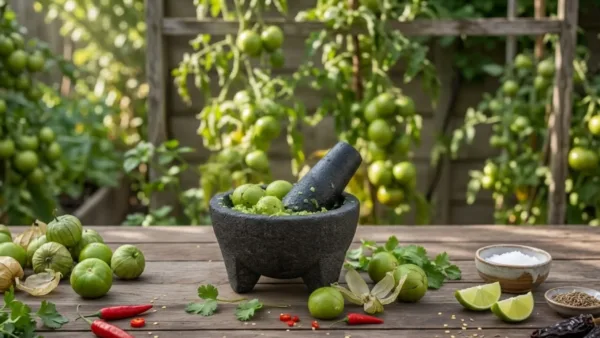
Choose full sun with shelter from strong wind. A warm south-facing position outdoors can work, but a greenhouse offers more control in a cool district.
Improve poor soil with mature compost and remove persistent weeds before planting. Avoid a low patch that stays saturated after heavy rain.
Allow space between plants for access, ventilation and picking. A narrow gap that suits a small seedling may become a tangle of branches by late summer.
Containers are possible, but choose a generous, stable pot for each plant and keep a second plant nearby. Use draining peat free compost and plan for regular watering and feeding.
Photo: Forest and Kim Starr, CC BY 3.0 us. Resized and optimised; cropped for display. Forest & Kim Starr
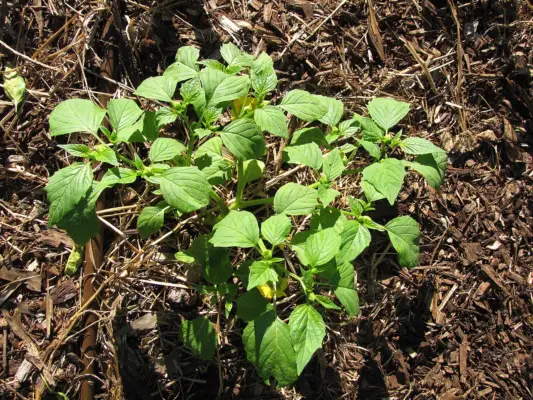
Choose seed or plants explicitly labelled as edible tomatillo. Other Physalis crops, including sweet Cape gooseberries and ornamental lantern plants, are not interchangeable with this growing and harvesting advice.
1.
Plan for at least two separate seed-raised tomatillo plants flowering together. They can be the same named variety; a small group provides a better pollination opportunity than one isolated plant.
2.
Sow in March or April in modules or a small tray of moist peat free seed compost. Cover lightly, usually about 0.5cm, while following the packet’s instructions.
3.
Provide gentle warmth around 20°C and bright light. Keep the surface from drying completely but do not leave the tray standing in water.
4.
Once seedlings have developed true leaves and can be handled safely, move them into individual pots. Hold a leaf rather than squeezing the delicate stem.
5.
Pot on before roots become congested and space pots so the leaves receive light. Support a floppy stem early, using a loose tie that allows it to thicken.
6.
Harden plants off gradually before an outdoor move. Wait until late May or June as appropriate locally, with frost risk past and the soil warm.
7.
Set plants roughly 75–100cm apart, or follow the variety’s wider requirement. Water them in and install sturdy stakes, a cage or a frame before the branches become difficult to handle.
8.
In a greenhouse, leave sufficient space around the crop and open suitable vents or doors in mild weather for ventilation and insect access. Retain protection whenever cold conditions return.

Watering
Water newly planted tomatillos while they establish, then maintain reasonably even moisture through flowering and fruit swelling. Containers need particularly close attention during hot weather.
Apply water to the compost or soil rather than repeatedly wetting the leaves. Check below the surface before adding more; good drainage matters just as much as avoiding drought.

Feeding
A compost-enriched bed gives plants a useful start. If extra nutrition is needed, use a suitable balanced feed at the label rate while plants establish.
Once fruit begins to set, a high-potassium liquid feed can support cropping, particularly in pots. Avoid excessive nitrogen, which can encourage a large leafy plant with delayed fruiting.

Pruning
Tomatillos branch naturally and carry fruit on side growth. Do not routinely strip all side shoots as if training a cordon tomato; guide and tie in useful branches instead.
Remove damaged growth and trim only where necessary to keep access and airflow. Handle branches gently, because heavy fruit and wind can cause unsupported stems to split.

Winter care
Tomatillos are not frost hardy. Gather developed, sound fruit before damaging autumn weather and clear plants when the crop is finished.
Collect fallen fruit so it does not produce a thicket of volunteer seedlings the next year. Clean supports and containers, and rotate the next crop with regard to other members of the tomato family.
A cultivated tomatillo has branching stems, toothed green leaves and small yellow flowers with darker central markings. Its expanding calyx forms the familiar husk around the fruit.
Green tomatillos are not simply unripe ordinary tomatoes. Cape gooseberries are a different Physalis crop usually grown for sweet orange fruit; an unknown lantern-bearing plant should not be treated as an edible tomatillo.
Photo: Forest and Kim Starr, CC BY 3.0 us. Resized and optimised; cropped for display. Forest & Kim Starr
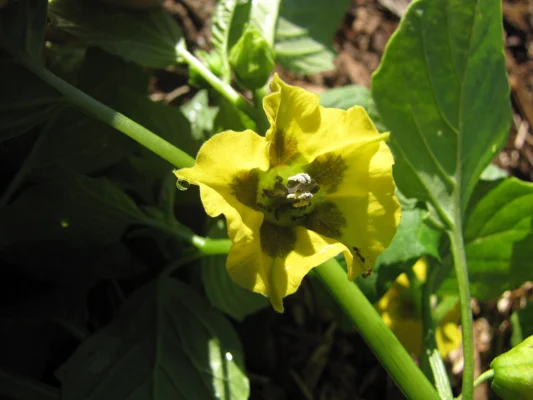
Begin checking fruit when it fills the husk and feels firm. The covering often loosens, turns papery or splits, but exact colour and fruit size depend on the variety; a green crop does not have to turn purple or yellow before use.
Pick regularly with a short piece of stalk, supporting the branch rather than pulling hard. Remove the husk and rinse the sticky coating from the fruit before preparing it; discard the husk and use only sound fruit.
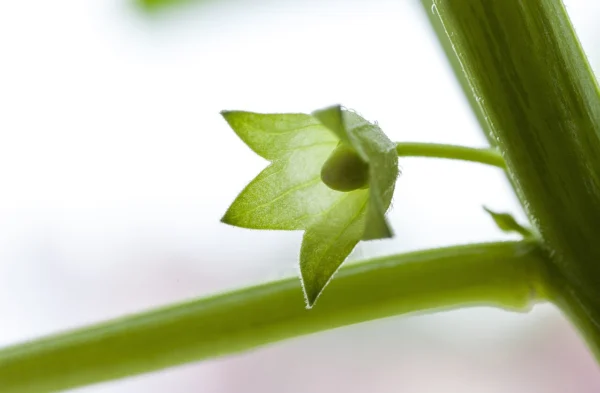
Check that at least two separate plants are flowering together and insects can reach them. Extra feed cannot replace compatible pollen; persistent cold or excessive heat may also interrupt fruit set.
Too much nitrogen, weak light or cool conditions can favour leaves over a useful crop. Improve light and ventilation, moderate feeding and allow time for established plants to flower.
Tomatillos can become top-heavy as fruit develops. Add a frame or loose ties early, support several branches and check the growing space after windy weather.
Inspect seedlings for slugs and snails and look closely at soft tips for aphids. Hand-remove pests where practical, rinse small aphid colonies and encourage their natural predators.
Check watering and root conditions first, then look for spreading disease symptoms. Improve airflow, keep leaves dry where practical and remove badly affected material; avoid planting related crops repeatedly in the same problem soil.
Seed is the usual way to start the crop. Raise a few spare seedlings so the loss of one plant does not leave an isolated survivor at flowering time.
For seed saving, retain fully mature fruits from several healthy plants and follow a suitable cleaning and drying method. Tomatillos can cross between varieties, so saved seed may produce mixed offspring; a tiny planting is not ideal for maintaining a strain.
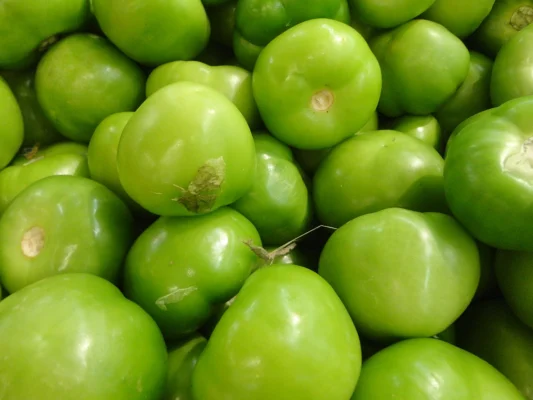
Verde
A familiar green-fruited type for salsa and cooked sauces. Pick when the fruit fills its husk and remains firm; green colour alone does not mean it is too early.
Green tomatillo fruit shown for illustration; the named Verde strain is not verified.
Photo: Diógenes el Filósofo, CC BY-SA 3.0. Resized and optimised; cropped for display. Adapted image under the same licence.
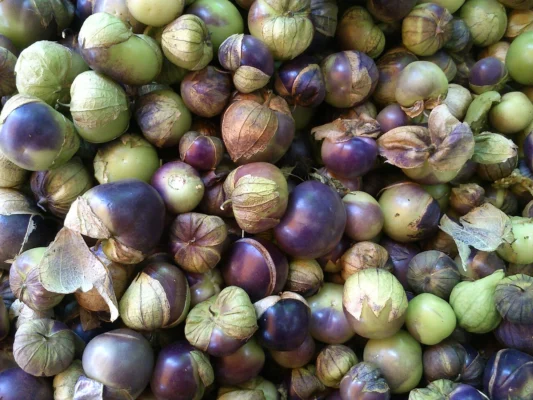
Purple & Green
A choice with green skin carrying a purple blush. The plants need support and enough room to branch, just like their green-fruited relatives.
Purple and green tomatillos shown for illustration; this is not a verified named strain.
Photo: History utility, CC BY-SA 3.0. Resized and optimised; cropped for display. Adapted image under the same licence.
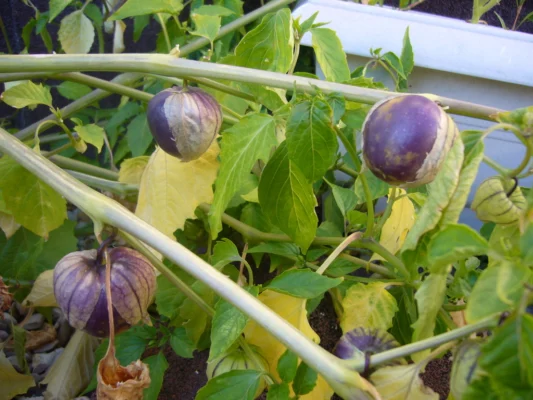
Purple Mountain Landrace
A diverse, purple-blushed selection. Colour may vary between fruits and plants, so judge readiness by development and firmness as well as the amount of purple.
Purple-fruited tomatillo illustrated; Purple Mountain Landrace identity is not confirmed.
Photo: Abrahami, CC BY-SA 3.0. Resized and optimised; cropped for display. Adapted image under the same licence.
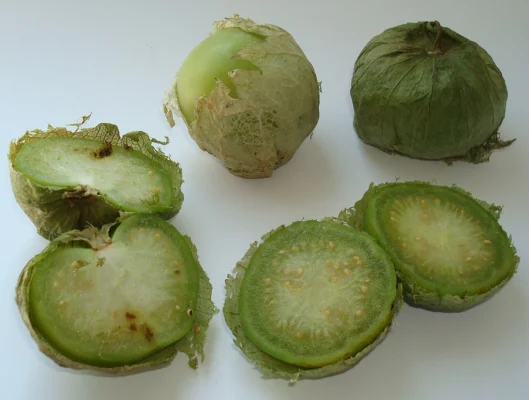
Plaza Latina Giant
A large-fruited selection for growers wanting fewer, bigger fruits to prepare. Give its substantial branching plants support and grow more than one for fruit set.
Ordinary whole and cut tomatillos illustrate the fruit; they are not confirmed Plaza Latina Giant.
Photo: Genet, CC BY-SA 4.0. Resized and optimised; cropped for display. Adapted image under the same licence.
Check the botanical name, expected height and fruit type, and leave room for at least two plants. Choose healthy, well-rooted stock rather than a single oversized specimen already struggling in its pot.
Visiting insects help carry pollen between tomatillo flowers. Under glass, give them access when weather permits and avoid unnecessary insecticide use around open blossom.
Nearby flowering herbs can support pollinators and aphid predators through the season. Keep any protective crop netting secure and avoid blocking access to flowers during the fruit-setting period.
Published by Buy From Farmers Direct. Growing guidance reviewed 6 October 2026. The seasonal timeline uses the shared BFFD Growers Calendar record; adjust timings to your variety and local conditions.
For reliable cropping, yes. Grow at least two separately raised plants flowering together, with insect access. One plant can make many flowers yet little or no useful fruit.
No. Two seed-raised plants of the same variety can work together. Different varieties may also pollinate one another, but seed saved from them may be mixed.
Yes, on a warm sheltered site after frost risk has passed. A greenhouse or polytunnel is useful where summers are cooler or the garden is exposed.
No. The natural branching growth carries the crop. Support it, removing damaged or badly congested growth only as needed.
When the fruit fills its husk and remains firm. The husk often dries or splits; use the variety’s guidance rather than waiting for every fruit to change colour.
Remove and discard it. Rinse the sticky film from the developed fruit before using it in salsa or cooking.
Give tomatillos companions for pollination, warm growing conditions and room for their branches. Pick firm, well-developed fruit regularly to make the most of a productive late-summer crop.
Explore more growing guides: Chilli Pepper, Coriander, Basil.
Want to get food independence, support your local grower, get better prices and shop more privately?
Local food isn’t just something you find. It’s something you protect. A free account helps keep local supply visible, supported, and resilient.

….it takes 30 seconds for food lovers and 5 minutes for suppliers
We built this for people who care where their food comes from. For people who want to remain food secure. For Farmers to get to the local people, who deserve a better income and to deliver a better price for you. For the environmentally conscious and the privacy-conscious. An account simply helps us make the map and supplier reach more useful to you, without changing how open it is. You’re always in control.


Find local food. Stay connected to it. Create a free account to support local producers and be part of a growing food network.


