Hazel brings winter catkins, summer foliage and an autumn nut crop to a garden with enough space. Native Corylus avellana suits wildlife planting, while selected cobnuts and filberts offer more predictable nuts. For a useful harvest, plan compatible pollen partners and accessible pruning before buying the first bush.
Hardy deciduous shrub
Compatible varieties needed
Wind pollinated
Sunny sheltered site
Fresh or dried nuts
| Main species | Corylus avellana and Corylus maxima |
| Family | Betulaceae |
| Common names | Hazel, hazelnut, cobnut and filbert |
| Native species | Corylus avellana is native to Britain |
| Plant type | Deciduous shrub or small tree |
| Natural habit | Usually a broad, multi stemmed bush |
| Unmanaged size | Common hazel can reach 4 to 8m or more |
| Managed nut bush | Often kept around 2m high for picking |
| Light | Full sun or light shade |
| Position | Sheltered, away from frost pockets |
| Soil | Well drained; avoid persistent waterlogging |
| Preferred soil reaction | Near neutral to alkaline |
| Winter hardiness | Common hazel is rated RHS H6 |
| Main planting window | November to March while dormant |
| Indicative spacing | About 5m for garden nut bushes |
| Flowering | Usually January to March, depending on variety |
| Pollination | Wind carries pollen between compatible plants |
| First crop | Often around three or four years after planting |
| Harvest window | August to October, depending on intended use |
| Propagation | Layering or rooted suckers from suitable plants |
| Plant name | Crop type | Spacing |
Sow indoors
Plant outdoors
Harvest
Polytunnel | |||||||||||
|---|---|---|---|---|---|---|---|---|---|---|---|---|---|---|
| Jan | Feb | Mar | Apr | May | Jun | Jul | Aug | Sep | Oct | Nov | Dec | |||
| Hazel | Orchard fruit | Single 500cm, In row 500cm, Row gap 500cm | Plant outdoors | Plant outdoors | Plant outdoors | No activity recorded | No activity recorded | No activity recorded | No activity recorded | Harvest | Harvest | Harvest | Plant outdoors | Plant outdoors |
Sow indoors: no months recorded. Plant outdoors: January, February, March, November, December. Harvest: August, September, October. Polytunnel: no months recorded.
The calendar shows dormant planting from November to March. The harvest band includes fresh green cobnuts from late summer and mature nuts in autumn; variety, weather and how you want to use the crop affect timing. No sowing band is shown because named nursery plants give a predictable cultivar. The 5m spacing is for substantial garden nut bushes, not a closely planted hedge. No polytunnel is needed.
Hazel works well in a larger garden, orchard or wildlife boundary. Even a bush kept low for harvesting needs room to spread, and a pollen partner needs its own growing space.
Choose named nut cultivars if cropping is your priority. Ornamental purple or twisted hazels may be attractive without matching the yields of selections bred for nuts.
Photo: Zeynel Cebeci, CC BY-SA 4.0. Resized and optimised; cropped for display. Adapted image under the same licence.
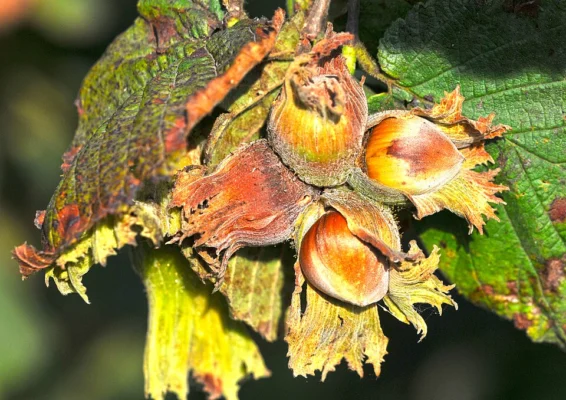
A sunny sheltered site helps the crop develop. Hazel tolerates some shade, but a dark woodland corner is a less promising place for dependable nut production.
Avoid a frost pocket where cold air settles during winter flowering. Mature wood can be hardy while pollen release and nut set still suffer in severe weather.
Choose soil that drains freely. Extremely fertile conditions can encourage difficult, vigorous growth; persistent wetness is a more serious problem than a modestly stony soil.
Plan at least two different compatible cultivars nearby. A supplier should confirm both pollen compatibility and overlapping flowering; simply buying two plants with different labels is not a complete pollination plan.
Photo: H. Zell, CC BY-SA 3.0. Resized and optimised; cropped for display. Adapted image under the same licence.
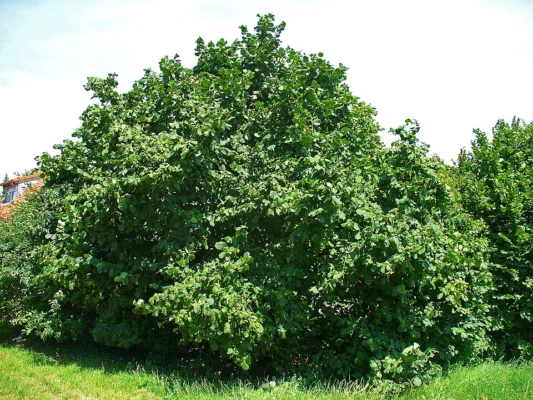
Plant while the bush is dormant and the soil is workable. Keep bare roots moist until they are safely back in the ground.
1.
Decide between a managed nut bush, an informal native shrub or a hedge. Match the mature size and pruning commitment to the site.
2.
For nuts, choose a compatible pair or group. Kentish Cob with an appropriate partner such as Cosford is a familiar starting point for a nursery discussion.
3.
Mark out generous spacing, around 5m for the garden bushes described here. Keep paths and picking access clear of their eventual canopies.
4.
Remove competing grass and perennial weeds around each position. Prepare a broad planting hole with room for the roots to spread naturally.
5.
Soak a dry root ball before planting, or keep bare roots covered while working. Do not plant into frozen or saturated ground.
6.
Set the plant at its previous soil level and spread the roots carefully. Refill with the excavated soil, avoiding a pocket of rich material buried beneath the roots.
7.
Firm gently, water thoroughly and add a surface mulch while leaving the stem base clear. Protect the young plant if rabbits or deer are a local problem.
8.
Keep the cultivar label and planting record. Water during dry spells and ask the supplier about formative pruning appropriate to the plant’s existing shape.

Watering
Check young bushes through spring and summer, especially in their first two growing seasons. Water deeply when the root area becomes dry so moisture reaches the developing roots.
Established hazels usually cope without regular irrigation, but prolonged drought can affect growth and crop development. Check drainage before treating every wilted leaf as a request for more water.

Feeding
Healthy hazels in ordinary garden soil may need little extra feeding. A surface mulch helps soil structure and moisture retention without forcing excessive leafy growth.
If growth is weak because nutrients are lacking, use an appropriate fertiliser at the labelled rate. Avoid heavy nitrogen feeding where a vigorous bush already makes plenty of shoots but few nuts.

Pruning
For an accessible crop, maintain an open centre and a manageable height, retaining useful short flowering shoots. Thin selected old or crowded growth instead of cutting the whole bush down every year.
Traditional nut pruning includes late winter work around pollen release. August brutting partly breaks strong side shoots and leaves them attached until winter shortening; use a clear specialist guide before trying it.

Winter care
Dormancy is a useful time to inspect structure, ties, guards and suckers. Remove unwanted suckers where you are maintaining a short trunk and open crown.
Coppicing has a different purpose from annual nut pruning. Cutting all stems back can provide new poles, but removes the established framework that would otherwise carry the crop.
Common hazel has softly hairy, rounded to oval leaves with toothed edges and a pointed tip. Male flowers form dangling catkins; female flowers appear as tiny red tufts on the bare shoots.
A cobnut has a relatively short husk, while a filbert’s longer husk encloses more of the nut. Naming is not perfectly tidy: the well known Kentish Cob is a filbert. Use nursery labels for cultivar identification.
Photo: Krzysztof Ziarnek, Kenraiz, CC BY-SA 4.0. Resized and optimised; cropped for display. Adapted image under the same licence.
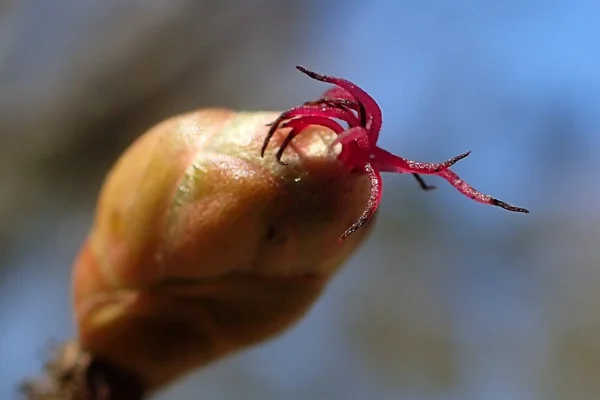
Native hazel grows across much of Britain, but reliable cultivated nut production benefits from warmth and shelter. A bush surviving in a northern or exposed garden does not guarantee an equal crop every year.
Fresh green cobnuts may be picked from mid or late August where suitably developed. For a fuller nut flavour and storage, wait until husks yellow and brown in autumn. Inspect a few nuts rather than using a calendar date alone.
Treat fresh green nuts as fresh produce, keeping them cool and ventilated. Dry mature nuts in shallow airy layers, turn them regularly and remove any mouldy or damaged ones. Keep stored nuts protected from mice.
Photo: KatherineGrundy, CC BY-SA 3.0. Resized and optimised; cropped for display. Adapted image under the same licence.
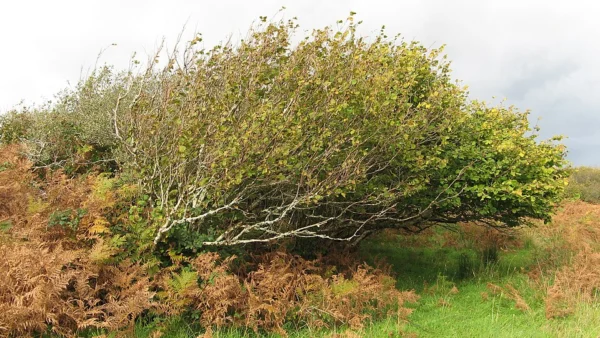
Review the age of the bush, cultivar compatibility, flowering overlap and winter weather. Catkins are male flowers; their presence alone does not show that female flowers received suitable pollen.
Grey squirrels can remove a crop rapidly. Inspect developing nuts frequently and be realistic about losses. Picking very early may save some nuts but sacrifices flavour and full development.
Nut weevil larvae feed inside developing nuts before making an exit hole. Sort the harvest carefully and discard damaged nuts. Not every nut on an affected bush will contain a larva.
Hazel big bud mite can prevent individual buds opening. In gardens it rarely affects enough buds to damage the whole crop; monitor the bush rather than assuming urgent treatment is needed.
Powdery mildew can be encouraged by dry roots and a congested canopy. Improve airflow through sensible thinning and support young plants with appropriate watering during drought.
Layering and rooted suckers can reproduce a known cultivar when it grows on its own roots. Check how the parent was propagated before using suckers: growth from below a graft belongs to the rootstock.
Seed raised hazels can be useful for wildlife planting, but their nuts and growth are variable. Sowing a nut from a named cultivar will not reliably reproduce that cultivar or its pollination behaviour.
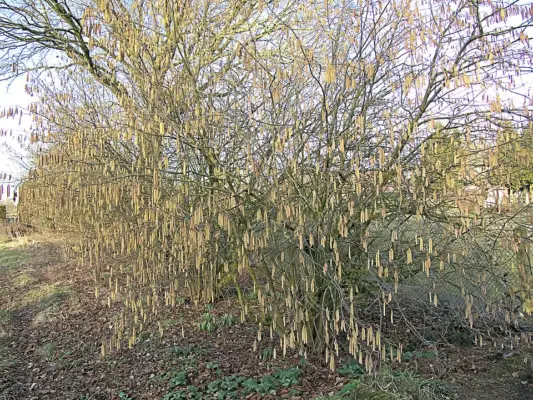
Cosford
Known for sweet nuts with relatively thin shells. It is also a useful pollen source for compatible cultivars, but should not be treated as a universal partner.
Cosford photographed with its male catkins.
Photo: Rasbak, CC BY-SA 3.0. Resized and optimised; cropped for display. Adapted image under the same licence.
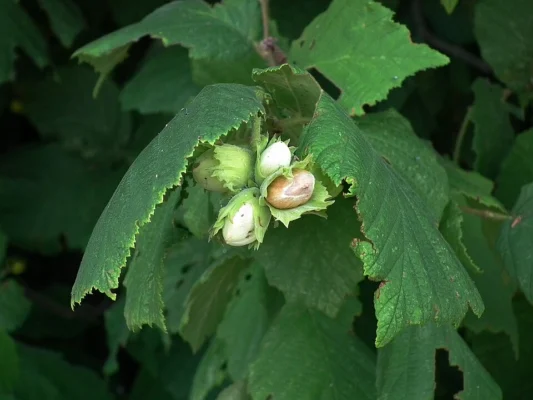
Kentish Cob
A familiar filbert with a good flavour and a long history of UK cultivation. Cosford, Gunslebert and Hall’s Giant are among its recognised pollen partners.
Illustrative common hazel nuts; the photograph is not confirmed as Kentish Cob.
Photo: 4028mdk09, CC BY-SA 3.0. Resized and optimised; cropped for display. Adapted image under the same licence.
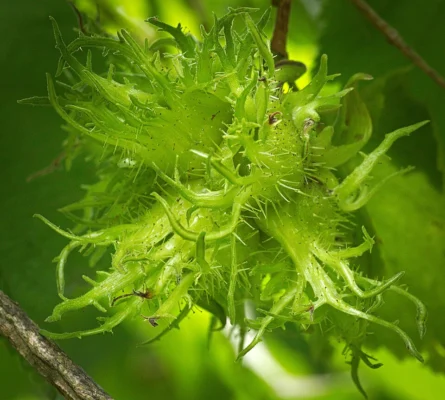
Hall’s Giant
Also called Merveille de Bollwiller, this vigorous selection produces large nuts and needs adequate room. Confirm a suitable pollen partner when ordering.
Illustrative developing hazelnuts, not a confirmed photograph of Hall’s Giant.
Photo: hedera.baltica from Wrocław, Poland, CC BY-SA 2.0. Resized and optimised; cropped for display. Adapted image under the same licence.
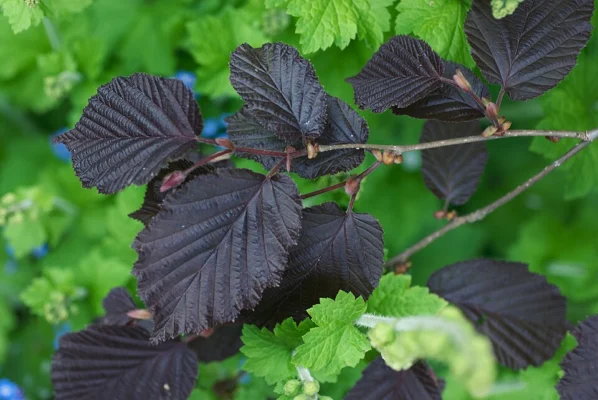
Purple Filbert
Corylus maxima Purpurea offers dark foliage and ornamental value. Its nut crop is generally a secondary attraction, so choose a cropping cultivar if yield matters most.
Purple foliage of Corylus maxima Purpurea.
Photo: Eric in SF, CC BY-SA 3.0. Resized and optimised; cropped for display. Adapted image under the same licence.
Ask a specialist nursery to match compatible cultivars for your location. Check eventual size, whether plants are on their own roots, and whether the supplied form suits a nut bush or an informal planting.
Native hazel supports moth caterpillars and provides nuts for birds and small mammals. Its leafy cover and branching structure add habitat even in a year when people harvest few nuts.
Hazel is wind pollinated, although bees can collect some of its early pollen. Keep other flowering plants nearby for a broader food supply, and accept some leaf feeding as part of a wildlife garden.
Published by Buy From Farmers Direct. Sources checked 6 October 2026. Growing references: RHS cobnuts and filberts; Kentish Cobnuts Association: cultivation and pollination; Kentish Cobnuts Association: storing nuts; Orange Pippin Trees: growing hazelnuts; Pomona Fruits: cobnut and filbert growing guide; RV Roger: cobnut and filbert management; RHS common hazel profile; RHS Cosford profile; RHS Kentish Cob profile; RHS Purple Filbert profile; Woodland Trust: native hazel and wildlife; RHS gall mites; RHS planting trees and shrubs; RHS tree establishment and care. The seasonal timeline uses the shared BFFD Growers Calendar record; adjust timings to your variety and local conditions.
For dependable cropping, plant at least two compatible cultivars with suitable flowering overlap. Nearby wild hazels may provide pollen, but a matched pair is a clearer plan than relying on a single bush.
Cobnuts and filberts are cultivated hazelnuts. Their husks differ in length, but common names can overlap. Kentish Cob, for example, is a filbert despite its name.
A nut bush can be trained to a manageable picking height, often around 2m, with regular selective pruning. It still needs width and root space. Hard annual cutting removes potential fruiting growth.
Fresh green cobnuts can be ready from late summer. Nuts for drying are left longer, until the husks change colour in autumn. Variety and local weather determine the exact dates.
Coppicing renews stems and can produce useful poles, but cutting the whole bush down removes its cropping framework. Use selective nut pruning if a regular harvest is the main aim.
No. Seedlings vary and do not preserve the named cultivar. Buy a labelled plant, or use suitable vegetative propagation from a known parent.
A good hazel planting begins with room for the bushes and a reliable source of compatible pollen. Keep the canopy open, protect establishment and decide whether each harvest is for fresh eating or careful drying.
Explore more growing guides: Elderberry, Cherry (Fan), Blackcurrant.
Want to get food independence, support your local grower, get better prices and shop more privately?
Local food isn’t just something you find. It’s something you protect. A free account helps keep local supply visible, supported, and resilient.

….it takes 30 seconds for food lovers and 5 minutes for suppliers
We built this for people who care where their food comes from. For people who want to remain food secure. For Farmers to get to the local people, who deserve a better income and to deliver a better price for you. For the environmentally conscious and the privacy-conscious. An account simply helps us make the map and supplier reach more useful to you, without changing how open it is. You’re always in control.


Find local food. Stay connected to it. Create a free account to support local producers and be part of a growing food network.


